He Just Doesn’t Get It

Friday, President Obama announced a modification to his HHS Department’s mandate that all employers provide health insurance policies that include free contraceptive services—which include contraception, sterilization, and abortifacients—including those employers with religious objections to this sort of thing.  One version of his announcement is here.  In sum, the modification allows religious institutions like hospitals and charities to opt out of the requirement, but if they do, their insurance provider must itself and separately provide those services to the institution’s women employees—still free of charge.  Does this solve the problem?  Where to begin….

Obama made his announcement against his usual backdrop of denigrating those who disagree with him as just playing politics; there couldn’t possibly be legitimate concerns

…as well as, frankly, the cynical desire on the part of some to make this into a political football….

and

Understand some folks in Washington may want to treat this as another political wedge issue….

which, though, is a minor aspect of his speech.  He had this to say, of a more substantive nature:

It’s a lot cheaper to prevent an illness than to treat one.  We also accepted a recommendation from the experts at the Institute of Medicine that, when it comes to women, preventive care should include coverage of contraceptive services such as birth control.

and

…find a way that protects religious liberty and ensures that every woman has access to the care that she needs.

Thus, he continues the fiction that pregnancy is a disease that needs prevention, not a conscious act with lots of very low cost mechanisms for preventing, if prevention truly is wanted.  I’m waiting for the hue and cry from yesterday’s feminists.

Nor does the federalism that is the core of our republican democracy matter to him.

This basic principle…is already the law in 28 states across the country.

And

An exemption…, by the way, that eight states didn’t already have.

If some states do something within their own boundaries, this is sufficient justification for the Federal government to impose it nation-wide.  Except when the states don’t already do that something.  Then it’s OK for the Federal government to impose it nation-wide.

There’s more.

Under the rule…if a woman’s employer is a charity or a hospital that has a religious objection to providing contraceptive services as part of their health plan, the insurance company—not the hospital, not the charity—will be required to reach out and offer the woman contraceptive care free of charge, without copays and without hassles.  The results will be that religious organizations won’t have to pay for these services, and no religious institution will have to provide these services directly.  Let me repeat: these employers will not have to pay for or provide contraceptive services.

If you watch the video, you’ll see that he said these words with a straight face: “the insurance company—not the hospital, not the charity—will be required to [provide] contraceptive care free of charge….”  He really thinks the insurance companies won’t pass on the costs for this in the form of higher policy premiums charged those religious institutions—and the employees, since most employer-provided coverages include employee premium-sharing—and in the form of higher premiums generally to everyone.

It’s highly doubtful, also, that he’s considered the likelihood that, when the institutions opt out of the mandate, many insurance companies will simply stop offering insurance plans to those institutions in order to avoid bearing the added cost of a separate, “free” service requirement.

Indeed, why does Obama think insurance premiums already have skyrocketed since Obamacare was enacted?  His ignorance of basic economic principles is breathtaking.

It’s also clear that the University of Chicago Senior Lecturer (which the university considers to be a professor) in Constitutional Law has carefully ignored all constitutional questions related to the federal government ordering private enterprises to give away products or services.  He’s simply, blithely, ordering private companies to provide, without compensation, those products he’s decided they should provide.

He concluded with this:

We live in a pluralistic society….  That doesn’t mean that we have to choose between individual liberty and basic fairness for all Americans.

But when government presumes to dictate the parameters of “basic fairness,” that is a direct attack on individual liberty.

Can we afford another four years of such ignorant arrogance?
Thoughts on Charity

As President Obama pretends to channel his inner Christian and, in doing so, distorts Jesus’ message, a friend reminds me of another passage from the Bible.  Ruth 2:1-17 has many lessons, but one of them concerns the charity of Boaz toward Ruth.  Within this lesson is another.  Boaz had productive fields, else he could not have let Ruth glean from them—there would have been nothing to glean.

This new and old lesson is understood by many in our own time.  Isabel Paterson has also written about the relationship between charity and production.  In her The God of the Machine, she wrote

The great religions, which are also great intellectual systems, have always recognized the conditions of the natural order.  They enjoin charity, benevolence, as a moral obligation, to be met out of the producer’s surplus.  That is, they make it secondary to production, for the inescapable reason that without production there could be nothing to give.

Charity is a moral duty, and so of necessity a personal one.  Government cannot command our morality.  Yet President Obama’s policies add to the difficulty we have in satisfying our moral duty by taking our wealth away from us, by dictating to us our production and our exchanges among each other—and thereby reducing our ability to produce enough for our families and to have a surplus from which to offer charity to others.  Obama would have us glean our fields threadbare and give the surplus to his government so that he can engage in the wealth redistribution which he pretends is our collective charity.

Thus, Paterson also says this about that Obama-style “charity,”

If the primary objective of the philanthropist, his justification for living, is to help others, his ultimate good requires that others shall be in want. His happiness is the obverse of their misery.  If he wishes to help “humanity,” the whole of humanity must be in need.  The humanitarian wishes to be a prime mover in the lives of others.  He cannot admit either the divine or the natural order, by which men have the power to help themselves.  The humanitarian puts himself in the place of God.

Who’s Out of Touch?

We see this from the National Journal [emphasis added]:

…the State of the Union address both one of the great opportunities for any president running for another term and one of the best advantages that an incumbent enjoys over a challenger.

Start with the setting: the ornate chamber of the House of Representatives, where so much history has been made. Add in the cheering members who reach out to touch the president as he strides down the aisle and the speaker of the House forced to sit attentively behind him during the speech, showing respect for the leader of the other party. Then factor in the audience arrayed before the president—diplomats, Supreme Court justices, and uniformed leaders of the armed forces. And don’t forget the audience outside the chamber: For his first two State of the Union speeches, Obama was watched by 48 million Americans in 2010 and 43 million in 2011.

The stature gap with his challengers could not be wider. Other than in televised debates (when he was getting beat up by the other candidates), Republican front-runner Mitt Romney has been riding his campaign bus to diners, delis, drafty school gyms, church halls, and barns. His biggest audience on a good day? Maybe 1,000, but usually in the dozens. His attire? Often jeans and an open collar. And the perks? Well, his son Tagg tweeted a photo this month of the candidate crouched down on the bus trying to duct-tape shut a vent blowing cold air on him.

All we lack are the Roman columns.  Which candidate is addressing the people of the United States?

Hmm….

More on (Un)Employment

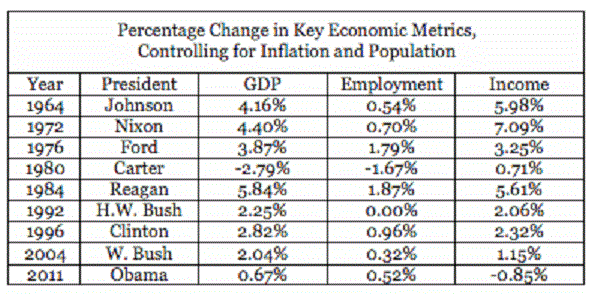
The Weekly Standard‘s Jay Cost has some thoughts on the recently reported headline jobs data.  The perspective into which these headline data fit can be neatly summarized in a table and a graph.

One aspect of this perspective is the overall economic situation in which the present data sit.  This table shows that situation for the last several Presidential election years. It’s true enough that the President Obama’s Employment growth number isn’t too different from those of past presidents in election years.  Keep in mind, though, that Obama’s number is for employment growing from an historically low employment condition: in December 2009, after a year of Obama Stimulus, unemployment was over 10%, with 15 million Americans unemployed.  Obama’s policies in 2011 have produced 0.52% annual growth against that start.  In short, we’re maintaining/growing employment very slightly at our present high unemployment rate, just as during the Clinton and Bush the Younger years, we maintained/grew employment very slightly in a time of already full employment.

Now look at those 2011 GDP and Income growth rate numbers.  They haven’t been that bad—our economy hasn’t been in such sad shape—since the Carter years.  That nearly flat employment growth rate is occurring in a terribly weak economy.

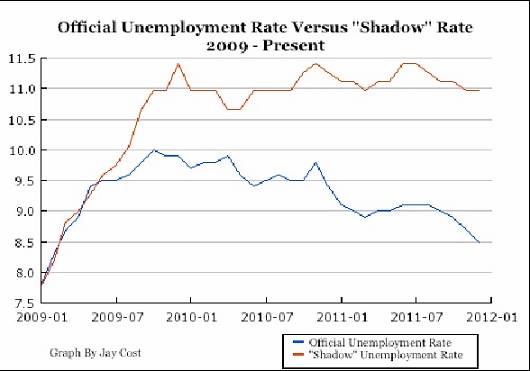
Now let’s look at the unemployment rate itself.  Cost’s graph is informative here.

Just in case the legend isn’t clear/legible, the blue line is the Official unemployment rate, as reported by the Obama administration.  The red line is the “Shadow” unemployment rate, about which neither this administration nor the NLMSM want to talk much.

As Cost points out, much of the decline shown on the Official unemployment (but not all, to be sure) is caused by the shrinking work force, as long-term unemployed give up and stop looking for jobs.  Indeed, as Cost says

Because of the length of this jobs recession, the number of people who claim to be in the workforce is near a 30-year low, and it has dropped substantially since Obama first took office (from 65.7 percent to 64 percent).

and

If we recalculate the unemployment rate based on the percentage of adults who said they were in the workforce at the start of Obama’s tenure, we get [the “Shadow” unemployment rate shown by the red line].

America’s Future—Defense Policy Principles, Part II

I wrote earlier about American defense policy here.  We saw there, and in my series of foreign policy posts, what war looks like from foreign and defense policy perspectives.  At this point, it’s useful to ask what defense policy principles we need to guide our defense behaviors and our force structure.  Defense policy itself drives, ultimately, defense strategy, and this drives, ultimately, force structure.  (I’ll not get into tactics in this series of posts; although strategy certainly does drive tactics as well as force structure.)  In this post, then, I’d like to get into some specific defense principles that I consider critical to our safety and future as they drive our defense policies.  In a later post, I’ll suggest some defense policies that both implement these principles and that give sound, concrete guidance to our defense strategies, and after that I’ll suggest some necessary force structures.

The most important principle for our defense establishment is that our defense must be built around the concept winning across the full spectrum of conflict, and across the full spectrum of kinds of enemy combatants.  We’ve seen in the Korean and the Viet Nam Wars the failures of fighting merely to hold, or to contain—deliberately fighting solely to a draw.  This is the point of having an ability to defend ourselves.  The spectrum of conflict runs, in one dimension, from economic war, through cyber war, and a full range of physical combat: low-level conflict (as measured, in one way, by the amount of soldiery and equipment committed to the war relative to the enemy’s or our total military establishment), through terror war, to all-out war.  The spectrum runs in another dimension from nation states as the enemy combatant(s), through non-national entities engaging in terror attacks (or other forms of war) and the nation states that harbor, if not outright support these terror organizations.  There can be no area of combat, no type of combat that we do not decisively dominate, and we must be able actively to deny sanctuary in any area to our enemy.  And there can be no question that decisive victory must be our objective.  Less than that simply invites renewed conflict at a later time and place of our enemies’ choosing.

As anyone with any military experience knows, control of the high ground is central to efficient use of force in achieving victory.  It’s certainly possible win from the low ground, but that is expensive at best in lives and treasure, and it’s wasteful of those lives and treasure when better alternatives are—or should have been—available.  Accordingly, the next principle must be control of the high ground.  Assured access is highly important, but it’s insufficient: better to be there already and in control of it; this, in turn, assures that access.

Today’s high ground is in space.  However, with today’s technology, and with the technology being developed by the PRC and by Russia (and (for now more slowly) by terrorist nations like Iran and northern Korea), the high ground of space is not earth orbit.  This high ground now extends much further: it includes the moon and lunar orbit, and it includes the LaGrange Points L4 and L5, gravitationally stable regions in front of and behind the moon at the moon’s altitude above the earth.  The high ground, and the race for it, won’t end here, though: as our enemies’ technology and capability improves, the high ground will move outward, to Mars in the next 20 years, and beyond Jupiter by the end of this century.  The advantages of controlling the high ground of space are obvious.

With this control, we can protect our economic infrastructure that relies to increasing extent on space-based assets: our GPS constellation that lets our automobiles navigate in strange cities, among other things; our communications satellites, that let us make cheap, clear telephone calls intercontinentally or let us see and hear first hand the struggles of fellow human beings as they fight against oppression in tyrannical nations; that also support our information access through television and the Internet; that together with our GPS constellation also power such appliances as OnStar®; and so on.  With this control we can protect similar systems critical to our government’s and defense’s operability around the globe.  With this control, we can deny access to our enemies, including their access for attacks on our systems, at times of our choosing.  With this control, we can achieve an additional direction from which to attack their surface to surface missiles and even their aircraft.  With this control we can maintain quality surveillance of their surface forces and weapons systems development and disposition.  The list goes on.

Our defense policies also need to be built around a principle of flexibility.  Flexibility here involves mobility, agility, and adaptability of both the weapons and support systems and of the soldiers themselves.  Mobility is especially critical.  One of the reasons the Crusader self-propelled howitzer was cancelled, for instance, was because it was so huge and amobile [sic] that a single Crusader required two large transport aircraft to deliver it with its initial ammunition load and its supporting equipment.  And it couldn’t go anywhere under its own power in rough terrain, like, oh say, the mountains of Afghanistan. In the end, a weapon that can hit a target 40 miles away but that is unable to move quickly with the tide of battle has no more value than the Maginot Line.

Each of the weapons systems our soldiers are expected to use must be able to operate across a range of terrains, whether physical or electronic or in space, and the systems must be mobile—able to move under its own power quickly or be rapidly loadable onto mobile, cheap transport systems—across the full range of terrain.  Each of these systems must also be easily and quickly loadable onto air transports, air droppable into the combat zone, and then able to go immediately into battle.  Physically, this terrain includes space, urban, desert, hilly and mountainous, muddy and rocky; sea, river, swamp; and so on.  Critical terrain also includes the virtual terrain of cyberspace.  Clearly, no individual system can be expected to operate over every type of terrain, but the totality of our systems must be operable over every type of terrain.  There can be no sanctuary space for our enemies.

Our systems require agility on the battle field.  Our spaced-oriented systems must be highly maneuverable and responsive in space, and our earth-based systems must be similarly very maneuverable on any land or water terrain, across the full spectrum terrain described above.

Our soldiers must be agile.  This includes hard physical conditioning, but it also includes their personal equipment—their weapons, batteries, ammunition, supplies, and so on: everything they carry by hand or in their packs.  This equipment must be both highly lethal and easily packed and transported in their packs as they travel on foot, as their transportation systems fail through battle damage, cyber attack, even “ordinary” wear and tear-related breakdowns.

Our weapons and logistics systems must be adaptable.  This goes beyond an ability to adapt systems to differing fuels availability, or being able to air transport via slings and helicopters, or on trucks, or inside cargo planes, and the like.  It also includes things like computer-aided or -controlled systems being able to be controlled manually as the computer systems become degraded or completely destroyed through battle damage or cyber attacks.

Our soldiers especially must be adaptable.  This isn’t limited to the need to adapt to the changing combat environment of a fight in progress.  It includes adaptability necessary to move from one kind of fight (counterterrorism, for instance) to another kind of fight (stability operations, for instance) to yet another kind of fight (total war, for instance) rapidly and with minimal need for personal equipment change out and similarly minimal need for retraining for the new fight.  But the needed adaptability goes beyond this, too.  It must also include the ability to adapt their own fighting to the use of their degraded weapons systems as battle damage accumulates, and even (especially) an ability to adapt to using what used to be (at least largely) automated systems manually, as battle damage accumulates yet farther—whether from physical damage to their systems or from cyberwar components of the fight in progress attacking their automating and computational control systems.

Successful implementation of these principles of demanding outright victory, controlling the high ground, and of being highly flexible while maintaining extreme lethality will maximize our ability to win any war that is thrust upon us.

Of course, these principles will need the implementation of defense policies governing more than the physical nature of defense; they’ll need technology and development policies as well.  I’ll go into some of those policies in my next post on this subject.