
Businesses Behind the Tree

California wants the Federal tax reform-saved money for itself, and they want a State Constitutional amendment to make the seizure permanent.

A proposed Assembly Constitutional Amendment by Assemblymen Kevin McCarty (D) and Phil Ting (D) would create a tax surcharge on California companies making more than $1 million….

The Progressive-Democrats claim the money would go to “programs that benefit low-income and middle-class families,” but that’s just tear-jerking.  The State’s government would divert the monies to favored programs at convenience.  That’s minor, though.

The point of the proposal is to take the money from business—the surcharge is a tax of fully 50% of business’ Federal tax cut—because Government Knows Better, and business doesn’t deserve it, anyway.  Nor did they earn it.  Government did that.

Don’t tax you, don’t tax me.  Tax that business behind the tree.  That’s not quite what Russell Long (D, LA) said all those years ago, but California’s new tax proposal is close in spirit.  What the Progressive-Democrats in California’s legislature and governor’s mansion are missing, though, is another sentiment of Long’s regarding tax breaks for businesses:

I have become convinced you’re going to have to have capital if you’re going to have capitalism.

This is an understanding completely absent in the Progressive-Democratic Party.
An Embassy Move

The Trump administration has taken steps to speed up the move of the US embassy to Israel from Tel Aviv to Jerusalem.  Instead of building new, the administration

has decided to modify an existing property to accommodate the new mission that will open next year, US officials said.

Good.  This illustrates that President Donald Trump is not just engaging in Obamatalk about any move, he’s actually suiting action to his words.

The execution of the move also is consistent with past behavior.  The original plan was that brand, spanking new building that would have cost a billion dollars and years of time to get done.  Instead, by retrofitting an existing consular building, a more than adequate (if not ridden with lots of bells and whistles and froo-froo) building can be had for considerably less (the retrofit still won’t be cheap: think security and cyber protections) and be open for business next year.

A Government Shutdown

Louise Radnofsky had a piece early Friday morning—before the Senate vote on a bill that would keep the Federal government running for another month—outlining the costs of a shutdown, based on the Progressive-Democrats’ 2013 shutdown.  Over those roughly two weeks of relative inactivity, the costs were quite trivial.

Those trivial costs are part of why the Progressive-Democrats are so anxious to have the shutdown this time around, too—they know there’ll be small practical impact while having large publicity impact.

Frankly, I hope Trump stands firm, and with the government shut down that it stays shut down for far more than a couple of weeks—let everyone see how little Big Government is needed and how well a skeleton government (at least compared to the present morbidly obese government) functions.  After all, to take one example from that 2013 shutdown, then-EPA Secretary Gina McCarthy admitted that more than 90% of her EPA personnel were non-essential, and she furloughed them for the duration.  Now, 90% probably overstates the long-term case (assuming we actually need an EPA, but that’s a separate discussion), but the EPA’s current budget request, which reflects a 47% reduction in EPA employees, is a good place to start.

Martin Feldstein Thinks the Markets are Headed for a Fall

He’s right, to an extent.  The Price-Earnings ratio for aggregated publicly owned businesses is at historic highs.  His reasoning centers on four factors: the Fed’s raising of its benchmark interest rates, which will make money cost more for businesses; the Fed’s reducing its own government bond holdings, which will contribute to upward pressure on interest rates generally; the Federal government’s needing to borrow to cover its still enormous deficits; and heretofore easy money has made the labor market too tight.

However.

There are a couple things about Feldstein’s four reasons. One is that the improving economic activity will greatly mitigate (albeit not eliminate) stock price falls by raising business earnings to meet those falling stock prices—both the numerator and the denominator of the P/E ratio, after all, are dynamic, not only the numerator (albeit the one is capable of moving faster than the other).  Prices won’t fall as far as Feldstein seems to think.

Another thing is that Feldstein’s third reason is a prime argument for the Progressive-Democratic Party to get out of the way and allow Federal spending to be cut.

A third thing is that Feldstein is overstating the case in his fourth reason.  The labor market isn’t as tight as it might seem, given that the underemployed per centage remains at elevated levels, as does the number of workers who’ve left the labor market because they’ve given up; the latter is a population that can be persuaded to return to the labor force.

A Bad Deal

And all for the sake of a personal legacy, apparently.

Republic of Korea President Moon Jae-in has cut an Olympic-sized deal with northern Korea concerning the latter’s participation in next month’s Winter Olympics.  According to the deal,

South Korean athletes and performers [will go] north of the demilitarized zone for training at a North Korean ski resort and a cultural event at a scenic mountain resort.

Further,

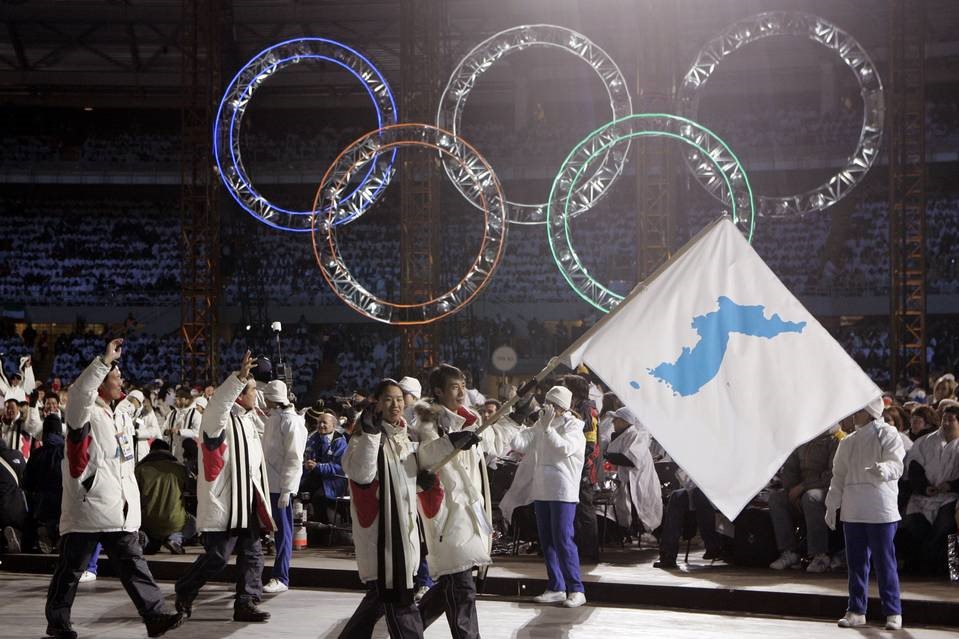
[T]he two Koreas will walk into the opening ceremony of next month’s Winter Games in Pyeongchang, South Korea, under one flag—the unification flag that depicts all of Korea. The two countries’ women’s ice hockey teams will unite to form a joint Korean squad.

It’ll be interesting to see how many ROK athletes and performers will be willing to go north and the quality of those who do.  It’ll also be interesting to see what the single flag looks like; here’s what the “reunification” flag looked like at the 2006 Winter Olympics:

It’ll be even more interesting to see how many of the RoK women’s hockey team actually show up.  There’s considerable disgruntlement among the team, Olympic athletes generally, and athletic sphere leadership over Moon’s agreement here, both over the agreement and over the RoK players who will be cut or denied ice time to make room for the north’s players.

And: the agreement seems not to have been done with athletes’ input or even warning that it was coming.  Moon certainly is setting his legacy.