
A Survey of Southeast Asian Nations

This one was done by ISEAS-Yusof Ishak Institute a research institute established by the government of Singapore.

Organizers sent the survey late last year to government officials, academics, and other stakeholders from the 10 countries comprising the Association of Southeast Asian Nations (ASEAN).

Here are some interesting tidbits from the report. First, the nations’ overall concern about the situation in the South China Sea:

Notice that—even concerns about a US-PRC confrontation are a distant 3rd to concerns about the PRC’s misbehaviors. And of those 12.5% concerned about our own military presence, Singapore (6.3% [of those 12.5%]), Vietnam (4.6%), and the Philippines (4.5%) have little qualms about it. These are the nations most directly threatened by the PRC’s acquisitive adventurism.

Next, the nations’ preferred response:
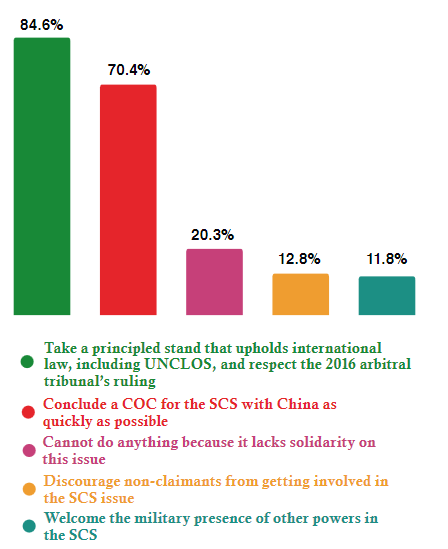
The vastly preferred solutions are the nations’ enforcement of the UN Convention on the Law of the Sea, which aligns to a large degree with the US’ position on freedom of the seas, and the conclusion of a Code of Conduct with the PRC, which agreement would severely hamstring the PRC’s seizures since the nations’ view of a legitimate COC would have it align tightly with the UNCOS.

And this:
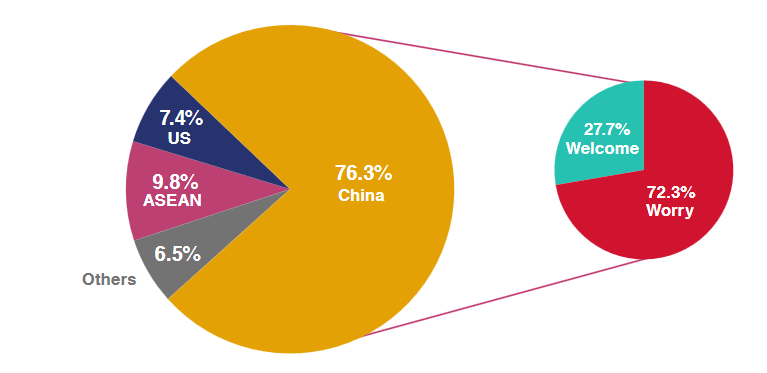
The left pie chart reflects the view of the nations concerning who has the largest economic influence in the region: 76.3% view the PRC as havng the largest influence. The right pie chart shows that nearly ¾ of the nations are concerned about that economic dominance.

These results, excerpted from a broader-reaching report, show the opportunities that former President Donald Trump was working to exploit, and that remain for President Joe Biden to exploit.

The entire report is worth reading, and it can be read here.

h/t to Just the News

The Biden Budget

Carol Platt Liebau, Yankee Institute for Public Policy President, wrote in her Friday Wall Street Journal op-ed about President Joe Biden’s dangerously expensive Wuhan Virus “relief” bill. A truly Pyrrhic relief it would be, too, even were it not occurring on an already dangerously expensive pair of “relief” bills enacted over the prior year.

She had one statement, though, that particularly jumped out at me, perhaps because it centers on a matter I’ve been on about for a bit already.

President Biden wants to send $350 billion in unrestricted cash to state and local governments to fill their budget holes.

Money is fungible. It doesn’t matter whether a dollar is “restricted” or unrestricted in its use. Even if it is, its mere existence frees up another dollar for the supposedly restricted-from use.

Aside from that, the States don’t need the Federal (which is to say our taxpayer) money. State revenues are much higher than initially expected, even in Progressive-Democrat-locked down and -run States.

In addition, the public union shakedowns of which Leibau wrote further demonstrate the lack of need.

“My Word as a Biden”

That was then-Progressive-Democratic Party Presidential candidate Joe Biden’s go-to phrase whenever he wanted to emphasize his seriousness in making a claim.

Here’s one of those serious statements:

If you’re ever working with me and I hear you treat another colleague with disrespect, talk down to someone, I promise I will fire you on the spot. On the spot, no ifs, ands, or buts[.]

When White House Deputy Press Secretary TJ Ducklo was abusive to a Politico reporter, he was suspended for a week without pay and barred from interacting with Politico reporters.

That’s an example of the worthlessness of the now-President’s word as a Biden.

Unless he’s going to stand on the technicality that he didn’t personally hear Ducklo’s abuse, or that Ducklo wasn’t directly working with him at the time of Ducklo’s abuse.

In which case that quibble would be a separate demonstration of the worthlessness of the now-President’s word as a Biden.

In the end, Ducklo was allowed to resign and slink away. Biden, choosing not to fire him, has pretty conclusively shown the worthlessness of his word as a Biden.

A Treasury Climate Czar

That’s what new Treasury Secretary Janet Yellen wants to set up. That’s not necessarily a bad idea.

A climate risk office inside Treasury actually could be useful—were its purpose properly targeted.

The risks that are worth assessing and which realizations worth planning for, though, are political and economic, not climatic.

The political risk is from government overreacting with laws and regulations to the overhyping of climate.

The economic risk is from businesses overreacting in anticipation of such political overreactions.

Somehow, though, I doubt that’s Yellen’s intention for her new office.

Too Far

Senator Marco Rubio (R, FL) has reintroduced his Terror Intelligence Improvement Act, his bill to allow Government to block suspected terrorists from obtaining firearms. This bill, far from improving anything, is a long step back from our rights under our Constitution. As Dana Loesch summarized it in her newsletter (behind a paywall after this month; subscribe now for a discount on her subscription price),

The bill would also provide more authority for law enforcement agencies to go after suspected terrorists, while safeguarding law-abiding citizens’ Second Amendment and due process rights.

But, as Loesch goes on to point out, that’s internally contradictory. It’s simply not possible to restrict American citizens’ rights while protecting those same American citizens’ rights. A suspect is just that—a suspect, and so still innocent, regardless of suspicion.

Then, however, Loesch makes her own mistake.

If lawmakers want to stop suspected terrorists placed on a watch list from buying firearms they need to indict them.
I have no problem with this.

I do have a problem with that. All a prosecutor has done with an indictment is convince a secret group of men and women that he has probable enough cause to hale the indictee—possibly an infamous ham sandwich—into criminal court for trial.

The indictee still is innocent; he hasn’t been proven otherwise in that criminal court.

It’s true enough that we do restrict innocent men—we lock them up; we make them wear ankle bracelets; we make them pay a significant something of value to be released, under restrictive conditions, from jail pending trial; and so on.

But those restrictions are done in open court where the prosecutor must convince the judge that his proposed restrictions are warranted, and he must do so in the face of the defendant’s right to answer the proposed restrictions.

Simple indictment isn’t enough. If the suspected terrorist must be denied his 2nd Amendment rights (in the present context), let the prosecutor show in open court that his suspicion is well enough founded that his suspect should be locked up.

As a practical matter, too, that’s the only way to deny such a suspect firearms—outside of jail, there simply are too many means of access to firearms, legal or not.

Beyond that, there’s another, better, way to protect us from terrorists, whether those persons are armed or not. That is for Government to get out of the way of the first responders to any situation—us citizens who happen to be already on scene when the action goes down—carrying our own firearms.