Maybe Not the Best Choice

President-elect Donald Trump (R) has chosen Congresswoman Elise Stefanik (R, NY) to be his Ambassador to the UN.

This is a mistake; although it’s no knock on Stefanik to say so. My problems with her selection are these.

With the Republicans retaining their House majority still up in the air a week after the election, even if they succeed, it’ll be a slim majority. Her departure from the House would trigger a special election, and while it’s unlikely that another Republican would lose that seat, that’s a non-zero probability.

More importantly, she’s too badly needed in the House, especially with the ability in this narrow majority environment of the Republicans’ Chaos Caucus to continue their foolishnesses. Stefanik is a skilled Congresswoman who could continue to tamp down (if not entirely successfully in the last Congress) those foolishesses.

Stefanik’s replacement is unlikely to be as effective as she has been as a Congresswoman, and especially neither that replacement nor an existing Congressman will be as successful as she has been in the House’s Republican caucus hierarchy or on her committee assignments.

The UN Ambassadorship’s role itself isn’t as important as her role in the House. Our UN Ambassador’s role, because the majority of the UN nations hate us or our allies and friends or both, is limited to calling out those nations’ misbehaviors and to vetoing their initiatives on the Security Council. There are a number of folks besides Stefanik who could fill that role.

Stop Treating These in Isolation

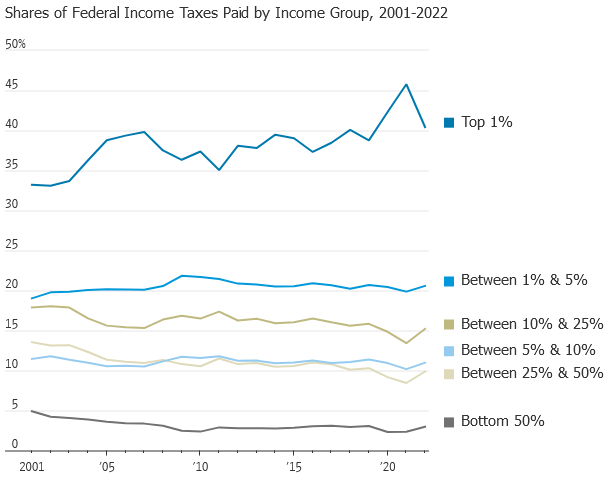
Richard Rubin thinks he has an approach to Republicans’ desire to cut taxes:

To pass a bill without Democrats, GOP lawmakers seek agreement on the deficit number

That’s the subheadline for his article. He then opens his piece with this:

As Republicans prepare the party-line tax bill at the core of their 2025 agenda, the key to everything is, simply, “The Number.”
The Number is the maximum budget deficit increase that Republicans are willing to tolerate as they extend tax cuts scheduled to expire after 2025 and advance the rest of President-elect Donald Trump’s plans. To unlock the gate to the legislative fast track that lets them sidestep Democratic objections, Republicans must agree, with virtually no defections, on The Number.

But that’s only part of the matter, and as long as Republicans—either party, come to that—insist on treating taxes in isolation, they’ll continue to fail. The plain fact is that Republicans don’t have to agree on any deficit Number; what they need to agree on instead is a Number that represents any value in the interval from zero to budget surplus.

That, of course, also would require them to agree on spending cuts that bring that overall spending down to within the expected (dynamically projected) revenues realized from the tax cuts.

There are two ways those revenues will grow on net from the from this sort of budget move. One is the well-known increase in overall economic activity that results simply from tax rate cuts. These leave more money in the hands of private economy players—individuals, households, and the businesses they own and operate. It’s been repeatedly demonstrated that those players allocate their spending far more efficiently than anything a government can achieve.

The other way revenues increase, though, is less frequently discussed, even as it’s closely related to tax cuts. This is that, with less government spending, there is less competition for the resources—labor, raw materials, finished and semi-finished products—that private enterprises need for their own operation. With that resource competition from Government greatly reduced, the prices for those resources come down, and private businesses can more easily and cheaply acquire what they need. Private enterprise competition then increases and overall economic activity increases, overlaying the increase from simply reducing taxes, and a positive feedback loop develops among increasing production, lowering prices, increasing private demand, increasing employment, and increasing innovation. And net increasing revenues to Government.

Those two outcomes achieve one other item of critical economic, and political, and security importance. It provides an opportunity to commit those budget surpluses to paying down our national debt.

Of course, the Progressive-Democratic Party is going to quibble over any spending cut and tax cut, all the while objecting to either altogether, so to get these done even temporarily, Republicans will have to do them through legislative reconciliation.

That, in turn—both the taxing and the spending reductions—will require the Republicans’ Chaos Caucus to leave off their ego-driven their-way-or-nothing-at-all obstructionism and agree to compromises that move things in their direction, even if not everything all at once.

And get Republicans like Senator James Lankford (R, OK) to shape up or at least stay out of the way. According to him:

We’re not going to have something that’s going to have zero deficit impact. That’s not going to happen[.]

On that score, the Chaos Caucus is right. There need to be spending cuts to achieve outright deficit elimination and actual surplus.

Duplicity

Senate Majority Leader Chuck Schumer (D, NY) on ending the filibuster:

Over the coming weeks, the Senate will once again consider how to perfect this union and confront the historic challenges facing our democracy. We hope our Republican colleagues change course and work with us. But if they do not, the Senate will debate and consider changes to Senate rules [eliminating the filibuster]….

And

In a session with reporters at the Democratic National Convention, Schumer (D-NY) suggested that—should Democrats win the White House, Senate, and House in November—he would seek to end the filibuster for purposes of passing voting rights and abortion legislation.

These are deliberate moves to pass legislation unilaterally, in complete absence even of any pretense of bipartisanship.

Soon-to-be Senate Minority Leader Chuck Schumer (D, NY) today:

The only way to get things done in the Senate is through bipartisan legislation while maintaining our principles—and the next two years will be no different.

Only because, despite Schumer’s efforts, the filibuster remains intact. Nevertheless, his meaning is plain. He’ll have his caucus being just as knee-jerk obstructionist of any Republican initiative as he always has had, now with the added fillip of knee-jerk obstructionism regarding anything Trumpian, just as he had done during the prior Trump administration.

Assuming the Republicans are able to retain their majority in the House, he’ll also have able functional allies—if unintended—in the Republicans’ Chaos Caucus.

“Gatekeepers of Political Discourse”

That’s how even The Wall Street Journal terms the press. This, as it notices the decreasing control influence the press has on what us average Americans are allowed to know about the political doings of our politicians.

A new media landscape has emerged. The traditional gatekeepers of political discourse—TV networks and newspapers—are shrinking in influence as Americans turn to many more outlets for information.

This comes especially in the wake of the last eight-ish years of naked bias by the press, a period wherein The New York Times has openly announced that there can no longer be objectivity in news reporting, newspapers must take sides, and a major broadcast news anchor announced that there are not two sides to every story; there can be only one side to many. In furtherance of those decisions, the press actively proselytizes on its news pages for its chosen candidates and party while actively suppressing stories that provide different information or that show their denigrated party and candidates in a good light. The press also suppresses stories that cast its chosen party/candidate in a negative light.

Beyond politics, the press actively spikes writing that contradicts its settlement of climate “science,” with the Los Angeles Times saying that it would no longer publish letters to the editor that disputed the LAT‘s determination of the proper discussion.

It’s no wonder that us average Americans no longer take the press seriously and are moving away from it toward other sources—including straight from the horse’s mouth in the podcasts that are becoming ubiquitous, and on some social media outlets like X, Truth Social, even the dangerous TikTok. If we can’t entirely trust these alternative outlets, we can at least hear what the candidates—and other guests—are saying, without the gatekeepers’ censorship filter.

“Firsts”

Earlier, it was Barack Obama becoming the US’ first black President and Michelle Obama becoming the first black First Lady. Then it was Melania Trump becoming the first immigrant/naturalized American First Lady (when the Left and the press were willing to take notice of her at all). Then it was Kamala Harris becoming the first black and woman Vice President. Then it was Harris with the potential to become the first black woman President. Now it’s Usha Vance who will become America’s first Indian-American and first Hindu First Lady.

All of that is manufactured by our press and by the Left’s and Progressive-Democratic Party politicians’ fixation on identity politics.

It’s time for the Left and for Party to leave off from their sexist and racist othering of our people through their intrinsically segregationist identity politics sewage. The only time race and sex will cease to matter is when all of us stop artificially making it matter.

The only thing to say about the Obamas, Trump, Harris, and Vance in this regard is that they are Americans assuming, or having had the potential of assuming, those positions and responsibilities. And we’ve had only Americans in those positions since our inception.

Full stop.