“Tightrope”

Progressive-Democrat President Joe Biden is walking a tightrope as he tries to deal with Israel. President faces pressure from both his left and right on Middle East conflict goes the subheadline.

Maybe pressure from the Left is there, maybe not.

There are two possibilities. One is that Biden is letting himself feel pressure from an extremely vocal but small Leftist faction that supports Hamas’ terrorists in their war against Israel, disguising their protests as support for Palestinians. Their constant chants of “from the river to the sea” demonstrates that disguise. If Biden really is that easily manipulated by the loudness of a small minority of the Left, actually feeling their “pressure,” then he’s too weak to be trusted with reelection to that office.

Alternatively, those extremely loud Hamas supporters aren’t a small Leftist faction, but instead comprise a large and growing portion of the Left and especially of the Progressive-Democratic Party. If that’s the case, that’s a Party as well as a Presidential candidate that can’t be trusted with reelection.

Biden’s Inflation

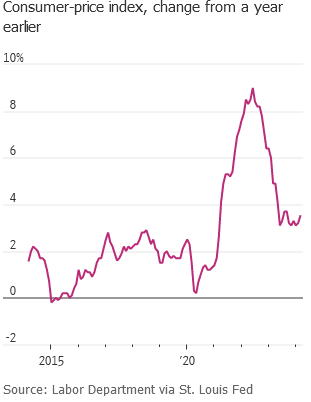
This is what Progressive-Democrat President Joe Biden’s proudly touted Bidenomics has inflicted on us: continued high inflation.

Tacitly, Biden knows his policies are a failure, but he won’t admit it.

For now, officials said, Biden and his senior aides aren’t planning any major policy or rhetorical shifts.

Yet,

Behind the scenes, administration officials said there was no magic bullet to slow rising prices immediately, an issue that has dogged the president for years.

Rising prices—inflation—has been Biden’s problem since he took office; that’s the time frame of that drily put “for years.” From the Biden-caused sharp increase that damaged so many millions of pocketbooks of us ordinary Americans through that partial fall in inflation, of which Biden is so, and so misleadingly, proud, to the last few months of steadier 3+% inflation, we’re still facing price levels increasing at much higher rates than before Biden began his reign.

Some of Biden’s cost-cutting plans will take months to come to fruition and will do little in the short term to slow the rate of price increases.

[T]ake months to come to fruition: yeah—they’ve taken three years and counting.

Some stubbornly high prices, such as the cost of groceries, are mostly out of the Biden administration’s control.

Here, the news personalities who wrote the article at the link are badly mistaken. ­All of those high prices are fully under the administration’s control. Begin with Biden’s war of destruction on our energy industry. Energy underlies every aspect of our economy: fuel for our personal vehicles, energy to heat our homes in winter and cool them in summer, fuel for generating the electricity that’s needed in every aspect of our personal and business lives, shipping costs for all of our goods and services—including shipment of our groceries—and on and on. By seeking to destroy our coal-, oil-, and natural gas-based energy production, and continuing to passively block development and construction of nuclear power plants, Biden is raising the prices of energy, and that alone raises the price of every single item in our economy. Including those groceries.

Most economists don’t believe Biden can do much at this point to bring down inflation, absent major tax increases or spending cuts that could curtail consumer spending. Even those policies, which aren’t being seriously considered in Washington, would take time to work their way through the economy.

Most economists are right as far as they go. And they’re wrong. Tax increases or government spending cuts would take time to have effect. However, tax increases would reduce economic activity in general by taking even more money out of our private economy than our usurious current tax code does. That reduced economic activity will only lead to continued, if not increased, government spending in the form of welfare handouts, and those lead to greater deficits and debt, and to increased dependence on government.

Government spending cuts won’t, though, lead to less consumer spending. On the contrary, with less government competition for the same goods and services our private economy needs, inflation—and real price levels—would come down, making it easier for us consumers to consume, not harder.

But most economists don’t go far enough. There is much the Biden administration—Biden himself as President—can do that would have more immediate favorable effects on price levels. He can remove his Executive Orders that are interfering with the free flow of goods and services and that inhibit coal, oil, and natural gas production. He can instruct his Departments and Agencies to withdraw their rules that interfere with that free flow and that inhibit energy production.

But he won’t.

A Governor Betrays our Children

Kansas’ Progressive-Democrat Governor Laura Kelly has vetoed a bill that would have banned gender surgeries and hormone treatments for minors. Her rationalization:

targets a small group of Kansans by placing government mandates on them and dictating to parents how to best raise and care for their children. I do not believe that is a conservative value, and it’s certainly not a Kansas value.

A small group: leave aside the Left’s mantra (apparently only when convenient) of “if it saves just one life….” Protecting children from mutilation that’s far too often crippling as well isn’t a conservative value?

That’s how far Left the Progressive-Democratic Party, epitomized by Kelly, has gone.

Presidential Debates

Former President Donald Trump (R) not only wants Presidential candidate debates, he wants them to occur much earlier than they have in prior campaign seasons.

The Trump campaign has asked the Commission on Presidential Debates to schedule the anticipated matchups between him and President Joe Biden earlier in the election cycle, signaling Trump’s willingness to work the panel on date and venue.

I agree, with a caveat.

Trump shouldn’t give the CPD much time to agree to an accelerated schedule. If they don’t meet an appropriately nearby deadline to get earlier debates scheduled, or if Progressive-Democrat President Joe Biden won’t agree to the schedule, or won’t agree to debate at all, then the Trump campaign should schedule the debates, including the venue (my preference here would be town hall style venues, with the majority of questions coming from the audience).

In addition to that, the Trump campaign should invite Robert Kennedy, Jr, Cornell West, Marianne Williamson (who has reactivated her campaign), and Jill Stein to the debates. If any of them decline to participate, then the Trump campaign should place empty barstools (that being the preferred seating arrangement at townhalls) labeled with the names of the candidates who didn’t want to appear.

And then proceed with the debates.

Toddler Temper Tantrums and the Fears of the Timid

Karl Rove may be whistling past the graveyard in his Wednesday WSJ op-ed. He opened his piece with this lede:

Conventional wisdom is that Republicans will lose the US House this fall. That may be right.

Then he ran a counterargument.

Yet the conventional wisdom that Republicans will lose the House may be wrong.
One reason is retirements. Much has been made of how many Republicans are leaving, including talented members such as Wisconsin’s Mike Gallagher, North Carolina’s Patrick McHenry, and Washington’s Cathy McMorris Rodgers. But more Democrats (24) than Republicans (19) have announced their retirements. Moreover, all the Republican retirements are in overwhelmingly red districts. The only open GOP seat considered competitive—the Cook Political Report calls it “lean Republican”—is Colorado’s Third District. Cook’s partisan vote index—which estimates a district’s leaning relative to the country based on the two most recent presidential elections—labels it an R+7 seat.
Retiring Democrats represent more-competitive seats. Cook rates the open Michigan Seventh and Eighth districts as “toss-ups.” They are R+2 and R+1 respectively. Cook classifies the California 47th (D+3) and Virginia Seventh (D+1) as “lean Democrat.” The Maryland Sixth and New Hampshire Second (both D+2) are “likely Democrat.”

Rove gave too little credence to the damage the toddler temper tantrum, led by Marjorie Taylor Greene (R, GA) and her Chaos Caucus supporters, does. These toddlers may well hand the House Speakership, and control of the House agenda, to the Progressive-Democrat Hakeem Jeffries (D, NY) before the current session ends, especially given the number of nominally Conservative Republicans who are abjectly cutting and running from their House seats, whether at the end of the current session or quitting just as soon as they can get their desks cleared.

The inability of Republicans to agree among themselves on what to put forward—the Chaos Caucus blows up anything that doesn’t suit their veriest whims to t—and the party’s timidity in putting any Conservative policies forward and putting the onus on the Progressive-Democrat-ruled Senate and the White House to work with them—tells the voting public that this is a ragtag collection of junior high politicians not ready for the national obligations they have.

Rove also gave too little effect to the timidity of the remaining “mainstream” Republican Congressmen. There are number of legitimate conservative policies that are proposed by the Freedom Caucus (when they aren’t acting in their Chaos Caucus guise). These, though, are routinely rejected by too many of the other Republicans in the House Republican caucus under the excuse that the Progressive-Democratic Party Senators would never agree to them, and that the Progressive-Democrat President would never sign, even were something to get to his desk. So, these Republicans won’t even try. They’re too timid to do something that might force the Progressive-Democratic Party’s politicians to take a stand, much less to force them to work with Republicans. Instead, these Timid Republicans would rather try, meekly, to work with the Progressive-Democrats, ceding functional House control to the minority party.

That timidity isn’t encouraging for voters.

Rove also underestimated the effect on voters by those who are heading out the door just as the battle is heating up. That timidity may well turn off voters, voters who won’t vote for the overtly destructive Progressive-Democratic Party, but who find they can’t trust Republican candidates who might well run away themselves. These voters are likely to stay home, which with today’s divisions is the same as voting Progressive-Democrat.

More Progressive-Democrats (my term, not Rove’s) than Republicans are leaving the fight? Only by five, and that, out of 43 departures, is as thin as the current Republican nominal majority. The Republican Party, too, has demonstrated in elections from 2018 forward that it’s fully capable of throwing away eminently winnable seats and donating them to the Progressive-Democrats. It would take only a net gain of five seats to get Jeffries as Speaker.

Public disgust with a Republican Party populated, at least at the national level, with toddlers and timids may well cost us a government interested in our borders, our economic strength—our national security.

Whistling past the graveyard, indeed.