
Budgeting and a Do-Nothing Senate

As a number of us, including Power Line, have been mentioning lately, the Senate-of-No has not adopted a budget in three years.

In the latest sham, we get Senator Kent Conrad (D, ND) feinting to his right with an offer to present a budget proposal and to discuss amendments before the Senate Budget Committee, which he chairs.

[The] standard markup process begins with the committee chairman laying out a proposal, with the chairman and the ranking minority member giving opening statements.  This is followed by an amendment process, in which amendments to the proposed legislation (here, the budget resolution) are offered and voted on.  The markup process concludes with a committee vote on the bill or resolution as amended. In this case, Conrad assured ranking Republican, Jeff Sessions, that amendments would be allowed.

Then Conrad held a presser at which he announced that he’d present his budget proposal, all right, but there would be no amendments allowed, and there would be no subsequent Committee vote on his proposal.

Senator Sessions (R, AL) responded to this shadow box theater noting that this is another demonstration of a

lack of will, courage, or the ability of Democrats to unify behind a plan.

and that they

don’t want to be held accountable for anything.

President Obama also has weighed in in support of his party’s Senate doing nothing.  Through his Acting Budget Director, Jeffrey Zients, Obama threatened House Appropriations Committee Chairman Hal Rogers (R, KY):

Until the House of Representatives indicates that it will abide by last summer’s agreement, the President will not be able to sign any appropriations bills.

Never mind that last summer’s spending agreement was to an upper limit of $1.047 trillion, not a lower limit of that amount.  Obama is simply acting, as Sessions noted, on any excuse he can dream up to not be constrained by a budget.  Again.

Never mind, moreover, that Conrad’s budget [is expected to have] no spending cuts at all from Obama’s present exploded baseline, and that it increases taxes by $2.6 trillion, $700 billion more than even Obama’s budget—which has gotten him zero votes, including zero Democratic Party votes—in two tries over two years.  Indeed, with Conrad’s budget, the national debt increases by $7 trillion.

Never mind that in all of 2011, the Senate Progressives voted down three different budgets, but they didn’t offer anything of their own.  Again.

Is this the level of integrity we want in our Senators?
Taxes and Fair Share

At the start of the week, the Senate failed a cloture vote on President Obama’s Buffet Rule by a 51-45 vote, with Senator Susan Collins (R, ME) voting for on the excuse that the measure should be openly debated (never minding that President Obama has been debating it on his latest campaign tours), and Senator Mark Pryor (D, AR) voting against on the theory that such a measure should be part of a debate on general tax reform.

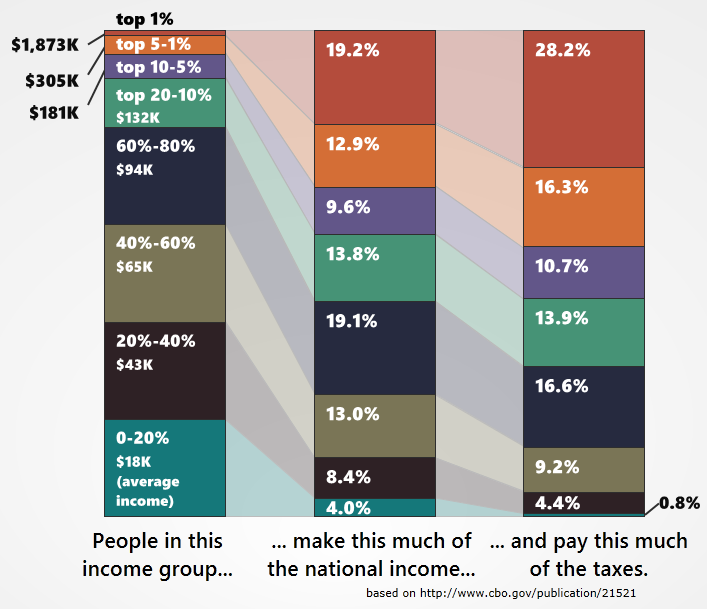
I won’t occupy bandwidth repeating commentary about Obama’s “it’s only fair” mantra.  However, via Villainous Company, comes another view of what’s fair—the following graphic, based on tax rates from 2007 and published in 2010.

Interesting, this.  The only folks paying roughly their “fair share,” if we’re willing to consider what’s fair to be paying a share of the nation’s income taxes roughly akin to the share of national income represented by one’s own income grouping, is those rich folks in the second 10% income group—those whose income puts them in the band of top 10% down to top 20% of income—and the truly destitute—those folks in the very bottom 20%.  The Stinking Rich, those top 10%-ers, are paying far more than their fair share.  And most everyone else below those top 20% are paying increasingly less than their fair share.

But President Obama and his Progressives want to pile on and make his ugly rich pay even further beyond their fair share.  With lots of words about creating yet another entitlement program, a program of transferring tax money from those who pay a lot to those who pay a little.  But with not a word about cutting spending to fit within the revenues already accruing to his administration.  With not a word about reforming existing entitlements like Social Security, Medicaid, and Medicare.

Hmm….

Higher Gas Prices: Yes, or No?

Earlier this week, Energy Secretary Steven Chu acknowledged at a Senate Energy and Natural Resources Committee hearing that he indeed told The Wall Street Journal in 2008 that

Somehow we have to find a way to boost the price of gasoline to the levels of Europe.

Now, with the damaging impact of rising gas prices on Obama’s approval rating, Chu claims a change of heart.

Senator Mike Lee (R, UT) asked Chu at that hearing

Are you saying that you no longer share the view that we need to figure out how to boost gasoline prices in America?

To which Chu responded

I no longer share that view.  When I became Secretary of Energy I represented the US government and I think that right now in this economic—very slow return—that we need to have, these prices well could affect the comeback of our economy and we’re very worried about that.  And so, of course, we don’t want the price of gasoline to go up.  We want it to go down.

Obama also was quick to downplay this rather dramatic shift.  At a news conference earlier this week, President Obama insisted to Fox News that it was foolish to think he wanted higher gas prices to wean Americans off fossil fuels, or for any other purpose.

You think the president of the United States going into reelection wants gas prices to go up higher?  Is that—is there anybody here who thinks that makes a lot of sense?”

Then, through his Press Secretary, Jay Carney, he insisted that he’d not instructed his Secretary to “clarify.”   No, Chu had made that earlier remark before he joined the administration, and so of course Republicans are taking it out of context to suggest it is administration policy.  This, though, means that Obama is claiming to have been utterly oblivious to Chu’s position when he selected Chu for Energy, that Chu’s preference for higher gasoline prices—to encourage Americans to shift to Obama’s “green” energy sources—couldn’t possibly have been among the reasons Obama selected Chu.

Never mind that Obama’s approval rating has slid to a nearby low of 41%, or that a new CBS News/New York Times poll indicates that 54% of Americans believe an American president can, indeed, do a lot about gasoline prices. That’s his story, and he’s sticking to it.

Since this change of heart is so plainly politically motivated, can we take Chu or Obama at their word on the matter?

On a separate but related note, Obama, through Carney, also tried to walk away from another allegation of his.  On Monday, Carney had said

What [Obama] is not willing to do is to look the American people in the eye and claim that there is a strategy by which he can guarantee the price of gas will be $2.50 at the pump.  Any politician who does that is lying, because…that strategy does not exist.

GOP Presidential candidate Newt Gingrich responded with a challenge to Obama to debate the matter, and energy policygenerally, offering a number of venues for Obama to select from: an oil rig, a gas station, a refinery, a university campus.  Obama avoided the challenge and had Carney respond, instead,

I said yesterday that anybody who said that would be a liar.  And I shouldn’t have gone into motivations.  I should have said anybody who says that doesn’t know what he’s talking about.

Hmm….

Why Would Anyone Buy This Debt?

Greece, last week, passed its Collective Action Clause legislation in preparation for its upcoming bond swap, wherein bondholders have agreed, in general, to a write down of some 53%: they’ll trade the bonds they hold for new bonds issued by the Greek government that will run out to just over half the value of those original bonds.  This was a—more or less—voluntary swap: agree to the deal or risk losing everything as Greece explicitly defaults.

However.

What the CACs do is force all bond holders to make the swap, whether they want to or not, once a minimum per centage of holders make the swap.  It’s important to note here that this was done retroactively—years after the bonds had been sold, years after a solemn debt agreement had been committed to by the Greek government (and the bond purchasers, but they’re not the ones making this commitment change).  In short, the CACs change the original terms of the debt, and they do so entirely unilaterally, and only after the fact.

There are two problems with this.  One, the most important, has to do with integrity and morality.  The Greek government, and the Greek citizens collectively, can be derided for their foolishness in running up so large a debt compared to the country’s ability to repay, and many of us have done so.  However, to things that are known a priori on any debt sale agreement are that there is a non-zero possibility of default, even on a government debt, and this is priced into the cost of buying a sovereign debt instrument, at however small a premium.  The other thing that is known is that the terms of the deal will be honored by all parties to it, come what may.  Even were the Greek government, for instance, explicitly to default on its bonds—to go through, for instance, the (inter)national equivalent of an American bankruptcy court proceeding—everything would proceed in accordance with already known rules and conditions.

This unilateral, retroactive change to the terms of these debt agreements, though, destroys that integrity, that morality.  An entity that will welch on its commitments as soon as they become inconvenient (albeit a large inconvenience in the present case, but there are more honest alternatives even here) cannot be trusted to honor any future commitments whenever those might become inconvenient.

The other problem is a moral hazard one; although this one has a chance of not materializing.  The moral hazard here is not the classical economist’s moral hazard, but a different kind.  Consider, for example, a basketball or soccer player who hits the game winner as the clock expires.  This player gets credit—gets the positive moral hazard—for hitting the winner.  Never mind that this is wholly unjustified: his teammates and he have spent the entire game keeping it so close that a single shot out of the 150 or so in an NBA game or dozen or so on goal in a soccer match, makes the difference.  Any shot from the first one taken in the first quarter to the penultimate one taken late in game, any of those, has significance equal to that last one made.

So it is with Greek bond holders in a more negative sense.  Suppose the required per centage of bond holders, less one, makes the swap.  The swap fails, and the Greeks default.  It’s easy to identify the game winning shooter and to lionize him.  It’s also easy to identify the bond holders who reject the swap, and I suggest that the last one to make that list will not be lionized.  All bond holders are put into this box, also, though.

Under these circumstances, I ask again my question: why would anyone buy this country’s debt in future?  An actual “I can’t pay, so I default” would bring about sore hits to Greece’s future borrowing capacity, but such a default would not, of necessity, impugn Greek honesty.  They would recover, and in pretty short order.  But having destroyed their integrity?

Another Lesson from the European Model

Here’s the present situation in Greece—it really is this apocalyptic.  Children are street-begging for food, and adults are dumpster-diving for food as soup kitchens close their doors on people because the kitchens have run out.  Professional talent is leaving the country for foreign work, and others are squirreling their money away in foreign bank accounts.  Medecins Sans Frontieres is reporting a return of malaria—and so the exposure of Europe generally to this once-eradicated disease.

University of Athens economist, Panagiotis Petrakis, describes other aspects of the economic failure:

…standard of living down, by as much as 30 per cent; bank deposits that have not been spirited out of the country are dwindling; almost 70,000 businesses folded in 2010 and bankruptcy is stalking more than 53,000 of the remaining 300,000; unemployment, 25 per cent – but youth joblessness is 47 per cent and rising; a quarter of the population living in poverty; homelessness, up 25 per cent, with well-educated youngsters accounting for much of the rise.  Petty crime, doubled.

Greece—and Portugal, Spain, and Italy; although Greece is the farthest down the path—is demonstrating the results of a welfare state running out of other people’s money.  The stimulus money is fully expended, and there are no positive results; only failure: competitiveness has disappeared into an overwhelming national debt, and with the loss of prosperity from that competitive fire, any ability to heal the economy—to repay that debt—is sorely constrained.  Corruption—crony capitalism—is becoming rampant.

Greece, like Detroit, and the US, like Greece, are gravely wounded by the policies of welfarism, however disguised by pretty words of “everyone gets a fair shot.”  Yet our own political elite still want to double down on their failed spending, taxing, borrowing—wealth redistribution—policies by imposing yet higher taxes, increasing spending even more, and expanding our debt explosively beyond its current already unsustainable levels.

Though Europe’s economies are dying, the collective mind of its political elite is still gripped patterns of thought and modes of analysis that were hatched in another era.  And so it is here, where Progressive policies, born in the failed New Deal, continue to hold sway and continue to fail today.

h/t to Belmont Club