
Obama Is Legally Allowed to Enforce—or Not Enforce—the Law

Amazingly, a professor at the University of Chicago’s law school wrote this in the New Republic, and he’s serious. Yet he cites not a single clause from the Constitution, not a single phrase, to support his…thesis.

Eric Posner wrote, among other things,

Would President Barack Obama, by refusing to enforce the immigration laws against millions of undocumented immigrants, be engaging in “domestic Caesarism,” as Ross Douthat charges [in a New York Times op-ed]?

…if he chooses not to enforce immigration laws against “up to half the country’s population of illegal immigrants,” as Douthat claims, the president wouldn’t be doing anything different from what his predecessors have done (or rather, not done).

There’s that Progressive morality, again. The rightness or wrongness of a behavior isn’t at all inherent in the behavior. No, the behavior’s morality is determined solely by whether someone else did it first or is doing it also.

And

The president cannot suspend or change the law: when he leaves office, the law will remain the same as it was, and the next president will be free to enforce it or not.

No, no president, nor Obama nor any “next president,” is free to not enforce the law (nor has any past president been, although past ones have been guilty of this, also; Posner is right on this much). Here’s what Article II, Section 3, has to say on the matter:

he shall take Care that the Laws be faithfully executed

Full stop. There’s nothing in there about taking Care if he feels like it or taking Care not to faithfully execute.

And

The executive branch spends a lot of time not enforcing laws. Congress has illegalized an enormous amount of activity without giving the president the resources to enforce the laws, so the executive has no choice but to make a list of priorities and devote its attention to law violations that, in its opinion, are the most serious.

with

Nearly all of this non-enforcement takes place with implicit congressional acquiescence….

This merely means Congress may be failing its tasks, too (“may be:” Congress has no obligation to allocate money to be spent in amounts a president might demand. A case can be made, in fact, that Congress allocates too much as it is); it in no way legitimizes Presidential lawlessness. Certainly, a lack of resources does increase the difficulty for a President. However, the difficulty in no way legitimizes choosing not to enforce.

This is, also, a straw man. This President also chooses not to enforce laws for which he has the resources: the Business Mandate and the Individual Mandate of the ACA; border security; delivery of subpoenaed documents to the Congress that subpoenaed them, including Benghazi, Fast and Furious, the IRS; refusing to comply with Congressional oversight; the list runs on.

Then there’s this:

People like Douthat wrongly think that separation of powers means that the president must do what Congress decides. That’s not the principle of separation of powers….

This is another straw man. The Constitution gave the President executive power for the purpose, among others, to take Care that the Laws be faithfully executed, not to choose among them to enforce only those convenient to him. In this guise, the President must, indeed, do what Congress decides: he must enforce the laws that they pass—and that become actual law when he signs the bill and thereby enacts it, or when they pass it again, over his veto. To do otherwise is the principle of Executive supremacy, embodied in monarchies like an earlier Britain’s, against which we rebelled some years ago.

And this:

If Congress cannot pass any laws because of gridlock, then it has violated its obligations under the Constitution, and accordingly the president has the right to use his enforcement powers to implement policies that serve the public interest.

Of course, a President has no such right. There’s that pesky Art II, Sect 3 clause, after all, which also contains no syllable of authorization for a President to create “law” on which he might then presume to act. Further, in the entirety of that second Article of our Constitution, there’s no such “right,” or power, or authority identified.

Above all that, the President has no authority to decide what “policies…serve the public interest.” That’s the province of We the People, who are the public, and we make those determinations through our elected representatives in the Congress.

Posner’s piece goes on, but you get the idea.
Laughingstock, Part 2

I’ve written before about this matter. This week, Spiegel Online International, not a fortress of Conservatism, brought it up again.

John Kerry has spent months rushing from one conflict to the next, but has little show for it. His failures are symptomatic of an America that lacks a foreign policy identity—and of a country that seems uncomfortable with its role as a superpower.

And

In recent days, global diplomacy has seemed like an absurd form of theater, with John Kerry in the role of the tragic hero. He doesn’t look like the secretary of state from a world power, Haaretz jeered, but like “an alien who just disembarked his spaceship in the Mideast.”

The helplessness of the world’s most important foreign minister shows just how little influence the US still has in the Middle East. And with each failure, Washington’s influence in the rest of the world erodes as well. A civil war is raging in eastern Ukraine, an agreement with Iran over its nuclear program is still a long way off, Islamist terrorists now control large swaths of Iraq—and the US doesn’t appear to be in a position to do anything about it.

And

Kerry has an “incomprehensible obsession and a sense of messianism,” Defense Minister Moshe Yaalon spat at the beginning of this year. “The only thing that might save us is if John Kerry wins the Nobel Prize and leaves us be.”

Daniel Hamilton of Johns Hopkins University [said,] “What he is lacking is a strategic vision. And he is working with a president who is primarily concerned with domestic issues.”

Sadly, it just doesn’t get any better than this. Unless we take appropriate action this fall. And again in 2016. And again in 2018. And again in….

Redlines and Deadlines

The currently about to expire “temporary” easing of sanctions on Iran over their nuclear weapons program is about to be extended. Recall that the sanctions were to be reapplied, were these negotiations unsuccessful by the next week. President Barack Obama “promised” this when this latest round of talks began last winter.

Alternatively, this Obama and his administration are so desperate for an agreement—any agreement—concerning the Iranian nuclear weapons program by the deadline that

[B]oth US Secretary of State John Kerry and Iranian Foreign Minister Mohammad Javad Zarif have signaled through their carefully worded statements that they are now moving toward agreement….

That agreement includes something along the lines of Zarif’s latest centrifuge proposal (centrifuges are necessary for purifying uranium to weapons grade) at 9,400 centrifuges. This is a far cry from the Obama administration’s original position that Iran must dismantle its nuclear weapons program altogether, which would necessarily include taking down all of its centrifuges.

It would appear that an Obama deadline means about as much as an Obama redline. And it’s about the same color.

The Obama Recovery

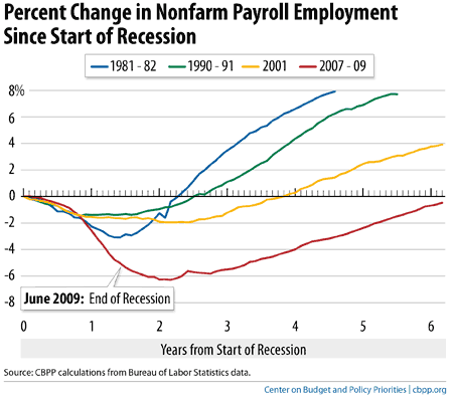
Here are some graphs of how well President Barack Obama’s regulations and economic policies have been working since he exploded our national debt with his “Stimulus” package in 2009. The graphs come from Southern Methodist University Cox School of Business’ Maguire Energy Institute.

First, the sad classic graph of how the Obama Recovery compares with past recession recoveries. It speaks for itself.RecoveryComparison_Cox

This graph shows the total number of Americans still unemployed—the flip side of the number of Americans who actually have jobs.TotalUnemployed_Cox

Like the classic above, things are improving—hence “recovery”—but unemployment still is at historic highs when we consider the number of Americans that make up the unemployed 6.3%. This is because our population is growing faster than the number of jobs available.

This graph shows that the length of time Americans are unemployed isn’t improving very much at all. See the bit about jobs not being created fast enough, above, for a major contributor to this failure. This is a problem that tends to be self-perpetuating, too. The longer folks are out of a job, the more of their skills they lose; if they were in a high-skill, and/or information intensive job (engineering comes to mind), the more obsolete they become, too, as they aren’t as able to keep up with the new data in their field as are those still employed—or even the newly graduated.UnemploymentDuration_Cox

And one more:ProductivityGrowth_Cox

Productivity growth, output per hour by an employee, or what he produces in his hour of working, isn’t very much at all. Most of the jobs that are being created in this pseudo-recovery are service jobs. There are only so many tables a waitress can handle in an hour, only so many disgruntled customers a Customer Service Representative can handle in an hour, only so many investors a brokerage’s Investment Advisor can handle in an hour.

This…recovery…is, to use the Institute’s term, anemic. But we knew that from last week’s GDP growth number. And all of you still looking for work, or who’ve given up on that, have known this for some time.

Status of Obamacare Six Months In

The preliminary results are not promising. And unsurprising.

Among those health-law marketplace enrollees who have seen a doctor or other health-care provider in the first quarter of this year, around 27% have significant health issues such as diabetes, psychiatric conditions, asthma, heart problems or cancer, the data show. That is sharply higher than the rate of 16% for last year’s individual-consumer market over the same time frame, according to the data[.]

It is also more than double the rate among people who held on to their existing individual policies; among those enrollees, the rate was 12%.

This was well understood and predicted from the jump by those (not only on the right) who viewed the matter objectively rather than through the lens of must-pass because it’s the Progressive thing to do.

Look for sharply higher premiums this summer and fall.