
A Tax Code Proposal

Below is the handout given to the NLMSM at Wednesday’s White House daily press briefing, this time hosted by Chief Economic Advisor Gary Cohn and Treasury Secretary Steve Mnuchin for the purpose of discussing President Donald Trump’s tax reform proposal, which was released today via that handout and press briefing.
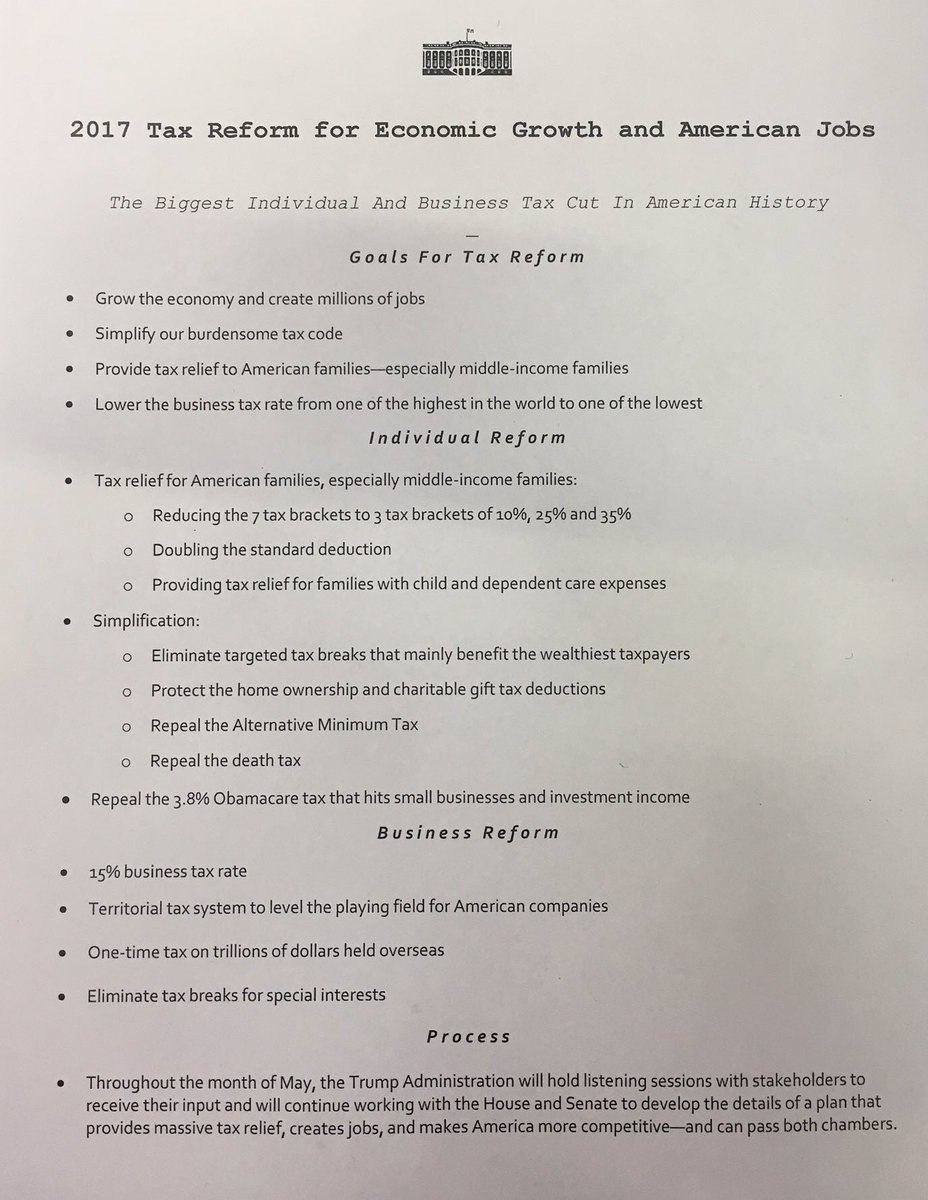
Also included, as mentioned during the briefing though not on the handout, is a proposed reduction of the peak capital gains tax to 20%, which Cohn and Mnuchin said will stimulate investment—and, I add, stimulate both productivity and new job creation via that increased investment.

About that doubled standard deduction: it increases from $6,300 to $12,600 for single filers and from $12,700 to approximately $24,000 for joint filers.  That’s a jump of $6,300 and (approximately) $11,300, respectively.  For folks with incomes of $50,000, $80,000, and $500,000, these represent reductions in taxable income of 12.6%/22.6% (single filers/joint filers), 7.9%/14.1%, and 1.3%/2.3%, respectively.  This doesn’t particularly favor the rich.

Then Mnuchin had this to say:

This is about massive reductions in business rates for corporations and for small businesses, and many studies show that 70% of the tax burden falls on American workers.  So, by cutting business taxes, this will increase wages for American workers and create more jobs.

It’ll do more than that.  Business taxes are cost centers for those businesses, which costs are passed, in large part, to their customers, just as all other costs are passed, in large part, to their customers.  This tax reduction, if enacted, will greatly shrink that tax cost center, and so it will tend to lower prices for buyers of the business’ goods and services.

As predicted, this is a major tax reform.  Congress needs to get behind it.  The Trump administration is making a large bet on this (although they and the Republican Congress also are working on the flip side,  reducing spending (not just slowing its rate of growth)) in that, in response to a question during the briefing, Cohn and Mnuchen said that this reform would stimulate sufficient economic growth that the Federal revenue reduction nominally resulting from these tax rate reductions would generally not occur in the realization.

Of course, the Progressive-Democrats in Congress immediately started protesting.

Senator Chuck Schumer of New York, the chamber’s Democratic leader, said the proposal to cut tax rates for pass-through businesses would just benefit high-income people like the president himself.

Never mind that the bulk of American pass-through businesses are mom-and-pop businesses and small- to medium-sized businesses, not the large, wealthy ones.  Never mind that these mom-and-pop and small- to medium-sized businesses produce the bulk of the economic activity in the US.  This is the same objection Congressional Progressive-Democrats have to eliminating the death tax: even though the death tax forces children to sell their parents’ small businesses or farms in order to pay the inheritance tax, that tax is necessary because some rich folks might benefit from its elimination.

And there’s this:

Among the biggest changes is the repeal of the state and local tax deduction; the effect of that would be to shift the tax burden from low-tax states such as Texas and Florida to high-tax states such as New York and New Jersey.

And California, and Illinois.  Democrat-controlled states, every one.  Congressional Progressive-Democrats will squall about this, too.

And this:

Senate Finance Committee Ranking Member Ron Wyden (D, OR) issued a statement calling it an “unprincipled tax plan that will result in cuts for the one percent, conflicts for the President, crippling debt for America, and crumbs for the working people.”

What the Progressive-Democrats in Congress have yet to offer is any reason why our middle class and poor should be denied this tax code improvement with its attendant increased opportunity to become wealthy themselves just because it might also benefit the wealthy.

What the Progressive-Democrats in Congress have yet to explain is why they insist on singling out particular groups of Americans for punishment via our tax code just because they’ve been more successful than the rest of us.

And, of course, there was ABC News Chief White House Correspondent Jonathan Karl and his permanent question, apparently because he can only hold one concept in his head: “Will the President release his tax returns?”  Never mind that President Donald Trump, and several of his spokesmen have answered this question quite clearly for the last year—both during the campaign and since Trump’s swearing in.

Filibusters

Since the Progressive-Democrats in the Senate are dead set on shutting down the Federal government (I won’t argue the utility of the government being shut down or by how much it actually would be) for the sake of their own petty political egos, it’s time to get rid of the filibuster on all matters relating to the budget, spending, and revenues.

It’s time to put an end to the obstructionism of these Precious Ones.

Full stop.

French Election

With the preliminary selection of Emmanuel Macron and Marine Le Pen as the France’s Presidential candidates for the money round, the election of 7 May, it would appear that the popular revolt against establishment politicians, if not practices, is continuing apace.

Neither of France’s mainstream, established parties—the Socialist Party, the party of outgoing (because with his popularity in the ditch, he chose not to stand for reelection) François Hollande, and Les Républicains (whose last elected President of France was Nicolas Sarkozy)—were able to pass a candidate into that second round, a first in the 5th Republic’s history.  (This is not a pure result, though; the Républicains may have lost because voters rejected its candidate due to his personal scandals as much, or more, than they rejected the party’s establishment policies.)

Le Pen is the head of the National Front, a far right party that originally espoused virulently anti-Judaism (and may still; Le Pen’s public words are often at odds with the party’s founder, her father, but not always), is virulently anti-Islam and anti-immigration, and she wants to take France out of the eurozone and reestablish the franc.  She’s also committed to holding a plebiscite on membership in the European Union.

Macron may be a centrist, but both it’s too early to tell—his party, En Marche! (On the March!), was newly created to support his candidacy.  Macron resigned from the Socialist Party and from Hollande’s administration, where among other posts he was Minister of Economy, Industry, and Digital Affairs, in order to run for the Presidency in his own right.  He’s a staunch supporter of the EU and of the euro, and so he might look centrist, and he might look establishment.

However, Macron also wants to revise France’s labor laws to give more flexibility to business’ ability hire and fire (at the expense of the unions), to lengthen the work week, to raise the retirement age, and reduce both government employment and taxes among other non- if not anti-establishment positions.

In fine, French voters have said Non! to the establishment of any stripe, and now will choose between two candidates who are outside the mainstream, much less the establishment.

My prediction: Macron will be elected in a solid, if not landslide, final round.  Le Pen and her National Front are too extremist and functionally too isolationist—not just from the international stage, but from anything not pure French—to suit most of France to get more than the roughly 22% of her first-round vote.  Her ceiling, the National Front’s ceiling, seems to be in the range of 25%, but the electorate’s disgruntlement along with the terrorist attack just before this first round might give her a boost.

François Fillon, of Les Républicains and Sarkozy’s Prime Minister, got around 20% of this first round vote, and he has urged his supporters to vote for Macron, if only to block Le Pen; Benoît Hamon, the Socialist Party candidate, recommended the same for his voters, some 6% of the first round vote.  If Républicain and Socialist voters do that, it would seem to give Macron 50% of the votes right there.

Thus, France will stay in the EU and stick with the euro.  There may or may not be hard fighting in the French Parliament over Macron’s economic reform policies, depending both on how well those politicians—primarily denizens of the establishment—have read their constituents’ disgruntlement with the way things are and on how sincere Macron is with his policy claims.

One last bit: with Le Pen wanting France out of the euro and the EU and Macron wanting France in both, the final round election will closely approximate Le Pen’s promised plebiscite, too.

The Congressman Misunderstands

What he misunderstands, though is a very expensive thing to misunderstand: basic economics.  Congressman Joe Crowley (D, NY), Vice Chairman of the House Democratic Caucus and member of the House Ways and Means Committee said in an interview with PJMedia‘s Nicholas Ballasy that he’s willing to “experiment” with a VAT in the US, “what effect that will have.”  And

PJM: … A traditional VAT tax that works in other countries or that other countries have, at least, do you think that could work in the United States?
CROWLEY: Well, it’s been something that we haven’t necessarily gone to in terms of—sales tax, for instance, is typically a states’ issue, you know, states have used that nominally in terms of tax purposes in terms of the impact. A VAT would be usurping that, taking for the federal government as opposed to state, and I think we’re open to talking about that and seeing what effect that will have because I do think that bringing our overall [corporate tax] rate down does make us more competitive, a more attractive place.  …   So I don’t think we have to go to 12% or to 20% per se; getting that right down is what we’re attempting to do and doing it in a way which is the least invasive or hurtful to the average working man in this country.

First, there’s a hint there: that “States’ issue” bit.  Other countries that use a VAT (which taxes an item sold at every stage of its production—at every stage at which value—as defined by the taxing government—is added to the product in production—so that by the time the end user buys the item is paying mostly tax value and not product value) are not federal republics like the US is, where the States in the federation are on an equal plain, at least nominally, with the central government in most national domestic areas, like taxing.

Second, it does no good to an economy to lower tax rates in just one area while other tax rates are increased in other areas (vis., the imposition of a VAT) to make up for it.  Total, overall taxes must be lowered, all tax rates must be reduced.  It’s the increased retention of money in the hands of citizens who work and who own businesses—shareholders—that spur economies, not the transfer of that revenue to government for spending.

Third, it’s not at all least evasive or unhurtful to force the average working man to pay a VAT-inflated price for everything he wants to buy or must buy.

Then this tidbit:

PJM: We’ll see. It’s going to be a quite a debate.
CROWLEY: It will be. There is a reason why neither healthcare nor tax reform was suggested by Democrats after the election as things we could work on right away—it was infrastructure. We did that for a reason—for some reason, that seems to have been lost on everyone.

Yewbetcha.  The Progressive-Democratic Party standard plan: get spending locked in first, then see about taxing to pay for it.

Warnings

The just concluded Kansas special election, held to fill the seat left by Mike Pompeo’s departure to become the CIA MFWIC, was much closer than it should have been, with the Republican Ron Estes winning by a narrower margin than originally expected.  Yet the Republican won, and the Democrat James Thompson lost despite the national effort (albeit a lackluster one) by the national Progressive-Democratic Party to get Thompson elected.

The just concluded Georgia special election first round (the nominal winner had to get 50% plus one vote of the total count to win outright, otherwise the top two go to a runoff) had the Democrat Jon Ossoff getting 48% of the vote and the Republican Karen Handel getting a skosh under 20%.  Yet the Democrat failed to win outright, despite a now far more enthusiastic national Progressive-Democratic Party push and more than $8 million of Progressive-Democratic monies, most from out-of-state, pouring in to this district-level by-election, and the Republican, who also competed against 10 other Republican first-round candidates (as did Ossoff also run against 4 other Democrats and 2 Independents), finished a solid, if diluted, second and remains the favorite to win the one-on-one final round.

These results should stand as warnings for both parties.

In addition to getting their party back together (or recognizing that the nation now has three prominent political parties, the Progressive-Democratic Party, the Republican Party, and the Freedom Caucus of No), Republicans have to guard against complacency.  The Progressive-Democrats, on the other hand, must guard against giving up; instead they must develop policies of actual value to Americans instead of the We Know What’s Good For You plots they’ve been pushing.