Disrespect

The House of Representatives held a moment of silence Monday out of respect for and sympathy with the victims and surviving family members of the Texas church shooting.

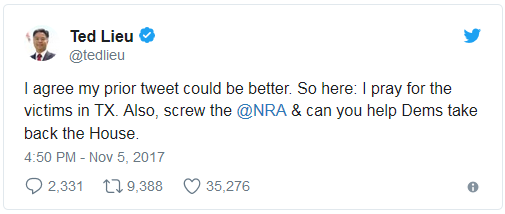
Congressman Ted Lieu (D, CA) walked out on that moment, and he’s proud of his disrespect, posting a video of his excuse on the Internet.  That excuse centered on his crocodile tears over not being able to get knee jerk gun controls enacted.

Then he added empty rhetoric:

Because his feelings are more important than a respectful moment of silence.  And he’s paraphrasing Rahm Emanuel’s remark about crises: Lieu isn’t letting a tragedy go to political waste.

Tax Reform and SALT

There are, unfortunately, some Republican Congressmen who don’t get it.  One such is Congresswoman Claudia Tenney (R, NY).

I worry about the way this bill erodes the deduction for state and local taxes, which has been in place since 1913.  …  This would compound the already excruciating financial burden that my state’s lawmakers have placed on New Yorkers.

How long the deduction has been in place is only an indication of the age of the error, nothing else.

More importantly, the decision of New York’s politicians to have such a usurious State tax code in no way obligates the rest of us to support the foolishness of SALT. If New York politicians—including Tenney—and those of other high-tax States truly are worried about the fiscal welfare of their citizens, they’d work to reform their State’s tax code and reduce their State’s tax rates and thereby allow their State’s citizens to keep more of their money.

At the Federal level, politicians like Tenney would work to reduce—even eliminate—Federal transfers of the hard-earned funds of one State’s citizens to another State absent a regional or national emergency. New York, for instance, sends more of its citizens’ money to other States than it receives from other States’ citizens; such a reform would seem highly attractive to the State’s politicians.

Federal Tax Reform and SALT

Included in the Federal tax reform plan now on offer is the elimination of the deduction for State And Local Taxes (primarily income and sales taxes; property taxes would remain deductible up to a cap).  Republican Congressmen from high-SALT States object to that elimination, and they base their objection on the premise that these high-tax States actually send more of their States’ citizens’ money to DC than they get back from DC in other funds.

That seems a fair beef to the extent that it’s accurate, which raises a question in my pea brain.

What are these Congressmen proposing in the way of tax reform and spending reform to reduce the amount of their constituents’ money—and the money of all States’ citizens—that gets sent to DC?  Surely, they can think of ways to reduce such regional redistributions (they are Republicans, after all), or even eliminate them absent a national or regional emergency.

These Congressmen’s silence on that bit strongly suggests that their objections are not principled, but simply personal power and ego stroking.

The Democratic National Committee

On a different matter, this time, from information in Donna Brazile’s piece in Politico.  Brazile’s article is centered on the control Hillary Clinton and her 2016 campaign organization exercised over the DNC and how they got that control, and the article is worth reading in that light.

But there’s another matter that Brazile only mentions in support of her description of Clinton’s seizure but that wants a bit more emphasis.  First, the allegation:

Debbie [Wasserman Schultz] was not a good manager. She hadn’t been very interested in controlling the party—she let Clinton’s headquarters in Brooklyn do as it desired so she didn’t have to inform the party officers how bad the situation was.

Then an event, typical of the DNC’s financial machinations and illustrative of DNC leadership:

On the phone Gary [Gensler, Chief Financial Officer of Hillary’s campaign] told me the DNC had needed a $2 million loan, which the campaign had arranged.

“No! That can’t be true!” I [Brazile] said. “The party cannot take out a loan without the unanimous agreement of all of the officers.”

“Gary, how did they do this without me knowing?” I asked.

And

She [Wasserman Schultz] seemed to make decisions on her own and let us know at the last minute what she had decided….

And

I kept asking the party lawyers and the DNC staff to show me the agreements that the party had made for sharing the money they raised, but there was a lot of shuffling of feet and looking the other way.

The outcome:

…in exchange for raising money and investing in the DNC, Hillary would control the party’s finances, strategy, and all the money raised. Her campaign had the right of refusal of who would be the party communications director, and it would make final decisions on all the other staff. The DNC also was required to consult with the campaign about all other staffing, budgeting, data, analytics, and mailings.

This arrangement was agreed a year before Clinton had “won” the Progressive-Democratic Party nomination.  In other words, the DNC remade itself into a satrap of the Clinton machine, and done so well in advance of serious campaigning.

The Party chair not being overly involved?  The management team quietly letting the chair make decisions in a vacuum, including those that required team input?  Her replacement being stonewalled by the Party’s—her—management team?  It boggles the credulity to think these grown, highly experienced and talented men and women atop the Party didn’t understand what they were doing, or were in any way forced into doing it.  No, they all knew what they were doing.  All along, the Party’s leadership was in the tank for Clinton and did not want an honest, balanced primary contest.

It’s rich, too, that all of this is decried by the woman who herself was so far into the tank for Clinton that she fed Clinton debate questions before primary debates.

This is the level of integrity we can expect out of the Progressive-Democratic Party and so of any of its nominees unless and until there is a complete turnover of all of the Party’s leadership on down into the middle management ranks.  Every single one of them.

Centralizing Power

China’s Communist Party granted President Xi Jinping authority on a par with Chairman Mao, revising its constitution to inscribe a political theory bearing Mr Xi’s name and endorse policies to make the nation a world power.

A weeklong party congress that ended Tuesday appeared to give Mr Xi unassailable power as he begins a second five-year term.

The move was unanimous, with not a single Party member out of 2,336 willing to vote no—an indication of Xi’s already present overweening power.

Adding to the significance of this power grab, only two other People’s Republic of China leaders have had their “thoughts” added to the nation’s constitution: Mao Zedong and Deng Xiaoping, and both of these were dead before the CPC codified their “thoughts.”  Xi is alive and well and in a position to build on this move.

It seems as though the running dog is, indeed, the permanent leader of the pack.

A couple of questions come up in my pea brain: Will he get his own statute, too?  Does anyone in the Communist Party of China have the stones to ask Xi about his caldrons?