
Tactically Sound?

Perhaps, but perhaps strategically disastrous.  British Prime Minister Boris Johnson asked the queen to prorogue the current parliament, and the queen agreed, in order to block it from blocking him from taking Great Britain out of the European Union on schedule 31 October without a deal in the likely event that the EU continues its intransigence in negotiating.  Prorogation is the formal end of an existing session of Parliament, and normally it’s done just prior to the beginning of the next session, to clear the decks for that session.

The current prorogation would run until 14 October, at which point the Queen’s Speech, which would reconvene Parliament, would lay out her (the PM’s) agenda for the new session. Existing bills, including those currently planned to interfere with Brexit, cease to exist with the prorogation; although, they could be reintroduced—to take their turn in the queue in those two remaining weeks.

There are a couple of reasons why Johnson’s move might be tactically sound.  Parliamentary sessions normally last for one year; however, the current Parliament has sat [sic] since June 2017, more than two years.  It’s time for this feckless band to get out of the way, go home, and contemplate their navels.

That brings up the second reason: prorogation would prevent this Parliament from blocking Johnson’s effort to bring the nation out of the EU with no further delay and associated economic uncertainty—and that uncertainty’s follow-on deleterious effects on the British weal.

The longer question that arises is whether prorogation is a strategically sound move.  It’s very likely that prorogation will result in an on-time departure from the EU, with or without a deal governing the terms of the exit.  However, it’s entirely possible that the associated hue and cry will lead to new elections (possibly triggered by a successful no-confidence vote in November) and a new, non-Tory government installed.

That government is very likely to go, hat twisting in hand, to Brussels and beg for reentry into the EU.  What then?

What would be the result on British sovereignty; British economic and political welfare; indeed, British self-respect in such an eventuality?

Even if that new government doesn’t go begging (or even if it does), what else could happen? The alternative to a Johnson-led Tory, sort-of conservative, government is a Corbyn-led Labour government.  That means the prosperity of a limited (relatively, within the constraints of present British concepts) government that Margaret Thatcher made so much progress toward and that Johnson would seek to preserve and extend would be entirely undone by the destructively socialist government that Corbyn would install.

What then of British economic and political welfare; of British self-respect?

Still, Johnson’s move is worth the risk, for the sake of British sovereignty.
Humans or Votes?

You’d think these terms wouldn’t be alternatives to each other, rather, one would describe a single attribute of the other having reached a requisite age and citizenship.

But no.

Jason Riley described, in his Tuesday The Wall Street Journal op-ed, how the New York City Mayor Bill de Blasio administration has chosen to work hard to eliminate all standards for entry into what used to be the city’s elite schools, schools that especially benefitted the city’s poorest students, most of whom happen to be minority children.

Riley closed his piece with this plaintive question:

You’d think that the main objective of the inequality-obsessed would be to help more minorities meet high academic standards, but Mr de Blasio and his fellow progressives would rather eliminate the standards altogether. I’d call that giving up on minority kids. What would you call it?

I call it what it is. Those kids aren’t human beings in the eyes of the Progressive-Democrats, they’re only a crop of newly-sown votes to be kept and nurtured in the welfare cage hot house until they’ve ripened and become ready for harvesting.

That’s Not Your Money

Echoing Progressive-Democratic Party Presidential candidate and New York Mayor Bill de Blasio’s claim that there’s plenty of money, it’s just in the wrong hands, more Progressive-Democrat Presidential candidates are moving toward taxing the mere existence of that money.

For the richest Americans, Democrats want to shift toward taxing their wealth….

After all,

At the end of 2017, US households had $3.8 trillion in unrealized gains in stocks and investment funds, plus more in real estate, private businesses, and artwork[.]

Gimme that money, say the Progressive-Democrats. You didn’t earn that. And besides, whether you did or not is irrelevant. We have better uses because just shut up.

Senator Ron Wyden (D, OR) has given the game away.

The whole tax system is stacked in favor of the tax-avoidance crowd[.]

Because it’s government’s money, not private money.  Never mind that were tax rates not so usuriously high, no one would have to work hard to pay the minimum the law requires (honest efforts that guys like Wyden, in wide-eyed innocence, call “tax avoidance”).

Aside: the article opens with this:

The income tax is the Swiss Army Knife of the US tax system, an all-purpose policy tool for raising revenue, rewarding and punishing activities, and redistributing money between rich and poor.

Which is what I’ve been saying, along with many others, all along. Our tax code is for social engineering not so much for raising revenue for Constitutional purposes.  And that’s a fatal flaw.

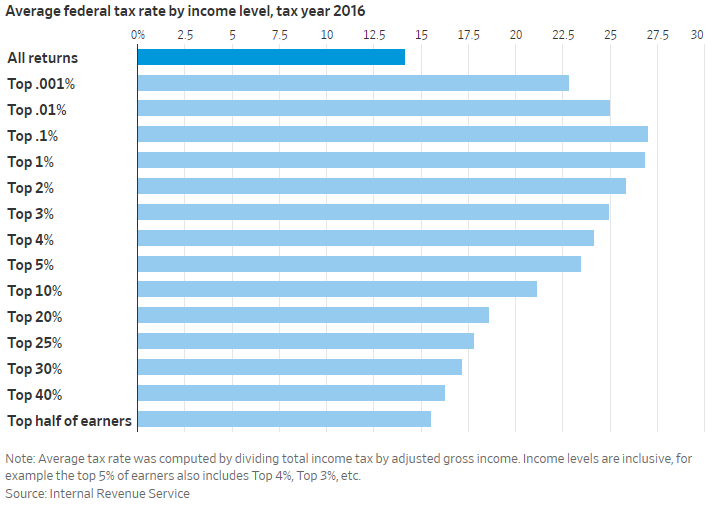
Second aside: Progressive-Democrats ignore how much more taxes the Evil Rich pay than the rest of us, as illustrated by this graph from the same article. It’s never going to be enough because you’re still talking—shut up, I said.

Identity Politics

In an op-ed in The Wall Street Journal ironically headlined We Liberals Need Self-Criticism, Ioannis Gatsiounis, a writer who reports on race and politics, called for an end to Progressive-Democrats’ (whom he thinks are “liberal”) practice of identity:

[S]top obsessing over identity.

But in the very next sentence, he went right back to identity politics:

We can and should support policies that benefit disadvantaged groups, from criminal-justice reform to a higher minimum wage and affordable health care.

Pick one: either liberals Progressive-Democrats should stop obsessing over identity—stop singling out some groups of Americans for special treatment—or they should continue singling out some groups of Americans for special treatment—continue their identity politics.

Unfortunately, the 21st century segregation of identity politics is at the core of the Progressive-Democratic Party’s ideology.

Debates and Getting Things Done

Some Progressive-Democratic Party Presidential candidates aren’t making the cut for Party’s September debate gala in Houston. So far, only 10, or so, have met debate criteria for get there, out of a field of some 20 candidates. The ones missing out are upset with the long-announced rules, and other now ex- candidates are dropping out of the race altogether.

If they’re serious about their complaints and not just whining like spoiled toddlers, those candidates who don’t make the “official” September debate would get together and hold their own debate at the same time and across the street from the DNC’s debate.

While they’re there, they could address an item Montana Governor Steve Bullock (D) raised:

As we’re losing governors from this race, maybe we ought to think about also, like, are these DNC rules for the debates disadvantaging folks that actually have to get things done?

Bullock and his confreres could debate why those governors are unable to “get done” their appearance on the big boys’ stage. Organizing their own debate would go a short way toward redeeming Bullock’s claim.