Here is a sort-of side-by-side comparison of Senator Rick Santorum’s economic plan with Governor Mitt Romney’s plan—only sort-of because they address different things in addition to their areas of overlap.
Senator Santorum opened the discussion of his plan with this:
…Obamanomics has left one in six Americans in poverty, and one in four children on food stamps. Millions seek jobs and others have given up.
while Governor Romney had similar words to introduce his plan:
We have record-breaking unemployment and deficit spending, and a tax code that looks like it was devised by our worst enemy to tie us in knots. These three afflictions are interconnected. I have a plan to address them and achieve three goals: more jobs, less debt, and smaller government.
|
Economic Area
|
Santorum’s Plan
|
Comments
|
Romney’s Plan
|
Comments
|
|
Individual Taxes
|
only two income tax rates of 10% and 28%. triple the personal deduction for children, eliminate the marriage tax penalty. |
Strong step in the right direction in simplifying through reducing the number of tax brackets while reducing tax rates.But why keep the distorting subsidy? |
20% reduction in marginal individual income tax rates |
A step in the right direction, but it maintains the multiplicity of tax brackets |
|
|
|
|
reduces tax rates for businesses that pay at individual rates and employ the majority of private-sector American workers |
Through the above 20% reduction |
|
|
|
|
abolish the death tax. repeal the Alternative Minimum Tax |
Unequivocally good moves |
|
|
|
|
place some curbs on personal tax deductions, exemptions and credits |
Such as…? |
|
Corporate Taxes
|
corporate tax rate halved to a flat rate of 17.5%. expense all business equipment and investment. Taxes on corporate earnings repatriated from overseas eliminated |
Again a sound move. But see my summary below about manufacturing taxes. |
reduce the corporate tax rate to 25% from 35%, transition from a world-wide taxation system to a territorial one |
A good step in the right direction.Especially, the territorial tax system can be very beneficial, depending on its details. |
|
|
|
|
make the R&D tax credit permanent |
Lower the tax rate further, and this distortion isn’t necessary. Nor will it be necessary y to weasel-word what constitutes R&D. |
|
|
|
|
maintain the 15% rate on capital gains, interest and qualified dividends, and eliminate the tax entirely for those with annual income below $200,000. |
Mostly maintains the status quo, but the differential treatment of groups of Americans just continues Obama’s class warfare.Also, see above concerning distortions and tax rates. |
|
|
|
|
broaden the corporate tax base. |
In what way, exactly? |
|
Federal Spending
|
spending cuts of $5 trillion over five years, including cuts for the remainder of fiscal year 2013 |
A sound start, but reduced spending in what areas? |
|
|
|
|
cut means-tested entitlement programs by 10% across the board, freeze them for four years, and block grant them to states |
A good start, but why not reduce the size of the grants each year until they’re eliminated? These are supposed to be State programs: get the Federal government out of them altogether. |
|
|
|
Federal Budget
|
propose budgets that spend less money each year than prior years |
Reduced spending in what areas? |
|
|
|
|
submit to Congress a budget that will balance within four years; call on Congress to pass a balanced-budget Constitutional amendment which limits federal spending to 18% of GDP. |
Reduced spending in what areas?An Amendment can be good or bad depending on how it’s written.Finally, calling for a thing is easy to do…. |
|
|
Unstated in his present plan is his prior insistence on continuing to use our tax code to perpetuate the myth of the usefulness of government-centric economic engineering: he singles out manufacturing for especially low tax rates—no manufacturing corporate tax at all.
In addition, Santorum had this to say about jobs: he’d approve the Keystone XL pipeline, and he’d repeal all “Obama administration regulations that have an economic burden over $100 million.” I don’t understand, though, why he exempts similar regulations from earlier administrations. He also insists that Federal agencies must use “sound science and cost benefit analysis;” although here, too, he’s short on specifics, like what analyses fit this bill, or what constitutes “sound” science and cost benefit analysis.
Santorum also says he’ll work to replace Obamacare with “competitive insurance choices,” but without saying what constitutes “competitive” in his view—and he claims to be able to achieve this while maintaining a mandate that somebody must “protect those with uninsurable health conditions.”
Finally, he promises to present to Congress five free trade agreements his first year—but with whom?
Romney, on the other hand, expects his lower taxes to stimulate job growth. He’s not far wrong here, but more specifics about jobs would have been nice in addition to those tax system generalities.
Both plans are vague on spending cuts, and both continue market distorting subsidies/tax credits of one sort or another—never minding that these simply continue government-generated distortions in our economy, driving up the prices of things that are subsidized and forcing all of us to pay for those price increases, whether we buy the subsidized item or not. The two plans also emphasize different sides of the revenue coin: Romney focuses on the tax system while Santorum dwells more on spending and budgeting.
In the end, both plans, shortfalls and all, are enormous improvements over the Progressives’ plan of increased spending, higher taxes, exploding debt, and starker class warfare.

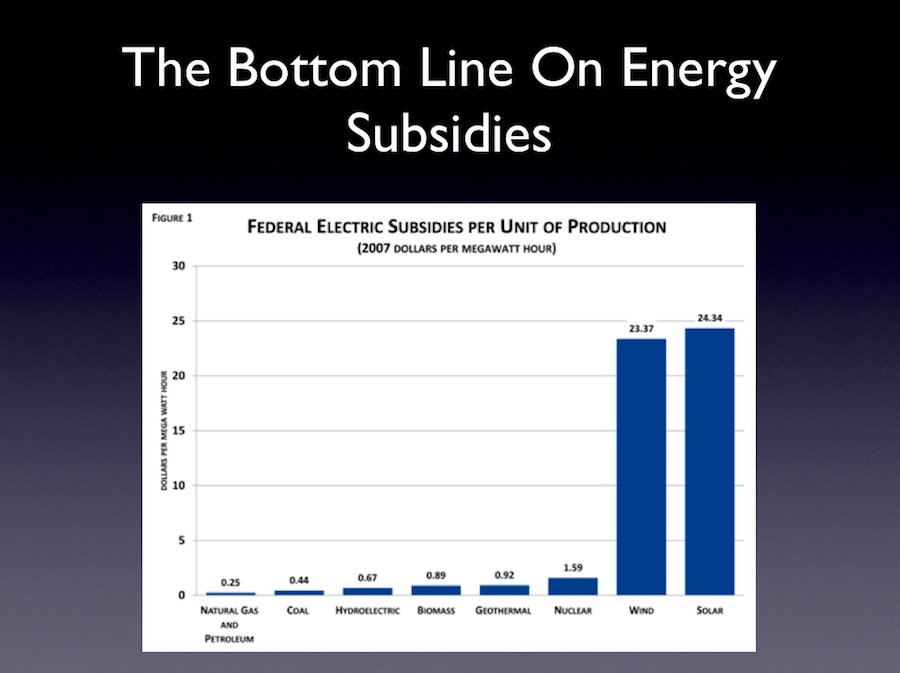 In case you’re having trouble reading it, the salient parts are these: the figure shows Federal electric subsidies in dollars per MW-hr produced (2007 dollars). The values on the left are for Natural Gas and Petroleum and for Coal at $0.25 and $0.44, respectively. The values on the right are for Wind and for Solar at $23.37 and $24.34, respectively. Those evil oil, natural gas, and coal companies get less than 2% of the subsidy Precious wind and solar companies get.
 The blue line indicates oil production on Federal land, and the Red line indicates production on private and State land. The key interval is from 2007 on, when the Progressives had control of the Congress, followed shortly by Progressive control of the Executive Branch. Notice that while production from private and State land was rising, production from Federal land was being driven down. This, coupled with Obama’s slow-walking of Gulf deep water drilling permits; his refusal to allow new drilling, much less production beyond existing wells, into/from known oil deposits on Federal land; his EPA’s CO2 regulation over even a Progressive Congress’ objection; his killing of the Keystone XL pipeline; and so on, represent a far more powerful, and far more insidious, subsidy of his Precious “green” energy producers: active suppression of competition from production of cheap hydrocarbon-based energy from nearby sources.