That’s the headline on a recent Financial Times piece (sorry, the FT has a paywall) by Martin Wolf. It’s a silly headline, for a silly article.
How should we assess the economic success or failure of Barack Obama’s presidency?
This is a difficult question to answer.
No, the question is easy to answer. Obama’s economic policies have been abject failures. It’s also straightforward to lay the bulk of responsibility on Obama and his administration. While it’s true that the Panic of 2008 began in the prior administration, it was Obama’s “stimulus” package that both blew up the nation’s debt and failed in its purpose of stimulating our economy with shovel ready jobs in a massive so-called Keynesian stimulus and its bailout of failing large banks. It was his Federal Reserve’s policies (yes, yes, the central bank is supposed to be independent, but it was Obama’s Ben Bernanke, extended at Obama’s decision, and his Janet Yellen appointment) that degraded money discipline with their decisions to ease the money supply and hold interest rates artificially low. It was his excessive—explosively so—regulation that limited business’ ability to function in the market, that limited small business’ ability to get started, that limited job growth and employment recovery.
It was the Obama administration’s Dodd-Frank, with its too big to fail policy that distorted those big business’ risk-taking decisions, decisions that used to be made in a free market but that under Dodd-Frank are made with the perception—courtesy of that “stimulus” bailout—that if the business messed up, Government would bail them out.
[S]hockingly, most congressional Republicans opposed all significant monetary, financial and fiscal actions taken to deal with the crisis.
This isn’t shocking at all; what’s shocking is the blind, knee-jerk rejection of free market principles by a Democratic Party (soon to become a Progressive-Democratic Party) suddenly in complete control of our government and cut loose from any restrictions on their power. Absent the “stimulus,” the Panic might have been steeper, but it also would have been much shorter. One only has to compare the Depression of 1920-21 with the Great Depression to see the efficacy of government non-response compared with Government intervention, and the Panic of 1907 with both to see another example of the efficacy of private response compared with Government intervention. Of course, the Democrats knew—and know—this history, yet they acted as they did, anyway.
He tried to move the US closer to the universal health insurance taken for granted in other high-income countries. The Affordable Care Act (“Obamacare”) has added an estimated 20m adults and 3m children to the insurance rolls.
He didn’t try, he did it by Party fiat and then by Executive diktats—lots and lots of diktats. Further, while Obamacare has provided health welfare to those adults and children, it also has thrown millions more out of their health insurance plans and denied them access to their doctors in direct—and knowing—contravention of Obama’s explicit promises that these denials would not happen. The claim of cost growth reduction is a cynical one, also, being limited as it is to the cost of selected groups of Americans. In fact, the cost has exploded, with premiums rising in double-digit per centages, deductibles going to 10s of thousands of dollars—an annual expense—the departure of heretofore health insurance companies from the health welfare plan “market,” and the cost to taxpayers similarly growing rapidly to pay for the subsidies of those given essentially free access to this health welfare.
Wolf’s discussion of our “jobs” recovery is misleading, also. Labor force participation rate is at historic lows, held back by those policies’ suppression of job creation. Even the male labor force participation rate, which has been in a declining trend since its early ’50s peak, is farther below that long-term trend than it ever has been in that time frame.
Finally, this graph summarizes the efficacy of the Obama administration “recovery” as compared to post-WWII economic dislocation recoveries.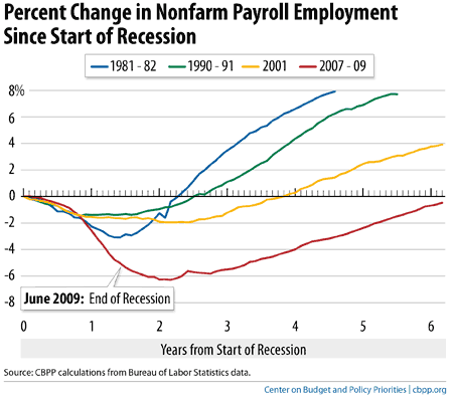
Even at the end of 2016 rate of 4.7% unemployment of 4.7%, the Obama administration’s economic policies have held back the recovery by years.
