
The Supreme Court and the Constitution

Here’s another implication of Chief Justice John Roberts’ ruling on the Patient Protection and Affordable Care Act, courtesy of The Wall Street Journal.

According to Chief Justice Roberts, the penalty is merely a tax on not owning health insurance, no different from “buying gasoline or earning income,” and it thus complies with the Constitution. This a large loophole. The result is that Washington has unlimited power to impose new purchase mandates and the courts will find them constitutional if Congress calls them taxes, or even if it calls them something else and judges call them taxes.

Except that not buying a thing or a service is radically different from buying that thing or service.  This isn’t merely a matter of opposites: opposites are related to each other.  There is no relation between buying or not buying—the thing/service being bought is known; the thing/service not being bought cannot be known, and so the bought/not bought functions can have no relation to each other whatsoever.

Chief Justice Roberts writes that construing the Commerce Clause as the Obama Administration argued “would open a new and potentially vast domain to congressional authority…. The Framers gave Congress the power to regulate commerce, not to compel it, and for over 200 years both our decisions and Congress’s actions have reflected this understanding.” [emphasis in the original]

But then

Supreme Court precedents going back to the 1920s and 1930s define penalties and taxes as mutually exclusive and critically different.

With this stroke, Roberts has cancelled the effect of his understanding on the limit of the Commerce Clause’s ability to compel commerce; he has simply transferred the ability to compel commerce to the Taxing Clause.  Which also had no prior compulsion power.

Whether the Federal government may compel our behavior via Commerce or via Taxing, our government now can compel our behavior.

This is judicial activism at its worst.
The Racism of the Left

MSNBC host and racial activist Reverend Al Sharpton in an interview with The Hill, as cited by Fox News:

I’m not saying that this is because Holder is black, and I’m not calling [Republicans] racists. I’m saying what they’re doing has a racial effect, and that’s what we’re going to talk about.

What the Reverend chooses to ignore is that only a racist would find “racial effects” in an affair that has nothing at all to do with race.

But there’s more: House Minority Leader Nancy Pelosi said last week that Republicans’ demand for a full accounting of the crimes of “Fast and Furious,” and Republicans’ objections to Attorney General Eric Holder’s stonewalling and potentially outright lying during the investigation, is mere obfuscation of their real goal—to  keep minorities from voting and to keep Holder from interfering.

They’re going after Eric Holder because he is supporting measures to overturn these voter-suppression initiatives in the states.

A vast, right wing, racist conspiracy.

Holder himself has been actively interfering with states’ efforts to ensure that their voter rolls are populated only with eligible voters, and not also with the dearly departed, or with Mickey Mouse, or with a white Holder.  Or with illegal aliens.  Because keeping ineligible voters from voting is somehow racist.

At least one Federal judge isn’t buying it, though, and that’s to the good.  US District Judge Robert Hinkle, of the Northern District of Florida, has rejected Holder’s suit against Florida, which suit was an attempt to block that state from protecting the sanctity of an American’s—a Floridian’s—vote by removing ineligible voters, of whatever race or stripe, from the voting rolls.

Ruling that while federal laws (vis., the National Voter Registration Act of 1993) are designed to block states from removing eligible voters close to an election, they are not designed to block states from removing voters who were never eligible in the first place, Judge Hinkle denied Holder’s motion to enjoin Florida from purging ineligible voters from their voter rolls.

Hope and Change

The last 3½ years have seen a lot of this slogan.  While the hope—for the better—waned long ago, President Obama has, in fact, achieved quite a lot in the way of change.  Here are some of those changes:

He got Obamacare rammed through, albeit in the dark of night in a wholly, cynically, partisan manner, and he did it without a single Progressive (or Republican, come to that) congressman actually reading the bill prior to voting on it—some proud in their ignorance.  This bill achieves quite a lot: it lets children extend their childhoods and parental dependencies to their 26th year, by staying on mumsy’s and popsy’s health insurance policies.  It adds to the Federal deficit with its trillion-dollar costs.  It lets you, taxpayers, pay for coverage for an additional 20+ million health insurees.  It nationalizes the health care and health insurance industries.

He got Dodd-Frank rammed through in the same manner and with the same level of Congressional ignorance.  And pride of ignorance.  This bill also achieves quite a lot.  It creates a fourth branch of government in the Consumer Financial Protection Bureau and the Financial Stability Oversight Council.  These two agencies are wholly unaccountable to the Congress—and so to us—are not under control of the President, and at least the CFPB’s budget comes, on demand, from the Federal Reserve System.  Yet these two will, single-handedly and without oversight, determine whether financial institutions will be allowed to do business (vis., extend loans or credit of any sort—even at your corner mom and pop grocery store) and the conditions under which they will be allowed to do so.

He’s achieved a trillion-dollar cut in our defense capacity at a time of rising PRC aggressiveness, a soon-to-be-nuclear-armed Iran, and an expansive, grasping Russia.  This includes a shrinking Navy, a gutted Army, and an Air Force with little capacity for anything other than looking pretty in fly-bys.

In an apparent nod to an earlier Secretary of State, Henry Stimson, he’s leaking every cyber-warfare and counter-terrorism secret we used to have to the news outlets.  Apparently, if we have no secrets, other gentlemen have no need to resist the temptation to read ours.  Or he subscribes to the theory that if we tell our enemies everything we have, we don’t need to spend our resources trying to figure out what they know about us (another savings!).  Or both.

He’s instructed his DoD to desist using unpleasant interrogation techniques.  And, since he believes our enemies have no knowledge of anything that’s of intelligence value at all, he’s instituted a program of killing them rather than capturing them and having to figure out how to hold them and question them.  And he brags about personally selecting, by name, the ones that are to be assassinated—a Roman circus thumbs down from the Emperor.

No, Obama has wrought enormous change.  Just all of it has been destructive of our great nation.

We need to fix this.

The Progressive Endgame

What Progressives don’t understand—won’t accept—is that, as Eric Falkenstein wrote

People get most of their pleasure, and meaning, being useful to others, which includes inspiring the admiration or happiness of others by one’s actions. Every time I make my daughter squeal with delight makes me thankful to be alive, because I know she really loves me, and I work to provide her with things and habits that will make her prosper, and hope that at some point after I’m gone she will remember me with sincere gratitude.

This made especially in the actual community interactions of individuals.  Progressives are only willing to help their fellows by government diktat, not directly with their personal resources.  I’ve written elsewhere about who donates to charity, for instance, but it bears repeating: Conservatives donate 3.5% to 4.5% of their incomes; Liberals just 1.25% to 1.5%.  And further,

A healthy wage is a strong correlate with one’s usefulness to non-family members, especially if you work in field without a lot of regulation.

Adam Smith understood this.  John Locke and our Founders understood this.  The “invisible hand” and the existence of a social compact both are founded on the not-so-enlightened self-interest—the greed—of the individuals participating in the commerce and in the formation of the social compact.  Free commerce, and the republican government over which the compact members are sovereign, are what lead to the greatest material and moral prosperity of the individuals involved.  The first is self-evident.  The second derives from that material prosperity: being useful to others, indeed, satisfying our duty to others (which involves such mundane things as honoring our commitments, here to provide our mutual support to defend and preserve our—and our fellows’—individual and several inalienable Rights, to help those less fortunate than ourselves, and so on) is enormously facilitated by personal prosperity (which, just incidentally, also creates community prosperity): we have more wherewithal with which to satisfy our individual obligations (which are, don’t forget, individual, not collective).

Falkenstein concludes

[Eric Hoffer considered that] intellectuals found free societies a threat because such societies didn’t need mandarins directing them, and if not flattered would help incite the masses to some sort of revolution.  A man is likely to mind his own business when it is worth minding, and so those unhappy with their own meaningless affairs will focus on minding other people’s business.  Hoffer noted one must not merely provide for those without meaning in their lives, but provide against them, because in a democracy and market economy their preferences will have power.  Those who see their lives as inferior and wasted crave equality and fraternity more than they do freedom, and this can cause a Republic to fall to a democracy, and ultimately a tyranny.

Thus,

In other words, Hoffer describes the essence of the Liberal [I say Progressive—ed.] desire to micromanage society into perfect equality at the expense of liberty.  A coalition of intellectuals and the underclass, both of whom feel unappreciated.  We haven’t figured out a good outlet for these do-gooders, or a good way for those without a purpose to find life rewarding, so they continue to plague us with their plans and angst.

Food Stamps and Poverty

John Hinderaker, at Power Line, notes that the Progressives in the Senate have voted down even a modest (some might say trivial) reduction in Federal spending on food stamps—using your tax money.  (Note, by the way, that 100% of the spending on food stamps is by the Feds; no state spends one red cent of state monies on these.)  The offered reductions were in the form of three  amendments, two put forward by Jeff Sessions (R, AL):

  • establish a federal asset test to ensure that food stamps aren’t going to families that may not have an income but have tens of thousands of dollars in savings or may even live in a million-dollar home
  • prevent states from waiving federal eligibility requirements for the program
  • eliminate the bonuses that the federal government now pays to states that deliberately swell the ranks of food stamp recipients.

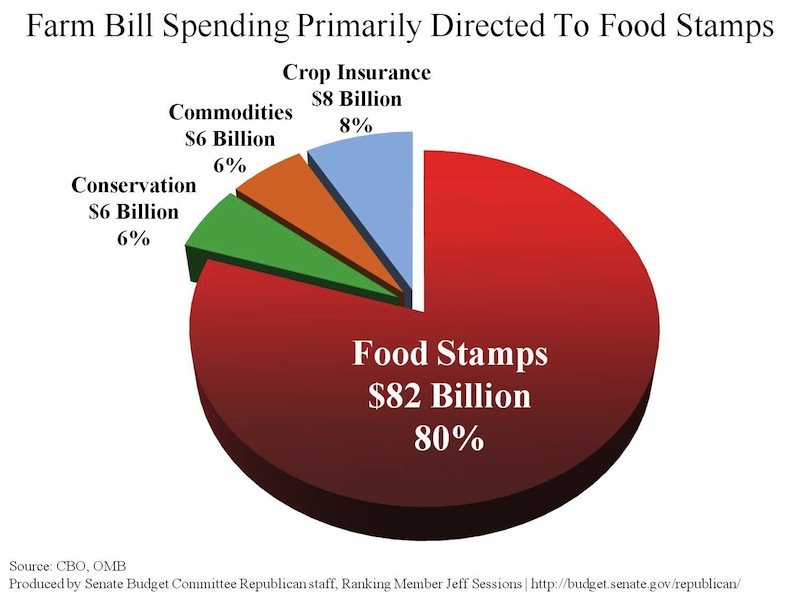
The spending mandated by the Farm Bill to which these amendments were to be attached is shockingly weighted, as this graph shows: There are a couple of other aspects of this Progressive demand to spend your money on their food stamps.  Forty-six million Americans currently live below the poverty line as a result of President Obama’s failed economic and social welfare policies.  Thirty-nine states have no limits at all on the fiscal well-being of a family in determining that family’s eligibility for food stamps—anyone who applies qualifies—and twenty-eight states have limits that are more than 130% above the Federal Poverty Guideline (which differs in a trivial way from the Federal Poverty Threshold that the Census Bureau uses to determine the number of Americans living in poverty).

Of those 39 states (the full list can be seen in Table 1 of the Congressional Research Service’s “The Supplemental Nutrition Assistance Program: Categorical Eligibility“), California, Illinois, and New York alone account for 70.5 million Americans.

Under Federal law, which the Progressives have refused to alter in any meaningful way, vastly more Americans are eligible for food stamps than are actually living in poverty.  Food stamps no longer are a program to help the needy; they’re a program to get and keep Americans dependent on a Progressive-run government for their welfare.  They’re a Progressive Incumbency Welfare program.