Byzantine Visas

In a Wall Street Journal op-ed earlier in the week, Martin Lawler and Margaret Stock wrote about dysfunctional and too low limits on H-1B visas for skilled, educated foreign workers. While on the right track, though, they missed some points.

Some claim there is no shortage of science, technology, engineering or math (STEM) workers, and that US companies hire foreign employees to be “indentured workers” who can be paid low wages. In 2012, David North of the Center for Immigration Studies said, “It is well known that many H-1B workers are, in effect, indentured by employers who had filed to obtain green cards for them—they are nominally free to leave, but it can be hard to keep your resident alien application alive after leaving the employer who set it in motion.”

Lawler and Stock correctly point out the fatuousness of this erroneous claim, but they miss a larger point. Say, arguendo, that North is right. There are two solutions to this, and neither include North’s view of how such foreign workers should be treated. Lawler and Stock addressed the foolishness of the (low) quota for H-1Bs. The other solution is to cut out the nonsense on the green cards: decouple them from visas. Either the green card applicant is suitable, or he is not. His STEM education is only one criterion, and it needn’t be a critical one.

And, in support of the above correction, Lawler and Stock note that

[t]he Labor Department must certify, through a formal process, that H-1B wages are appropriate. Public notices of the jobs, including the wages, must be posted at the work site. The notices must contain specific information about filing a complaint challenging the wage and working conditions. Once the certification is issued, the US Citizenship and Immigration Services conducts a thorough review of the entire case, including details about the employer, employees and positions.

But this misses a larger point, too. Government has no business entering the premises of a private enterprise and dictating to that enterprise who it may hire, at what pay rate, or (within very broad limits) under what conditions.

Full stop.

Labor price should be as competitive as any other good or service price.

Addendum to the Jobs Numbers

…about which I wrote earlier.

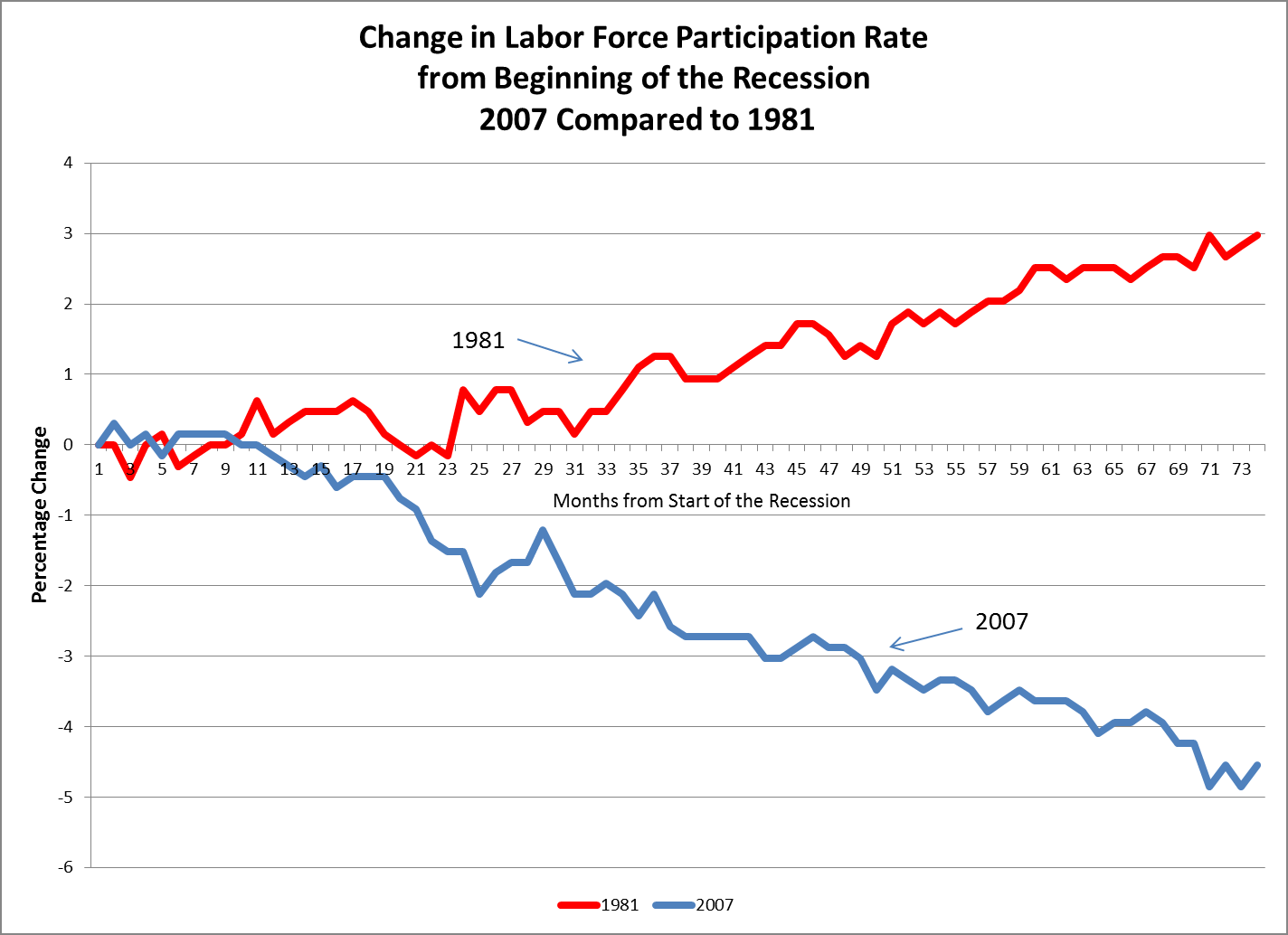
This graph (constructed from the Bureau of Labor Statistics’ Current Population Survey, Table A-1) comes from a report by Senator Jeff Sessions (R, AL), Ranking Member of the Senate Budget Committee.LaborForceParticipationRate_Sessions

Notice that. The labor force participation rate wasn’t affected at all by the Panic of 2008. Quite the contrary, the participation rate’s decline continued unaltered by the Panic—and unaltered by President Barack Obama’s policies. Closely tied to that failure is this: in 2007, just prior to the Panic, 146,273,000 Americans had jobs. As of last February, in the middle of that failed GDP quarter of which I wrote, 145,266,000 Americans had jobs—a decrease of a bit more than 1,000,000 Americans.

And Obama has been on the hustings bragging about that headline unemployment number.

Hmm….

Jobs Numbers

According to the headlines, our unemployment rate fell to 6.3% in April (from 6.7%); it hasn’t been that low since before the Panic of 2008. This also came as the private sector and state and local governments added 288,000 jobs. Good news, eh?

It is good news, for those 288,000 Americans. However. There’s always a however.

806,000 Americans gave up looking for work in this economy and dropped out of the labor force. The labor force participation rate fell to 62.8% (from 63.2% in March), the lowest rate in nearly 40 years. If this number had only held steady at March’s value, the unemployment rate would be in the 6.7%-6.8% range.

These data also come on the heels of our GDP datum for the first quarter of 2014, which ended in March: GDP grew at the sickly rate of 0.1% over the 4th quarter 2013.

The jobs report turns out to indicate a fine beginning for the second quarter of 2014.

Jobs and Income in the Current “Recovery”

AEIdeas‘ James Pethokoukis has some data in his article, “Obama’s low-wage jobs recovery.” He talked about the type of jobs being…created…in this so-called recovery; the graph below highlights his point.NetChangeEmployment

There’s another aspect to this, though, and that’s the income implication of the type of jobs being created. I constructed the table below from the data in the graph above, using the mid-points of each industry type wage range and assuming a 2080 hour work year—that is, everyone, even the low-wage industry worker, either works all 52 weeks of the year or gets paid in full for vacation time, including holidays, to keep the arithmetic simple.

Wage Mid-Point Jobs Lost (Thousands) Jobs Gained (Thousands) Not Jobs Gained (Thousands) Net Annual Wages Gained/Lost (Thousands $)
High Wage: $26.3250 (3,579) 2,603 (976) ($53,441,856)
Medium Wage: $16.8650 (3,240) 2,282 (958) ($33,605,874)
Low Wage: $11.4050 (1,973) 3,824 1,851 $43,910,162
Total: ($43,137,567)

You’re reading that right. The only net gain in income is in the low end industries; these folks, by being able to go back to work, have gotten a net increase of some $44 billion in their annual income. But that’s swamped by the losses in the other two categories, and the nation as a whole has lost some $43 billion in annual income.

This is a fine recovery, yes, indeed.

Income Inequality and Blinders

The impact of Obamacare, still being denied in some circles:

In January, nearly half of small-business owners with at least five employees, or 45% of those polled, said they had had to curb their hiring plans because of the health law, and almost a third—29%—said they had been forced to make staff cuts, according to a U.S. Bancorp survey of 3,173 owners with less than $10 million….

And

Given how much the President talks about income inequality, it is perhaps ironic that his signature achievement is preventing people from earning incomes.

ObamaCare-induced phenomenon of “29ers”—employees held below 30 hours of work per week to avoid counting as full-time workers eligible for employer-provided health insurance. As a Journal editorial explained last year, “The savings from restricting hours worked can be enormous. If a company with 50 employees hires a new worker for $12 an hour for 29 hours a week, there is no health insurance requirement. But suppose that worker moves to 30 hours a week. This triggers the $2,000 federal penalty. So to get 50 more hours of work a year from that employee, the extra cost to the employer rises to about $52 an hour—the $12 salary and the ObamaCare tax of what works out to be $40 an hour.

Hmm….