Jobs Numbers

The headline numbers are in, and they seem favorable enough: unemployment has dropped to 5.9%, and 248,000 new jobs were created in September.

However.

Counting the 142,000 new jobs created in August, new jobs were created at a monthly average of 195,000 jobs per month over the total interval. Using, instead, Labor’s revised August number of 180,000 new jobs (I’d be curious to learn how President Barack Obama’s Labor Department could make such a large estimation error—a 20% error), that still works out to a pretty anemic 214,000 new jobs per month over the period.

The labor force participation rate, at 62.7%, remains at historic lows. If this rate were at 2007’s level of 66.2% (a rough average for the year), the unemployment would be nearly 11%.

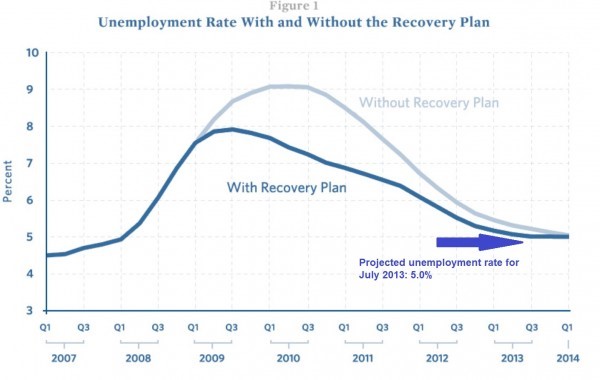
Even taking the 5.9% unemployment rate as legitimate, we’re still years behind schedule—not just behind the rate extant at this point in a normal recovery, but behind Obama’s promised unemployment rate which he used to sell his Stimulus package, as this graph illustrates.ObamaPromisedEmploymentRate

In particular, we’re still not at the 5% Obama promised we’d reach by last year. Oh, and that peak unemployment of 8% worked out to over 10%, which was worse than the No-Stimulus situation which he projected.

Additionally, median income remains down sharply from pre-Panic levels—7.9% sharply.

Additionally, new jobs created since the Panic officially ended in 2009 has only just, this past summer, matched the number of jobs extant in 2007, some three or more years later than prior recoveries. And that…milestone…ignores the fact that there are, today, 16 million more Americans in the civilian noninstitutional population (able-bodied Americans, capable of working) than there were just prior to the Panic.

What’s different between this recovery and the recoveries from prior recessions? Only Obama’s policies, actively aided and abetted by his pet, Senate Majority Leader Harry Reid (D, NV) and the latter’s Senate cohorts. All the prior recoveries proceeded much faster, and those paces occurred under both Republican and Democrat administrations.

Some Thoughts on Immigration

Started 24 years ago, the EB-5 program allots 10,000 visas annually to foreigners who invest at least $500,000 in US development projects, from dairy farms and ski resorts to hotels and bridges. In return, the investor and family members become eligible for green cards, or permanent residency, typically within two years.

There are similar quotas, if not monetary requirements, on the other visas we issue.

But why? Immigrants are good for the United States: they bring with them ideas, problem solving techniques, entrepreneurship, a demonstrated view of the importance of family, and so on.

Beyond that, they are spring-loaded to take to heart the modern Conservative/18th Century Liberal view of their personal responsibility and liberty, and the proper role of limited government in their lives (in too many cases, they’re coming here explicitly to escape an intrusive, controlling government)—they already possess much of that view.

Why are modern Conservatives afraid? In any contest of ideas, the Conservative message will resonate with the majority. Immigrants are not at all “natural Democrats.” Far from it: they’re natural Conservatives.

Democrats and Inversions

Inversions in this context, to oversimplify, are when American companies buy foreign companies and then relocate their headquarters to that foreign country in order to take advantage of that country’s lower tax rates. That this is part of an American company’s management fiduciary duty to the owners to minimize costs and maximize profits is unimportant to the denizens of the present administration and to too many “Republicans” as well.

President Barack Obama’s Treasury Secretary, Jack Lew, had some thoughts about the evils of inversions.

These transactions erode the US tax base, unfairly placing a larger burden on all other taxpayers, including small businesses and hardworking Americans[.]

Of course, Lew and Obama carefully ignore the fact that half of us Americans already pay little or no taxes, “unfairly placing a larger burden on all other taxpayers.”

They also ignore the fact that it isn’t their money in the first place; the money belongs to the companies’ owners.

They also ignore the fact that our “tax base” already is excessively progressive and that it has the highest business rates in the world.

Lew went on:

These first, targeted steps make substantial progress in constraining the creative techniques used to avoid US taxes, both in terms of meaningfully reducing the economic benefits of inversions after the fact, and when possible, stopping them altogether.

A better way to reduce the economic benefits of inversions would be to do the patriotic thing: lower, drastically, the tax rates on American businesses. Taxes, after all, are at the foundation of our Revolutionary War—not only the stereotypical taxation without representation, but also the point of that demand of representation: so we could keep tax rates from getting out of hand.

If our business tax rates were lowered sufficiently—Ireland, for instance, taxes businesses at 12.5%, compared to our 35% rate—a couple of things would occur. The first would be a cessation of inversions, and if our business taxes were lowered significantly below 12.5% (I’ve been advocating all along for an elimination of taxes on our businesses), foreign businesses would be attracted to the US, bringing with them the jobs they have.

The other thing that would occur involves the $2 trillion that American companies with foreign branches, affiliates, and so on are holding overseas in order to avoid our usurious tax rates. With those tax rates vastly reduced, that money would come home. $2 trillion is a lot of jobs and capital investment (which is more jobs in the nearby future) waiting to happen.

But tax rate reductions are anathema, if not inconceivable, to Democrats.  And to too many “Republicans.”

They Need to Make up Their Minds

The Minnesota Vikings issued a statement early Wednesday saying that running back Adrian Peterson must remain away from all team activities until his felony child abuse case is settled.

The move was an about-face for the team, which reinstated Peterson to the active roster Monday after deactivating him following the All-Pro running back’s indictment Friday.

Peterson has an initial hearing scheduled for October 8 in Montgomery County, Texas on a charge of reckless or negligent injury to a child. He is accused of beating his four-year-old son with a wooden switch, leaving bruises and other wounds that were visible days later. Peterson told police that he was merely inflicting discipline and had not intended to hurt the boy.

He spanked his son with a switch. So were my brothers and I by our parents. Charles Barkley has said, without too much exaggeration,

Whipping—we do that all the time. Every black parent in the South is going to be in jail under those circumstances[.]

This pasty white blogger grew up in the Midwest, and spankings with switches, paddles, whatever fell to hand, were commonplace. We weren’t harmed, except in our pride. And we learned discipline. “Beating?” Bruises “and other wounds that were visible days later?” Based on what evidence? Besides rumors reprinted in newspapers, I mean?

The Vikings’ statement continued:

We want to be clear; we have a strong stance regarding the protection and welfare of children, and we want to be sure we get this right. At the same time, we want to express our support for Adrian and acknowledge his seven-plus years of outstanding commitment to this organization and this community.

This is hypocritical. They’re not supporting a man who’s losing a significant part of his career—even great running backs only have careers of 10 years or less. Sitting him down until his case is “resolved” will cost him this year, and the trial and appeals can go on for two or three years before the matter is “resolved.”

Pick a response and stay with it; quit the bouncing back and forth. But as the Vikings choose their final answer, they need to keep in mind a quintessentially American principle: in the end, of what is Peterson guilty? Not of what is he accused, what has he actually done? When was his trial? All the evidence isn’t available, only that subset of it that a press anxious for stories to peddle chooses to make available.

There’s also this minor contractual obligation:

Under the collective bargaining agreement, a team can only deactivate a player for non-injury reasons for a maximum of four games. The same limit applies if [a team] were to suspend [a player] for conduct detrimental to the team.

An Instructive Graph

This one is from the Census Bureau’s Income and Poverty in the United States: 2013. The headline of the report is that American household median income stagnated for the second straight year and remains, in real terms, 8% lower than it was in the last year before the Panic of 2008. The graph below reflects that.2013MedianHouseholdIncome

What interests me about this graph, though, is not the end result snapshot, but the slopes of the graph’s separate lines, the changing levels of median incomes, as we come out of recessions and panics over the last 50 years.

Notice: coming out of nearly every one those dislocations, either immediately after it was over or shortly after, the slopes are up. Median household income recovered quickly for all groups indicated. To be sure, there were some significant lags in this—blacks often, Hispanics coming out of the 1990 mini-recession, for instance. However, even coming out of the 2000 dot-com bust, incomes “merely” stagnated overall (although with that one, incomes didn’t fall very much, either).

But coming out of the Panic, this administration’s policies have set a new record for holding back a recovery—incomes have not stagnated (would that we’d done that well); they’ve been pushed down.