
A National Parental Leave Policy

AEI has a piece on this; unfortunately, their piece proceeds from some false premises.

Developing a National Paid Parental Leave Policy

It’s interesting that folks of a bent proceed from such claims. They always decline to establish, for instance, that we need a national policy for parental leave. It’s such a widespread failure that I have to conclude it’s deliberately Alinsky-esque in its attempt to control the discussion.

The United States is one of two countries without a national policy providing new mothers with rights to paid leave following the birth of a child.

And then this non sequitur keeps getting dragged out as if it matters that we don’t look like the rest of the world. Never mind that, more substantively, we aren’t like the rest of the world, so there’s no reason we should look like the rest. There aren’t very many federated republics extant.

At present, we simply do not know what the ideal leave program for the US would look like.

Yes we do. It’s what each of the 50 States in our republic think one would look like–it’s what the citizens of each of those States think is best for themselves. Full stop.
Some Context For The Latest Headline Unemployment Rate

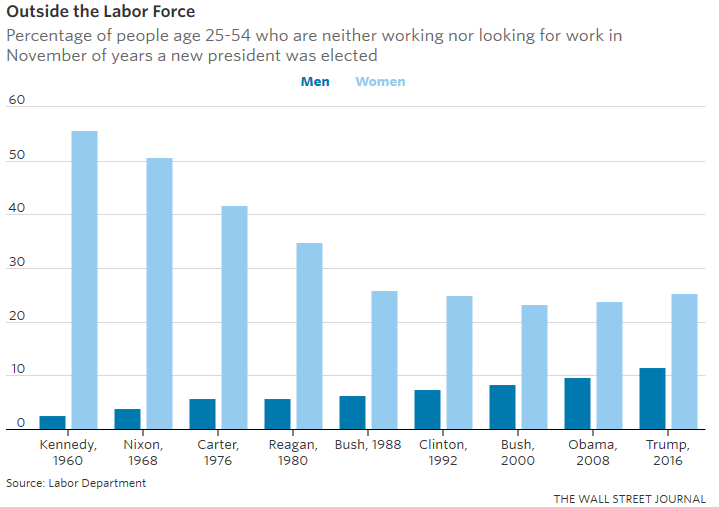
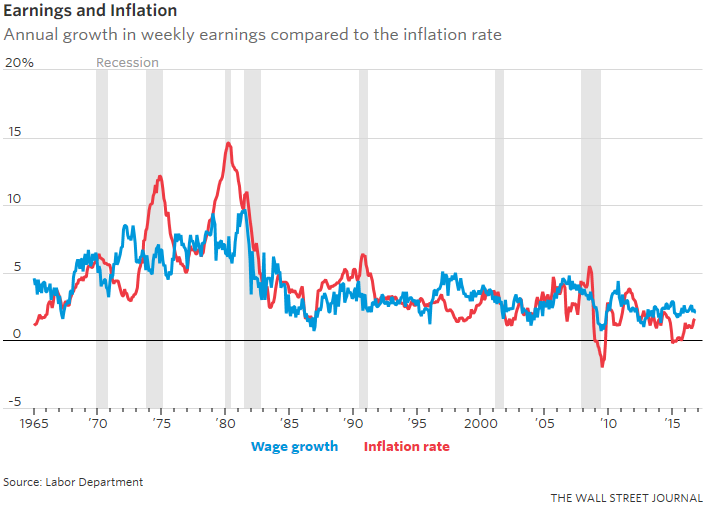
Here are some graphs, via The Wall Street Journal, that show why that headline rate of 4.6% isn’t all it’s cracked up to be.outdidelaborforce

The WSJ emphasized two points here, aside from the fact that this age group being outside the labor force has nothing to do with retirement or being in school:

First, a small but ever growing minority of 25-54-year-old men are no longer in the labor force. In the 1960s, just 2.7% of men that age were outside the labor force. As of November, it’s 11.5%.

Second, from the 1960s to late 1990s, 25-54-year-old women became less and less likely to be outside the labor force (this is primarily driven by a decline of stay-at-home mothers, as more women took jobs). But in the last 15 years, the share of women outside the labor force has been growing too. It’s now up to 25.3% from 23.2% in November of 2000 just before George W. Bush took office.

Which might contribute to and why, perhaps, there’s so little wage growth, as shown in this graph:wagegrowth

There’s just too much slack in the population’s ability to work.

Federal Green Expenditures

Watts Up With That has some ideas for budget cutting in the next administration.  Or, actually, these ideas come from Salon (!) via WUWT (never mind that cutting isn’t what Salon meant).

  • Energy Department

2017 climate-related budget: $8.5 billion

  • Interior Department

2017 climate-related budget: $1.1 billion

  • State Department

2017 climate-related budget: $984 million

  • NASA

2017 climate-related budget: $1.9 billion

  • Environmental Protection Agency

2017 climate-related budget: $1.1 billion

  • National Oceanic and Atmospheric Administration

2017 climate-related research and development: $190 million

That works out to $13.8 billion of “useless waste.”  Yes, indeedy.

While we’re about it, let’s cut the “green” subsidies, too.  Every single one of them.  The fossil fuel (coal, oil, and gas) enterprises don’t need the $3-$5 billion (depending on who gets asked) in subsidies they get, either.  That’s yet more budget cutting.19+, although fossil fuels get much less than the “green” money being tossed down rat holes.

A Minimum Wage Mandate Demonstration

McDonald’s, which already has ordering stations—kiosks at its restaurant tables from which diners can order their meals and have them delivered to them—at some 500 of its restaurants in Florida, New York, and California.  The Daily Caller, citing CNN Money, says more of these kiosks are scheduled to be added, next year, in McDonald’s restaurants in Chicago, Boston, San Francisco, Seattle, and DC.

Governor Andrew Cuomo (D) signed into law a new $15 minimum wage for New York State in 2016, and the University of California has proposed to pay its low-wage employees $15. Florida’s minimum wage will rise I January 2017. Seattle raised its minimum wage to $15 in 2014, followed by San Francisco and Los Angeles.

Notice that.  The additional kiosks are going into areas that have raised (Chicago and Boston in addition to San Fran and Seattle) or will raise soon their required minimum wage, instead of letting that be an item of negotiation between free workers and free employers.  It doesn’t cost $15 to operate one of these kiosks for an hour.  Even given the up-front costs of acquiring and installing the kiosks, their life cycle costs are much less than those of a $15/hr unskilled order-taking worker doing unskilled work, given the worker’s training (even if minimal) and high turnover rate costs.

Which is what the Left has known all along, because serious economists have been telling these Know Betters about these outcomes right along.  The Left’s policies are actively destructive of the prospects for those the Left claims it’s aiming to help, but those of the Left would rather virtue signal and feel good about themselves than do actual good for others.

Aparna Mathur, Resident Scholar for Economic Policy at the American Enterprise Institute [emphasis added]:

We know that we don’t really need someone to take an order…and we will eventually have machines do it. It is risky to fight for something that could put you out of work[.]

There’s an understatement.


H/t AEIdeas

Education and Unions

What do teachers unions have against quality schools?

Georgians will be voting on a State Constitution amendment that would create a statewide school district into which failing public schools from any individual school district could be transferred.  This statewide district would have the authority to make any changes to a failing school it deemed necessary—including ridding the school of its union representatives and including further converting the failing school to a charter school or closing it altogether.

Naturally, teachers unions oppose this threat to their core.  The National Education Association alone has dumped over five-and-a-half million dollars into the state to oppose the amendment, because union teachers.  Never mind that there are 68,000 children currently trapped in 127 failing public schools—535 children per failure.  Unionization is more important to teachers unions than the education of the children for which these unions are responsible.

It gets…better: this is what a Clinton administration will allow unions to inflict on our children nationwide, even if the unions lose—and the children win—on the Georgia ballot tomorrow.