Missing the Point

In a Letter to the Editor last Thursday, one letter writer had this to say about a Wall Street Journal op-ed, The Great Progressive Tax Escape:

[T]he problem of interstate tax competition, like the continuing bids to draw Amazon to pick a favorable second headquarters, isn’t strictly speaking a problem of high progressive taxes, as your editorial asserts. Better to view it the other way, as a problem of low-tax jurisdictions using these devices to compete in a way that erodes the tax bases of other states. That is exactly what is happening globally as well, when Ireland, Panama, Malta, etc. make rock-bottom offers to global companies to do business there. Developed states and countries cannot run governments at the discounted prices offered by these tax havens….

And yet these States and countries—developed all—do run their governments at “discounted” prices.  The resulting economic activity is how they can afford these additional “discounts.”

The plain fact is high-tax governments do not need the tax rates they have—as demonstrated by the fact that the “winning” States already have low rates and high enough revenue to pay for what those governments have been hired to do.  And they do so despite the plethora of special interest give-backs that so heavily populate even these States’ tax codes.  The high-tax States and the high-tax countries would do well to learn from these examples, and instead of whining about losing an entirely fair competition, reformed their tax codes.  Ireland—and Luxembourg, which the letter writer omitted to mention—have some of the lowest tax rates in the world, and their people are prospering.

A related and equally plain fact is that with low, flat tax rates there’d be no need to compete on who can offer the biggest tax breaks.  Such breaks have considerably less value coming on a base rate of, say, 10%, than they have at usurious rates like 35%.  Further, the base rates, applicable to all and already low, would allow businesses to locate themselves on the basis of sound business and not at all on who’s offering the most goodies.

More on Tax Reform

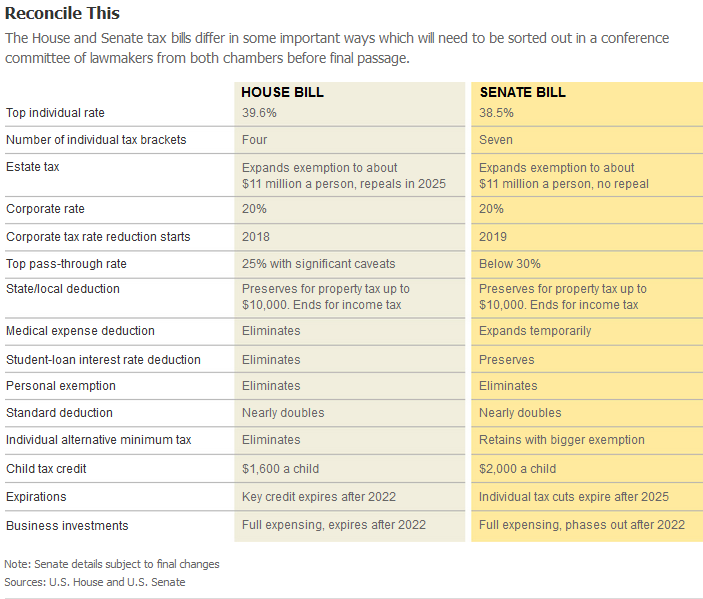
The House passed yesterday, 227-205, its version of tax reform, and the next milestone is in the Senate.  The Wall Street Journal is referencing some special interests who are expressing misgivings about it.

Both the House and Senate bills would cut the corporate tax rate to 20% from 35%. If that overall tax rate decreases, tax credits and deductions become less valuable.

Well, of course.  Credits and deductions get their value from how much they reduce taxes for the government-favored groups of Americans for whom those credits and deductions are targeted.  With lower overall tax rates, those credits and deductions have less tax value—as any graduate of 3rd grade arithmetic can see.

That alone would mean that nearly 300,000 fewer low-income units will be produced over 10 years, according to an analysis by Novogradac & Co, an accounting firm specializing in real estate.

That’s the claim of a special interest group. It’s also not entirely true. With the elimination of real estate-related credits and deductions, housing—and rental—prices would no longer be elevated to absorb for the realtor’s benefit those bennies.

The same logic applies to other bennies on the chopping block: preferential tax treatment for bonds used by developers to build “affordable” housing and private activity bonds, which fund hospitals, roads, nursing homes, and charter schools—and sports stadiums and other froo-froo.  These things, too, would no longer have their prices elevated to absorb for the developer’s benefit the monetary value of the bennies.

On top of that, the reduced value of deductions and credits under the plan just passed in one house and on offer in the other is a non sequitur.  Our tax code should not be used for social engineering, least of all in accordance with the personal imperatives of 535+1 politicians in DC.  The—our—tax code should be limited to funding our government; social engineering should be left to We the People in our local communities.

Another Reason

…to push for lowered State tax rates, empirically observed.

There are signs home buyers in metropolitan New York are pausing to consider the effects of proposed federal tax law changes, setting the stage for a possible chill in the market, brokers say.

The changes, in versions of bills in both the House and the Senate, likely would increase the cost of home ownership and reduce after-tax discretionary income for many mostly affluent home buyers in New York and other states with high state and local income and property taxes, brokers and analysts say.

This isn’t entirely true, though.  The reduced deductibility of mortgage interest will lead to lowered house prices (and through that, downward pressure on rents, even in rent-controlled New York City) through two pathways.  One is reduced demand for house ownership.  The other is through a lesser interest deduction being factored into a house’s price—this one will impact primarily, the high-end houses bought with jumbo mortgages, contra those brokers and analysts.

Or a high-tax State can do nothing and suffer the consequences.

One couple, who looked for homes in the area last year, is coming down to see a house on an island off Miami Beach listed for $22.5 million over the summer, Mr [Jeff, a Miami broker] Miller said.

“People I have been working with were on the fence,” he said. “Now they want to move [to Florida]. The new tax bill was the nudge they needed to push them over.”

These are exactly the high-income, high-asset folks whose pockets high-tax States like New York want to pick.

TPP Light

President Donald Trump, on taking office, pulled the US out of the not-yet-finalized Trans-Pacific Partnership, which involved nations all around the Pacific rim including the US and Canada.  The TPP was far from perfect, but international trade is more about international relations and foreign policy than it is about economics, and it was a mistake to pull out.

The economic and political power of the coalition would have been a powerful brake against an acquisitively aggressive People’s Republic of China; the remaining 11 nations still represent some 17% of all world trade—and 30% of the world’s trade runs on sea routes the go through the TPP’s region—trade that is every bit as critical to the PRC’s economy as it is to Japan’s and the US’.

It might yet be.

[T]he eleven remaining TPP members have reached an agreement on the trade pact in principle, which means a new pact—without the United States—could be put into place which could shape trade in the Asia-Pacific area for the next decade.

Of course Canada is being nearly as foolish, demanding union rights over right to work parameters and expressing a willingness to blow up the remaining TPP if they can’t have them, but at least they’re still talking.

We should support the TPP’s conclusion for its PRC-containment potential, at the very least.

Death Panels?

The Affordable Care Act required Medicare to penalize hospitals with high numbers of heart failure patients who returned for treatment shortly after discharge. New research shows that penalty was associated with fewer readmissions, but also higher rates of death among that patient group.

Because sometimes readmission is necessary for quality care—whether that readmission was driven by later complications, by too-soon original discharge in the Medicare (which is to say Government) pressure to hold down costs first, or by some other factor—but that Government pressure to push the patient out the door also pushes against the patient’s return.  Even when necessary.

Here are a couple of numbers from a study soon to be published in JAMA Cardiology:

One in five heart failure patients returned to the hospital within 30 days before the ACA passed. That dropped to 18.4% after the penalties. Mortality rates increased from 7.2% before the ACA to 8.6% after the penalties….

In other words, an 8% drop in readmissions is associated with a 19% rise in death rates for heart patients.  That’s not a favorable trade-off.

There is a legitimate interest in improving the quality of care for all patients, including those for whose care us taxpayers are paying, but readmission rate is not an accurate measure of that quality.  Readmission rate can only measure…readmission rate.  That metric addresses neither the reasons for readmission nor the reasons for the prior discharge.

Government pressure to hold down readmissions doesn’t quite amount to death panels, but the outcomes seem dismayingly similar.  To be clear, the results of the study do not establish a causal relationship, for heart patients, between the lowered readmission rate and the higher death rate.  However, the magnitude of the apparent association between the two desperately wants further investigation.