
Economic Recovery

What sort of recovery will we have in 2021 with the Wuhan Virus situation under control and, with the release of two vaccines (I’m betting on the come with Moderna as I write on Friday) and others in the nearby pipeline about to stamp the virus into the mud?

Jon Sindreu, in The Wall Street Journal, provided a couple of clues, although he was writing toward a different purpose. This graph of his is my first clue:
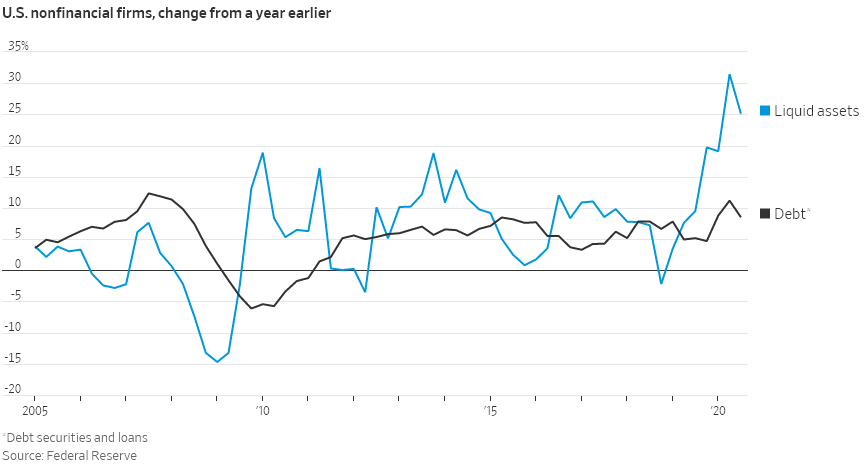
He fleshed that out with this:

Flow-of-funds data recently published by the Federal Reserve shows that companies have accumulated even more cash than debt this year: their liquid assets were up 25% in the third quarter. On a net basis, debt was down 7.9%. Relative to GDP, it remains well below 2007 levels.

Another clue:

Nor are property and asset prices tanking, hitting households’ net worth as they did in 2008. So consumers have kept spending when they could.

There’s more in his article, but the upshot is this: 2021’s recovery (and into the later years) won’t be nearly as weak as some have feared. It’ll be strongly positive, although—because of 2020’s already in-progress recovery—it’s unlikely to be quite as strong as hoped.

Limits to Response

Massive Hack Blamed on Russia Tests Limits of US Response is the headline of a Wall Street Journal piece on the Russian hack of our government and some infrastructure facilities.

Despite its size, a sprawling computer hack blamed on Russia could leave President Trump and the incoming Biden administration struggling to find the right response, former US cybersecurity officials and experts said.

The Russian hack was an overt invasion of the United Space, just as much in cyber space as it would have been had it occurred in physical space. The only limits on our response—the only real limits—are our capacity to respond, and the mindsets of those with the authority to order the response.

Capacity includes our shamefully limited cyber capability coupled with the much lower degree of Russia’s dependence on cyber in its various facilities (military, political, economic).

Capacity also includes, though, political, economic, and physical response venues.

This attack badly wants a more prompt response than economic sanctions are capable of effecting.

 “It’s a hack. It’s a breach. It’s espionage. It’s not an attack,” said former White House and Justice Department official Jamil Jaffer, executive director of George Mason University’s National Security Institute. “I don’t think some major offensive response is warranted based on what we know now.”

And

…the former officials said the intrusions fell more along the lines of classic digital espionage, however brazen.

This insistence on downplaying the severity of an invasion is a major player in our vulnerability to such attacks is an illustration of the weakness of the mindsets involved, for all that Jaffer is not one of those charged with the responsibility. It increases our vulnerability to physical attack.

There needs to come an end to mental weakness, idle chit-chat, and vapid responses and to get serious about such invasions.

Now.

Couple Rude Questions

These arise from the SolarWinds hack attack that some experts claim doesn’t rise to an act of war (but that I think might do so*).

Why wasn’t it spotted sooner? This applies to SolarWind as much as it does the IT MFWICs and their staffs at the various government agency and private business recipients. Who inspected SolarWind’s “updates,” how were they tested both before SolarWind disseminated them, and how were they tested before the receiving entities implemented them? Were the recipients actually, with straight faces, allowing a remote entity to enter their systems and install software that was uninspected/untested by those recipients?

What’s being done about the hack now—both defensively and offensively?

On what basis would we be able to believe all of the proximately done SolarWind hackware has been rooted out?

What other software is broadly used in government and automatically updated from outside? What inspecting and testing is being done on that software?

What inspection/testing is being conducted on all the private economy cloud software extant?

More serious, though, are these questions:

Was this hack, which embedded spyware, among other things, all of it? Or was this hack intended to be found as a distraction from detecting other, more hidden, more nefarious software—software that could be triggered later to conduct sabotage of critical systems, insert misleading or outright false data into critical databases and imaging systems, cut off communications between critical government and military leadership entities and between those and their field-operational systems at critical moments of a more overt attack?

Was this hack conducted by Russia? Or perhaps by Iran, while framing Russia, the butcher of Chechnya? Or perhaps by northern Korea, while disguising its own culpability by framing Russia? Or by the People’s Republic of China, which still regards Russia as a foe and now recognizes Russia’s political and military impotence vis-à-vis the CCP and the PLA, and so harming two enemies with one exploit?

*Shameless plug

Bill de Blasio is Disappointed

The Wuhan Virus bill under discussion in DC (as I write Thursday) doesn’t have any bailout money for States and municipalities. New York City Mayor Bill de Blasio isn’t happy about that.

What do we see right now in Washington? Endless discussion that now is leaving out all state and local aid, that means that city government, state government will not be able to get back on our feet and serve our people—it just doesn’t make any sense[.]

What do I see right now in New York City Hall? Endless tin cup rattling that continues to demand other people’s money.

To paraphrase (not very loosely) a man far more intelligent than any of us ordinary Americans,

…there’s plenty of money in [City Hall], it’s just in the wrong hands. Democrats have to fix that[.]

Indeed. De Blasio and his Progressive-Democrat-dominated city council (46 Progressive-Democrat councilmen out of 51 seats) have only to reallocate their spending priorities and their actual spending.

That they won’t—it just doesn’t make any sense.

The Biden Cabinet, So Far

In Biden’s own words, as summarized by Howard Kurtz:

  • the first-ever openly gay nominee to lead a Cabinet department.
  • the first ever black secretary of Defense
  • the first ever Latino head of the DHS
  • the first ever Latino head of HHS
  • the first woman…of South Asian American descent to lead OMB
  • the first woman and Asian-American to lead [as] the United States trade representative
  • the first black woman to chair the president’s Council of Economic Advisers
  • the first ever woman to hold Alexander Hamilton’s position as Treasury Secretary

And that’s just for starters.

Notice what Biden is bragging about: the first identity square checked off.

Biden isn’t even picking these folks because they’re politically expedient, or because many of them reprise his BFF ex-President Barack Obama’s (D) administration, an indirect political expedience.

No, Biden is picking these folks in furtherance of his Progressive-Democratic Party’s identity politics imperative—a political expedience of an especially…prejudicial…nature.

Notice, too, what Biden isn’t bragging about: these prospective nominees’ qualifications for the job. In keeping with Party’s identity politics ideology, qualification is centered on identity; actual skill or experience is in the far reaches of the system—if present at all.

Even if these folks could be counted on to put in honest effort, their broad and aggregated lack of qualification, their intrinsic incompetence, will be disastrous for our nation.