Fired or Resigned?

Ex-Veterans Affairs Secretary is making his case that he didn’t resign, he was fired.

Shulkin said he had not submitted a resignation letter, or planned to, and was only told of Trump’s decision shortly before the Twitter announcement.

Of course, the format of a resignation is immaterial to the act; in particular, letters are the polite, professional way to quit, but they’re not required, not at all.  Too, learning that your boss wants you to leave “shortly before the Twitter announcement” might be impolite, even impolitic, but again, learning the boss’ desire is not required for resigning.  Nor is desiring one to leave the same as firing that one.

The distinction in this context might seem minor, but it actually flows from a very serious legal matter.

The semantics could be relevant to Trump’s ability to name an acting VA secretary to temporarily fill Shulkin’s place. Last week, Trump named Defense Department official Robert Wilkie to the acting position….
Under federal law, a president has wide authority to temporarily fill a federal agency job if someone “dies, resigns, or is otherwise unable to perform the functions and duties of the office.” There is no mention of a president having that authority if the person is fired.

The fact is, Schulkin may have felt considerable pressure to resign, and it’s common to conflate pressured-to-resign with being fired, but the two are not the same.  Especially here.  Cabinet Secretaries are nominated by the President, but they are confirmed by the Senate.  The President cannot fire a Secretary.  He must be impeached.  It may be that Secretaries serve “at the pleasure of the President,” but once confirmed, they serve “at the pleasure of Congress,” also.

Schulkin could have held out for being impeached, but he resigned—under pressure certainly, but voluntarily nonetheless.

Quid Pro Quo?

Recall that the Veterans Administration’s Inspector General had written a damning report of its investigation into the fraudulent behavior of the VA Secretary and of the Secretary’s Chief of Staff.  The IG even had referred the matter to the Justice Department for criminal prosecution.  DoJ then declined to prosecute.

Now that chief of staff, Vivieca Wright Simpson, has announced her retirement, and the VA has opened its own investigation into her actions, an investigation that might lead to civil action, but it’s not a criminal investigation.  I have to ask, then: was this a quid pro quo?  Did DoJ agree not to prosecute if Simpson agreed to leave?


Veteranos Administratio delende est.

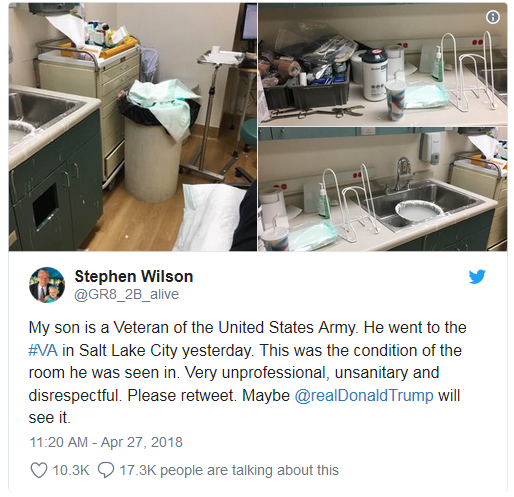
The Veterans Administration Is Not Getting Better

VA Secretary David Shulkin, according to an IG report, has been misappropriating VA funds for his and his family’s personal benefit, and he’s been abusing his authority to require a subordinate to act as his “personal travel concierge.”  He

improperly accepted a gift of Wimbledon tennis tickets….

And his Chief of Staff, Vivieca Wright Simpson, apparently tampered with evidence:

made false claims to a VA ethics official by altering an email to get official approval for Dr Shulkin’s wife to take part in the trip as an “invitational traveler,” a status that meant the VA would cover her expenses. Her airfare cost taxpayers $4,312.

Shulkin and his fellow travelers (not only his wife) spent an exhausting 3 and a half days in business-related meetings out of their 10-day trip.  That’s some jet lag.

Of course, Shulkin and his staff denied all of this and complained that the week the IG gave him to respond was, somehow, not enough time.  Must have been still jet lagged.

He’s paid the money back?  He should have known better in the first place.  If the leadership cannot be counted on to perform, how can anyone else be?  Reallocate the VA budget—every single dollar of it—to vouchers for our veterans.


Veteranos Administratio delende est.

The Veteran’s Choice Program

This is a program that would give veterans the option of going to a private sector doctor in lieu of playing the delay wait game at a Veterans Administration facility, after the veteran has jumped through the requisite VA hoops.  After a political tussle in Congress over increasing/renewing its funding, some additional money was provided.  That additional funding was necessitated because

its popularity depleted the allocated funds more quickly than anticipated. Patient visits through the program increased more than 30% in the first quarter of fiscal year 2017, according to the VA.

Extra points for those of you who can say why the program is so popular.

Despite the success of this limited program, the Progressive-Democrats in Congress want to get rid of it.  Congressman Mark Takano (D, CA), for instance,

argued on the House floor in July that it’s a “mistaken belief that the private sector is better equipped to care for our nation’s veterans than specialized VA doctors.” But while the VA provides high-quality specialized care in certain areas, for the most part veterans’ needs are similar to everyone else’s.

Indeed.  Takano and his fellow Progressive-Democrats just want to maintain control over OPM. It’s a mistaken belief that the private sector cannot care for our nation’s veterans better than specialized VA doctors. As Burgess and Cleland (authors of the piece at the link) note, mostly our veterans’ needs are similar to everyone else’s.

Those few specialized needs unique to a veteran’s particular military history? The VA’s specialists, functioning in the private sector, can deal with those at least as well as they do now, and probably better and faster without the VA’s bureaucratic impediments.

Make the Veteran’s Choice Program functionally universal: privatize the VA, and use its current and what would have been its future budgets for veterans’ vouchers.

Veteranos Administratio delende est.

The VA Continues to Fail

…as it continues to exist.  This time, its failure is in not reporting “90% of potentially dangerous medical providers.”

Based on a sampling of 148 providers at five unidentified VA hospitals who required review, officials had only reported nine health care workers since 2014, and none had been reported to state licensing boards.

Never mind that

the VA is required to report providers to a national database designed to prevent them from crossing state lines and endangering other patients.

The GAO says in its report on this failure that much of the failure stems from “confusion” about VA responsibilities and reporting requirements.

Does any reader want to look at some beachfront property north of Santa Fe that I might know about?

VA management wasn’t confused.  They just don’t care.


Veteranos Administratio delende est.