Scottish Independence

The view of a poor, dumb colonial.

Suppose the Scottish referendum next week goes in favor of independence. What would be next for Scotland?

Among the complexities of separation is the matter of pensions provided by employers. Most such pensions are not fully funded; although, most such pension providers have apparently viable plans for curing the shortfall, over some number of years. However, the EU (and we’ll assume Scotland succeeds in joining the EU for this bit) requires all pension funds with members in two or more countries to be fully paid up. Moreover, funds that are not have only two years to get fully paid up. There are quite a number of large-ish UK companies, employing thousands each, whose pension funds have members in both countries, and whose pension funds are on one of those “some number of years to fund” plans.

There’s some chatter in the UK about splitting the pensions in two, one for the UK and one for Scotland, as a means of ducking this problem. I see a possibility of splitting the companies themselves in two, each with its own pension scheme. Either course, though, is fraught with complexity.

A larger complication is the UK national debt, some £1 trillion ($1.62 trillion): how would this be divided, and based on what criteria? I’ll elide whether the new Scottish economy could handle its new debt.

That sort of thing is trivial, though, compared with a couple of larger questions. Scotland has some serious economic problems, including that debt, a risk of sharp inflation, lack of clarity on what it would use as a currency, what sort of trade arrangements a settled-on currency would imply, and so on.

The economic problems will have their impact on independent Scotland’s near- and mid-term stability.

Too, accession to the EU requires a unanimous vote of the existing members, and that’s not a done deal. Which means Scotland would not be able to count, soon, on any EU…assistance.

Frankly, I think Scotland would be better off outside the EU than in it (recall the EU’s treatment of Ireland and Iceland), but this is a move Scotland has to make, and properly so, without my sage advice.

Regardless of EU membership and those “larger problems” just mentioned, though, independent Scotland will need to broaden its economy. 80% of its national income is from North Sea Oil which, aside from questions of how to divide that with the UK, is a declining asset value [sic], and the bulk of the remaining 20% is from tourism. A self-sustaining independent Scotland will need a more broadly based economy in order to function without the UK subsidies it currently gets.

Finally, I don’t know that Scotland would be better off independent from the UK. Certainly, there are advantages for a nation that’s free to chart its own course without having to say, “Mother, may I” to a higher-up. I think, though, given Scotland’s socialism and those subsidies, the UK would be better off with an independent Scotland.

The aftermath also will be fun to watch. Northern Ireland? Catalonia? Basque Country? Sicily?
Obamacare and Health Coverage Cost Growth

President Barack Obama promised us, all those years ago, that if only Obamacare were enacted, a family’s health plan premium would drop by $2,500 per year, and no one would lose their employer-provided health plan. Period.

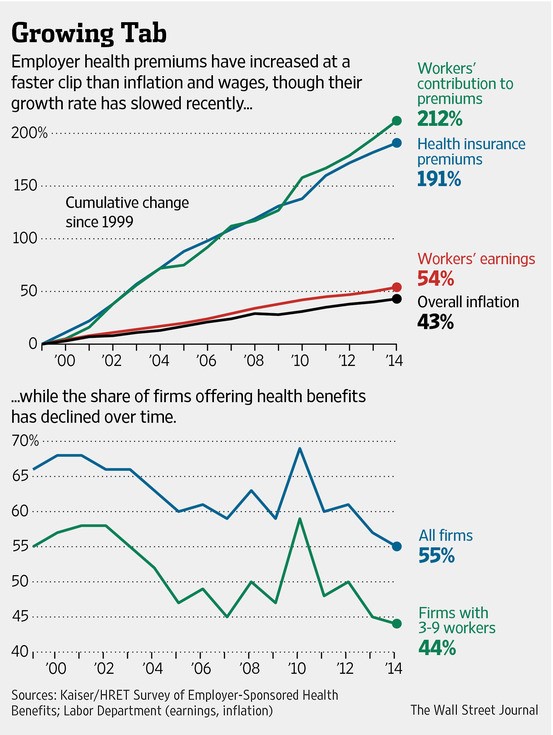
These two graphs from The Wall Street Journal draw a different…picture.ObamacareCost

These graphs cover the period since 1999. As the upper graph shows, the premiums for employer-provided health insurance and, since Obamacare’s passage in 2010, for employer-provided health plans, have risen at a steady pace—unchanged by Obamacare, and specifically, no drop in premium cost. It’s the same with the employee’s share of those premiums; that share’s pace of increase also has been unaffected—that is, no drop in cost—from Obamacare.

Now look at the lower graph. After spiking in Obamacare’s year of enactment in 2010, the per centage of businesses offering health plans to their employees has fallen to the lowest level in the 15 years depicted.

At best, Obamacare isn’t lowering employer-covered workers’ health coverage costs. There has been, though, a sharp decrease in the number of folks even offered employer-provided plans.

(That wages have risen much more slowly than health plan premiums is a different subject.)

Continued VA Cover-Up

This time with the VA’s IG participating. It’s an unfortunate side effect of having an organization’s inspection/watchdog function be an internal one, even if it works for the organization’s boss and not for anyone further down the totem pole.

Crucial language that the Department of Veterans Affairs Inspector General could not “conclusively” prove that delays in care caused patient deaths at a Phoenix hospital was added to its final report after a draft version was sent to agency administrators for comment….

The single most compelling sentence in the inspector general’s 143-page final report on fraudulent scheduling practices at the Phoenix veterans’ hospital did not appear in the draft version, according to a staff analysis by the House Committee on Veterans’ Affairs.

It was inserted into the final version, the only one that was released to the public, after agency officials had a chance to comment and recommend revisions.

It’s certainly legitimate for IG draft reports to be run by the group just inspected and about whom the report is being written, but that’s to give the inspectees an opportunity to check facts and to suggest corrections to factual errors. Giving the inspectees the ability to “correct” the conclusions themselves is entirely illegitimate.

A separate report, written by the inspectee, is a normal part of the proceeding. Here, the inspectee indicates its concurrence with IG conclusions and its plan of corrective action regarding those conclusions. It’s also in this separate inspectee response report that the inspectee indicates its disagreement with a conclusion and the reasons for that disagreement.

Then the IG responds, again in a separate report, indicating its acceptance of the inspectee’s disagreement or the IG’s overruling of the inspectee, with the original conclusion standing and the inspectee required to take corrective action. All three of these reports are part of the official record.

Notice that: the legitimate course is to disagree with an IG conclusion, in writing, in a separate report, not to rewrite the IG conclusion itself.

And the cover-up of the cover-up:

The House committee obtained the draft version of the report late Thursday, after the [Washington] Examiner published a story that IG had been refusing its release.

Again, I say, it’s time to disband the VA altogether and send the VA’s existing budget and what would have been its future budgets directly to our veterans as voucher checks with which they can be free to seek out their own doctors and their own medical facilities.

Economic Gains

President [Barack] Obama used Labor Day to tout the country’s economic gains under his leadership….

Let’s look at those gains.

  • he’s increased the national debt in his six years by 70%—it stood at $10 trillion at the end of 2008; it’s now over $17 trillion
  • median income has fallen—it stands now at $53,900 compared with $56,700 in December 2007 at the start of the current economic dislocation
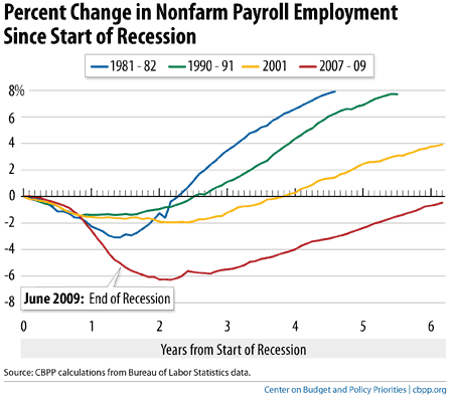
  • job creation is only just back to pre-Panic levels, 6 years into his administration, compared with normal economic recovery needing only 2-3 years to get to this point
  • unemployment rate now stands at 6.2%, dropping 1.1 points over the past year—still 20% above full employment, and again years behind schedule
  • labor force participation rate is at an historic low
  • GDP growth remains anemic at 1.5%-2.5% year on year (with this year’s growth rate projected to be in the 2.5% range) compared to a normal economic recovery growth rate in the 4.5%-6.5% range.

And this graph sums it all up:RecoveryComparison_Cox

Obama, in the same appearance, also claimed that “higher wages and other progress for workers can only be achieved through a Democrat-controlled Congress.”

Really? Can our country afford more of this Progressive progress?

Obamacare and ObamaMart Strike Again

In the continuing story of ObamaMart’s still incomplete (!) backend, the part of the Web site that takes the citizen’s input and sorts it, collates it with other government information, and then passes it on to other relevant parties—the health plan providers, for instance, and the IRS—there’s this:

Because of complicated connections between the new health care law and income taxes, the Department of Health and Human Services must send out millions of new tax forms next year.

The forms are called 1095-As, and list who in each household has health coverage, and how much the government paid each month to subsidize those insurance premiums. Nearly 5 million people have gotten subsidies through HealthCare.gov.

If the forms are delayed past their Jan 31 deadline, some people may have to wait to file tax returns—and collect their refunds.

A delay of a week or two may not sound like much, but many people depend on their tax refunds to plug holes in family finances.

That folks should better plan their withholding (where possible) and not extend Uncle Sugar a year-long interest-free loan is a separate story. Such planning is typical, and the folks who do this the most are the poorest among us—the very folks President Barack Obama and his ilk claim to be trying to help.

And there’s the coming collapse of employer-provided health plans.

Analysts predict that as ObamaCare takes hold, it will mean the end of employer-provided insurance….

The Wall Street research firm S&P IQ went even further, predicting 90% of such plans will disappear.

Now, I don’t see such an eventuality as necessarily a bad thing. Employer-supplied health plans should be what employer-supplied insurance plans used to be, when the practice began: a matter of employment compensation negotiation between employer and (prospective) employee. What interests me here is the hypocrisy of the thing.

President Barack Obama promised, repeatedly, that

you can keep your plan and your doctor, no matter what[.]

If you lose your employer-supplied health plan, you lose with that “your plan and your doctor” bit. Which, of course, Obama knew at the time he was making those promises. He even bragged about it to then Majority Leader Eric Cantor at the infamous health summit.

Also, when Presidential Candidate Barack Obama was debating Presidential Candidate John McCain in 2008, he decried McCain’s health insurance industry reform proposal as being destructive of employer-supplied health insurance.

[T]his would lead to the unraveling of the employer-based health care system. That, I don’t think, is the kind of change that we need.

Hmm….