
“How Much Should a Currency Be Worth?”

That’s the title of Ian Talley’s piece in a recent Wall Street Journal online edition. The question arises from the People’s Republic of China’s open manipulation of its currency through its control of the yuan’s exchange rate in the currency markets. The PRC executes this manipulation by limiting the range of values within which the yuan is permitted to trade in those markets.

The question gains currency (sorry) as Congress contemplates adding an anti-currency manipulation clause to the Trans-Pacific Partnership free trade pact or to the fast track trade bull currently in progress of a sort. But that’s currency manipulation from the other side of the matter: instead of a country manipulating its own currency, this clause says the currency must be manipulated according to our imperatives:

Some US lawmakers are channeling their constituents’ long-held grievances by pressing to incorporate enforceable currency provisions….

The problem from this side of the coin (sorry, again) centers on the determination of what is a “fair” value for a nation’s currency, who gets to make that determination, and on what grounds. The point of Talley’s article concerns the difficulty of making those determinations.

It’s really quite simple, though. There are only two ways to determine the value of a currency. One is that a currency is worth what the nation’s government says it’s worth. (This, incidentally, blows up the gold bug argument that the US should go back to a gold standard for the dollar, that being the only way to bring stability to our currency. But the gold would have the value our government says it has, and nothing else, as FDR demonstrated when he devalued the dollar against gold in the ’30s.)

The other way, the free market (and so most moral) way, is this: let the currency float; its value is what the market says it is, empirically, by what the participants in that free market—free men and woman, acting voluntarily according to their own wants and needs—are willing to exchange currency for.
Market Disruption

…is what happens in a free market, and one result is wealth redistribution, not by inefficient, politically motivated government mandate, but morally and efficiently by voluntary exchange among market participants—folks like you and me. One example of this is the price of taxi medallions.

…leading cabbies and fleet owners throughout the USA worried that their industry will be decimated if local and state government doesn’t intervene.
…
In Chicago, which has the country’s second biggest fleet with roughly 7,000 taxis, the median sale price for a medallion hovered around $70,000 in 2007 before reaching a median sales peak of $357,000 in late 2013.

Since reaching that high point more than a year ago, the value of medallions in the Windy City have sharply declined and sales have ground to a near halt—with the city recording only seven medallion transfers in the first quarter of 2015….

(Aside: can you see the bubble in that?)

Now cabbies and fleet owners are worried about the prices of their medallions and want government to “intervene.”

Cabbies around the country complain that drivers for services like Uber, which use a smartphone app to connect riders with freelancers using their own vehicles, are disrupting the market and playing with an unfair advantage.

Not so much of an unfair advantage. Nothing is stopping the “official” cabbies from using the same sort of smartphone application to achieve the same thing: on demand, low cost rides for the customer. It’s certainly true that the price of a medallion is tanking (but really: 70 large for a license to drive a car for hire? What supports that sort of pricing other than a government protected monopoly?)

Let’s look at the wealth redistribution of a medallion-for-sale monopoly and an Uber or a Lyft, in which anyone can play for as long or as briefly as they wish.

With the medallions—especially with their cost—cab fleets charge high prices per fraction of a mile on the trip, with government-mandated price floors (in addition to the monopoly aspect, a need presumably driven by the necessity of recovering the cost of the license to operate represented by that medallion). Wealth is transferred from the customer to the cab fleet owner, and the customer gets a ride to his destination. When the cabbie can, or is willing to, get to the customer’s location.

With an Uber-like operation, a customer can make his wish known via his smartphone, and a ride-share participant arrives promptly (because there are a lot more of these than there are formally licensed cabbies), and the customer gets his ride, at a rate commensurate with the area and the demand for rides in the area, but at a significantly lower price than the medallioned cabbie. The wealth redistribution is at that lower rate—competition, you know—and the money transferred goes directly to the driver (minus some Uber overhead, which isn’t much compared to that medallion, just for starters).

The fact of that lower price, and the ubiquitousness of what are essentially part-time and wholly voluntary drivers (who are driving as an additional thing, not as their day job) demonstrates that the fleet cab pricing is excessive relative to the industry needs: the alternative to the formal fleets simply have a much lower cost structure.

That’s a thing to be celebrated, however disruptive it may be to the establishment. Medallion cabbies and buggy whips….

Lots of folks are getting a service they want at a lower price than heretofore, and lots of folks are getting some extra money—lots more folks than the special few who drive medallion-permitted cabs.

Interest Rates and Economic Recovery

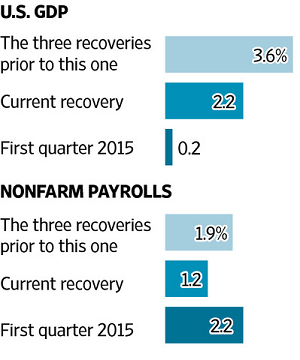
The Fed has been actively suppressing interest rates, keeping them near zero, for a long time. This is in addition to the Obama administration’s economic policies, and the two attitudes have combined to produce an economic recovery from the Panic of 2008 that is one in name only. See this graph, adapted from one in a recent Wall Street Journal to see just how bad the current “recovery” is. The numbers other than the two first quarter 2015 are average annualized rates of increase.EconomicRecovery_Cropped-Resized

Certainly, the Obama policies need to be corrected, but here’s something the Fed can do all by itself: it could let interest rates float, and see them rise to market rates, probably with a temporary overshoot, given the duration of its suppression and separate money printing, but that’s only going to get worse as the Fed delays correcting its own error.

With interest at their more normal level, banks would be more willing to lend, and without lowering their credit standards; businesses would be more willing to borrow, since even though they’d be paying more for their debt, they’d recognize the positive economic indicator; and folks dependent on fixed income sources for their living—widows and orphans—would have more money to spend, even if only on necessities, which would help make that positive economic indicator more concrete.

Banks, Government, and Risk

Fed governor Jerome Powell, in remarks prepared for a conference of community bankers in New York, said banks under a certain asset level, “perhaps $10 billion,” should be exempt from Dodd-Frank compensation restrictions. The restrictions, which are being developed by the Fed and other agencies, are designed to remove encouragements for bankers to take excessive risk.

Couple things about this. Why $10 billion? Why not $20 billion? Why not $5 billion? Based on what logic is this limit chosen? Based on what logic is any limit chosen? How is “system risk” from bank failure, the putative rationale for Dodd-Frank at all, a lesser risk than government’s intervention into the market place?

The other thing is “excessive risk.” Based on what criteria? What constitutes “excessive?” Under what circumstance is risk excessive here, but not there? What about government’s excessive risk from the bailouts and “stimulus” package of the 2008-2009 period; risks from which our economy still has not recovered?

How is government—politicians and bureaucrats—better qualified to determine what is excessive than the businessmen and shareholders and investors involved? How are those politicians’ and bureaucrats’ solutions to actual business failure and economic dislocation better than the folks involved—including in the aggregate, the collected citizenry? We still haven’t recovered from those government men’s last set of solutions.

Gun Control

Or just control.

One guy, Cody Wilson, worked out a way to make pistols out of plastic and a 3-D printer, posted the information on the Internet, and tried to start a business out of the thing. Nothing secretive here; he wasn’t trying to hide anything.

The technology will break gun control. I stand for freedom[,]

he said.

But

…Wilson’s invention also caught the attention of the State Department, which came after him with both barrels blazing. The feds claimed Wilson violated the International Traffic in Arms Regulations, which “requires advance government authorization to export technical data,” and as a result, could spend up to 20 years in prison and be fined as much as $1 million per violation.

Wilson was ordered to remove the blueprints for The Liberator from his web site. The government also told him they were claiming ownership of his intellectual property.

Never mind that the “international arms trafficking” beef has no basis, unless simply identifying where firearms can be obtained and how to obtain them are somehow trafficking. Never mind that the “technical data” are old technology: 3-D printing is years old, and anyone can write a printing program. Nor is there anything magic about the plastic that is the printer’s ink. Indeed, that’s a major drawback for these 3-D weapons: they wear out quickly.

No, this is just an overreaching government trying to control for control’s sake. Nothing else.