
National Defense or National Security

When did they become mutually exclusive concepts?  In the Progressive meme, the downsizing of the US’ status in the world is in full force.  Because of cuts to our national security—our defense—budget driven by Progressive intransigence in cutting spending anywhere at all and their parallel intransigence in demanding increased taxes, our military capability is shrinking dramatically.  Rather than being able to fight two wars simultaneously, which we have been able to do for decades, the defense cuts will reduce us to being able only to

…fight and win one major conflict, while also being able to “spoil” a second adversary’s ambitions in another part of the world while conducting a number of other smaller operations, like providing disaster relief or enforcing a no-flight zone.

Notice that: we’ll be able to win once (maybe—war always is an iffy thing) and only hold elsewhere, hoping for a miracle there.

This is based on the idea of a superfluous military—we won the Cold War 20 years ago, for crying out loud, and if we hadn’t had this large military-industrial complex, we would never have been able to start those evil wars in Iraq or Afghanistan.  Besides, defense spending has been going up and up and up, and we need to stop it.

But here’s a graph that sheds some light on that last (I’ll not dignify the others with a response.  (a hostile Russia and China, 9/11, a nuclear Iran, Saddam’s inhuman butchery are sufficient answer.)
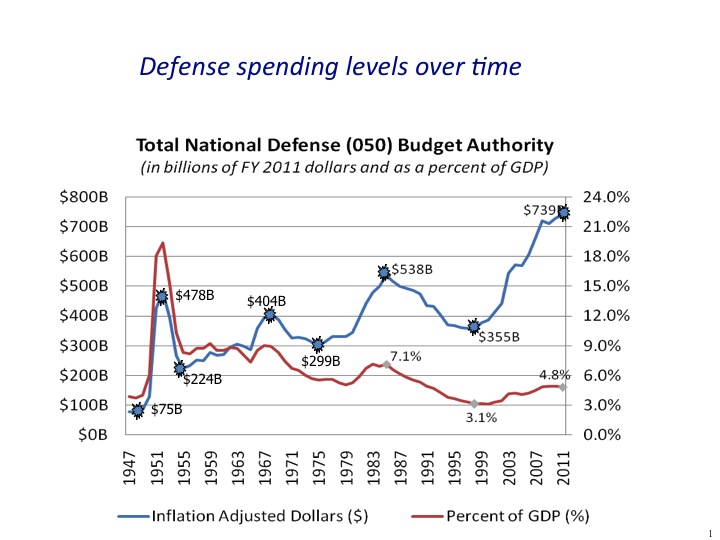
Notice that.  As a percent of GDP, defense spending has been remarkably stable.

Nevertheless, for the sake of national security, defense spending must be cut—the deficits and debts are too great and they threaten the weal and the safety of the nation.  The debt and the deficit picture certainly are as threatening as they’re made out to be, but consider: with no defense capability, where is the security?

What do we gain, though, by cutting defense?  Consider these items, courtesy of Neptunus Lex:

…shutting the doors on DoD entirely would still result in an $800 billion increase to next year’s aggregate deficit….

…radically reduce the ground forces, a couple of fighter wing equivalents and at least one or two aircraft carriers—the same forces which have allowed the US since the Cold War days to provide forward presence and deterrence.

Which is actually OK, because the Islamic Republic of Iran has just told us that the USS John C. Stennis is no longer welcome in their neck of the woods….

Well, at least one of those carriers won’t be needed, since it’s worn out its welcome in Iran as well as in DC.

One Progressive argument is that we can get away with such draconian cuts.  Even with cuts as deep as 90%, we can still wipe our attackders off the face of the earth.  But there are a couple of flaws with this argument.  The first is a moral one—and so a practical one.  With such deep cuts, we could wipe our enemies off—by going nuclear.  But with no intermediate capabilities, we’re stuck with the moral, and practical, choice of nuclear war or surrender.  There aren’t any intermediate options with such deep cuts.

The other flaw, though, goes to that ability to go nuclear.  Our nuclear weapons are aging.  They need testing and upgrade.   That takes money that’s being cut from the defense budget.  In the end, we have to ask ourselves, “what is the value of our nuclear weapons when we can’t count on them working?”  while our enemies are asking us, “Do you feel lucky, punk?  Well, do you?”

But the whole “we can cut defense” attitude suffers from another fundamental misconception.  It assumes that our enemies think like us, that their pain level is similar to ours, that their goals are similar to ours.

What do we gain by cutting defense rather than cutting somewhere else?   We keep three entitlement programs that are bankrupting us, and that will continue to do so, even after gutting national defense: Social Security, and Medicare, Medicaid.  But those are the programs that politicians use to buy votes with which to stay in power.

In the end, national defense and national security aren’t mutually exclusive.  Without both, we have neither.

Gridlock Works

Lost in the hoo-raw over the payroll tax reduction extension at the end of the year was Congressional inaction on a couple of other weighty matters—and this inaction redounds to our benefit.

Congress failed to continue a 45 cent per gallon tax credit for corn-based ethanol and a 54 cent per gallon tariff on imported ethanol (mostly from Brazil—Obama wants us to be one of their best customers).  Since these two items were among the few things Congress even constructed reasonably—they actually had sunset clauses—they expired Dec. 31.  Of course we can expect the Progressives to attempt to redress this egregious failure or to score the evil Republicans for stopping a resumption—that is, if the Republicans find their courage, lost in the debt ceiling fiasco and which loss was underscored by their screw-up on the payroll tax reduction, and block a resumption.

Another useless “green” subsidy expired through Congress’ inaction, also: the thousand dollar tax credit for installing an electric car charging station in a residential garage expired, as did the related tax credit (up to $30 thousand) for installing a commercial charging station.

Unfortunately, the gridlock didn’t achieve a sweep: fuel refiners still are required to add 36 billion gallons of ethanol to their fuel mixes by 2022, and the (maximum) $7,500 tax credit for buying an electric car remains in place.

Of course, as with all subsidies, these had just made the subsidized items more expensive.  The 45 cent credit for the ethanol-in-gasoline just followed the fuel right into your cost at the pump, for instance.  The $6 billion per year we taxpayers were being hit for this credit bought everyone else’s ethanol gasoline.  And we paid those $6 billion even when we bought an electric car, instead.  Those of us that have bought one; sales are steady, but far from outstanding.

That credit for buying the electric car is interesting in its own right.  Just to take an anecdote for an illustration, a Ford Fusion (ignoring the usual haggling, and only looking at MSRP) runs around $20 thousand.  The correspondingly ungussied-up Fusion Hybrid is a bit under $29 thousand.  With the subsidytax credit, that drops the Hybrid to a shade over $21 thousand.

In some cases, the credit doesn’t do the buyer as much good, though.  The Tesla’s Model S is a $50 thousand electric car, and their Roadster seems, from Tesla‘s Web site, to be of a price that if you have to ask, you can’t afford it.  The tax credit doesn’t have so much practical effect here.  As to the Fisker Karma, well, that electric car isn’t available at any price, at least for a while: its batteries are…defective.  The credit is useless for it.

Maybe instead of renewing the ethanol subsidies, we can get Congress to eliminate the electric car subsidy and the requirement to dump ethanol into our gasoline, too.  Keep in mind that ethanol is hard on your car‘s engine.

Or am I hoping for too much change this year?

What’s in it for the New Year?

Irwin Stelzer, of The Weekly Standard, offers some excessively realistic predictions for 2012.

Some examples follow; their accuracy, as Stelzer points out, depends on the likelihood of some things occurring—whether you believe in certain “ifs,” in his terms.  Stelzer mentions certain possibilities in Europe, but I’ve dwelled on the doings of that continent several times already; I’ll just mention some of his “ifs” for the US.

If you believe that the recent jagged but downward trend in claims for unemployment insurance foretells a drop in the unemployment rate that will be reported on Friday, and if you give weight to recent cheery numbers such as the uptick in regional indices of economic activity, you will stop worrying about the possibility of a renewed collapse in the jobs market.

If you read the recent upsurge in consumer confidence and spending to be suggesting that the demand side of the economy is ready to contribute to a more rapid recovery, you will murmur a word of thanks to the sainted John Maynard Keynes, and face 2012 with equanimity

You’ll also be, I think, ignoring the spike nature of the hiring, as it was primarily for temporary labor to man the retail stores and related endeavors as retailers and suppliers ramped up for that part of the year—Thanksgiving through New Year’s—when consumer shopping itself spikes for holiday buying.  You’ll also be ignoring this same season’s normal spike in optimism as the Christian optimism that underlies the two holidays dominates, as does the festive nature of the season, at least for a little bit.  And you’ll be ignoring three years of belt-tightening under these difficult economic conditions that produced what economists call pent-up demand: buying has been put off, and put off, and put off, until necessary things absolutely must be bought—or the feeling of too-tight living must be relieved at least a little.

The holidays are over.  The next few jobs and spending reports and consumer confidence readings will be interesting.

On the other hand,

If you believe that the continued fall in house prices—down in October for the 13th consecutive year-over-year decline—is more significant a harbinger than the recent modest pickup in sales, you also believe experts who guess that the bottom of the housing market will not be reached until 2015. That bodes ill for the jobs market….

If you believe that the recent spurt in consumer spending will prove unsustainable because it has come at the expense of savings…you believe the demand…will remain too weak to sustain [growth.]

See above re jobs and spending.

If you believe that the new round of regulations being readied by the Obama administration for the new year will frighten businesses, especially job-creating small businesses, you also believe that business investment is unlikely to provide much of a boost to the economy.

See above re jobs, and think about an ability to continue spending, even were a desire to do so present.

Stelzer then concludes, in keeping with the rump of the holidays, on an optimistic note:

…longer term the outlook brightens. America is still the world’s largest source of major innovations. It remains the home of risk-taking venture capitalists, deep and liquid securities markets, and a labor market so flexible that thousands can flee, and indeed are fleeing high-tax, regulation-heavy, union-ridden California for booming Texas. It is a safe haven for investors and the country of choice by immigrants.

But given the state of our educational system, for how much longer can we innovate?  Given the state of our economy, for how much longer can our jobs engine—small and medium businesses—afford to pay for innovation, or take risks involving innovation—or any other risks, come to that?  Given the present administration’s drumbeat of attacks on business—regulations Stelzer also mentions—for how much longer will small and medium businesses be willing even to try?  Given the present administration’s steady drumbeat of attacks on right to work states (vis., NLRB’s attack on South Carolina via its suit against Boeing for the miscreancy of wanting to build airplanes in that state), for how much longer will there be states that are sanctuaries for business, for innovation?  And he misses the fact that, in this economy, immigration is way down.

I’m not as sanguine about the coming year, or the years after, if we continue on our present course.

Free Market Capitalism And Democracy

I want to spend a little time talking about the relationship between free markets and democracy and about how closely connected the two are to each other.

A free market in this context is a market in which the participants—buyers and sellers, producers and buyers, businesses and customers, i.e., any pairing you’d care to think of involving people exchanging items of value—are free to determine for themselves both what it is that’s of value and the terms, if any, by which they’re willing to exchange those things.  Moreover, since the participants are free to bargain among each other, their collective choices, summarized into a general supply of and demand for goods and services and money determine general—and since voluntary, constantly fluctuating—terms of exchange: what can generally be expected to be available for buying and selling, and at what prices.

Capitalism in this context means private ownership of property, including money, and of the means of production: one’s body, including labor output; one’s thoughts, including intellectual property and output; and physical plant, including the entire gamut from individual hammers and screwdrivers up through whole plants and companies that use plants and employ physical and intellectual labor.  Further, capitalism occurs within the framework of a free market, and it facilitates accumulation of capital in a broad variety of forms for profit, for future expansion, and for development of new products and/or means of production.  Thus, capitalism underpins free markets.

Democracy is a means, often political, by which the members of a community decide for themselves a variety of matters, usually by voting in some manner.  A democracy may use a government as a mechanism for arriving at decisions, but in a democracy that government is subordinate to the people.  This is as opposed to a government originating decisions and handing them down to a subject people, with the people being subordinate to the government.

The aggregate of individual economic decisions is what makes up an economy.  In a free market, capitalist economy, individuals, at bottom, vote on what we want produced, vote on what we want to possess or to consume, with our economic property: dollars (which we earn in another component of the free market capitalist economy, the labor market, in which we sell our labor for a price voluntarily agreed on with an employer) and any other items we might offer in an exchange.

Every purchase we make, every sale we make, is the outcome of our voice speaking and the result of our choice made.  I’ve cited Adams before, but he’s applicable here, too: an individual’s happiness—the pursuit of which is one of those inalienable rights acknowledged in our Declaration of Independence—is this:

All men are born free and independent, and have certain natural, essential, and unalienable rights, among which may be reckoned the right of enjoying and defending their lives and liberties; that of acquiring, possessing, and protecting property; in fine, that of seeking and obtaining their safety and happiness.

Where we are free to choose for ourselves what we will do with our property, we there are free to develop our own lives toward our own goals.  And our economic property is founded on our natural right of property in our lives, our bodies, our minds, and the things we produce with those.  (As an aside, this natural right, among others, is acknowledged in our Declaration of Independence, as well as in Adams’ Massachusetts Constitution.)

It is this democracy of a capitalistic free market that enables us to manage our own ends, to reach for goals of our own choosing.  This is where we exercise our property rights in our own outputs.

And we must do so: if government exercises rights in our property, it also has control over our political property: it can give or withhold from us according to its approval of our voting.  Any time a government determines these things for us, even indirectly, by determining the terms of our exchanges, by determining the things we will be permitted—or required—to exchange, regardless of lofty motive, we individual participants lose our vote, we lose our voice: government is speaking, not for us and saying what we have instructed it to say; it is speaking, rather, to us and saying what its instructions to us are.

This is a two-way street.  Without political democracy, we cannot have the economic democracy of capitalistic free markets.  Within political democracy, we individually and freely vote with our political property for the things we need and want; it is through political democracy that we are able to act to preserve the freedom and capitalist nature of our markets.  The free market, our individual ownership of our property and of our productive facilities, are both demonstration and constructor of democracy.

In the end, free markets, capitalism, and democracy each needs the others; none can exist without the other two.  In fact, they are the same; they are merely economic and political sides of the same coin.

Lessons from Germany

Spiegel Online International talks about a (relatively) strong German economic performance in the coming year, following on the heels of a strong performance for 2011.  It also draws a contrast, while outlining the jealousy of its European neighbors.

Germany’s economic success does not make the country more popular among its neighbors, though. After all, this is the same country that has been blocking all proposals to use the European Central Bank (ECB) to provide more generous financing for embattled euro-zone countries. Some European countries appear to be secretly hoping that Germany, Europe’s economic paragon, will also soon feel the brunt of the crisis.

How did the Germans achieve this?  One path is through the intermediate-term outcome of some economic and governmental reforms they put into place in 2003, in part to cure themselves of being the “sick man of Europe.”  They:

  • increased, from management’s perspective, the mobility of their labor force,
  • provided stronger financial incentives for the unemployed to go back to work, rather than paying them unemployment “benefits” for not working,
  • reduced taxes,
  • reduced government debt relative to their GDP.

One of the things the labor reforms led to was increased hiring because the reforms made it easier for employers to hire.  In 2011 alone, for instance, a half million new jobs were created in a population of 81.5 million.  Their reforms also encouraged more people to try to go back to work.  The resulting increased employment rate matched up with the lower tax burden to leave more money in the hands of individual Germans.  In short, Germany took steps to free up its economy, moving it closer to an open, free market, especially in comparison with their embattled euro-zone neighbors, and embarrassingly so relative to the US.

Their European neighbors, on the other hand, are not implementing similar reforms; indeed, although the embattled euro-zone nations are cutting spending, they’re actually raising the tax burden on their populations and businesses.  Moreover, they’re eschewing reforming their labor laws which leave unions with a decisive upper hand.

Are there lessons here for us?  Let’s see: those half million German jobs would work out to nearly 2 million new jobs in the US in 2011.  Germany cut taxes, but like the failing nations of Europe, our government insists on raising taxes.  Our tax increases aren’t even intended to close any budget gap, or to pay down any national debt, either—they’re for supporting even higher spending.  And here we are, just as are the embattled euro-zone nations, mired in a three-year-old recession in all but name—stagnating away with high unemployment, rapidly increasing budget deficits, and exploding national debt.

Hmm….