Jobs Numbers

According to the headlines, our unemployment rate fell to 6.3% in April (from 6.7%); it hasn’t been that low since before the Panic of 2008. This also came as the private sector and state and local governments added 288,000 jobs. Good news, eh?

It is good news, for those 288,000 Americans. However. There’s always a however.

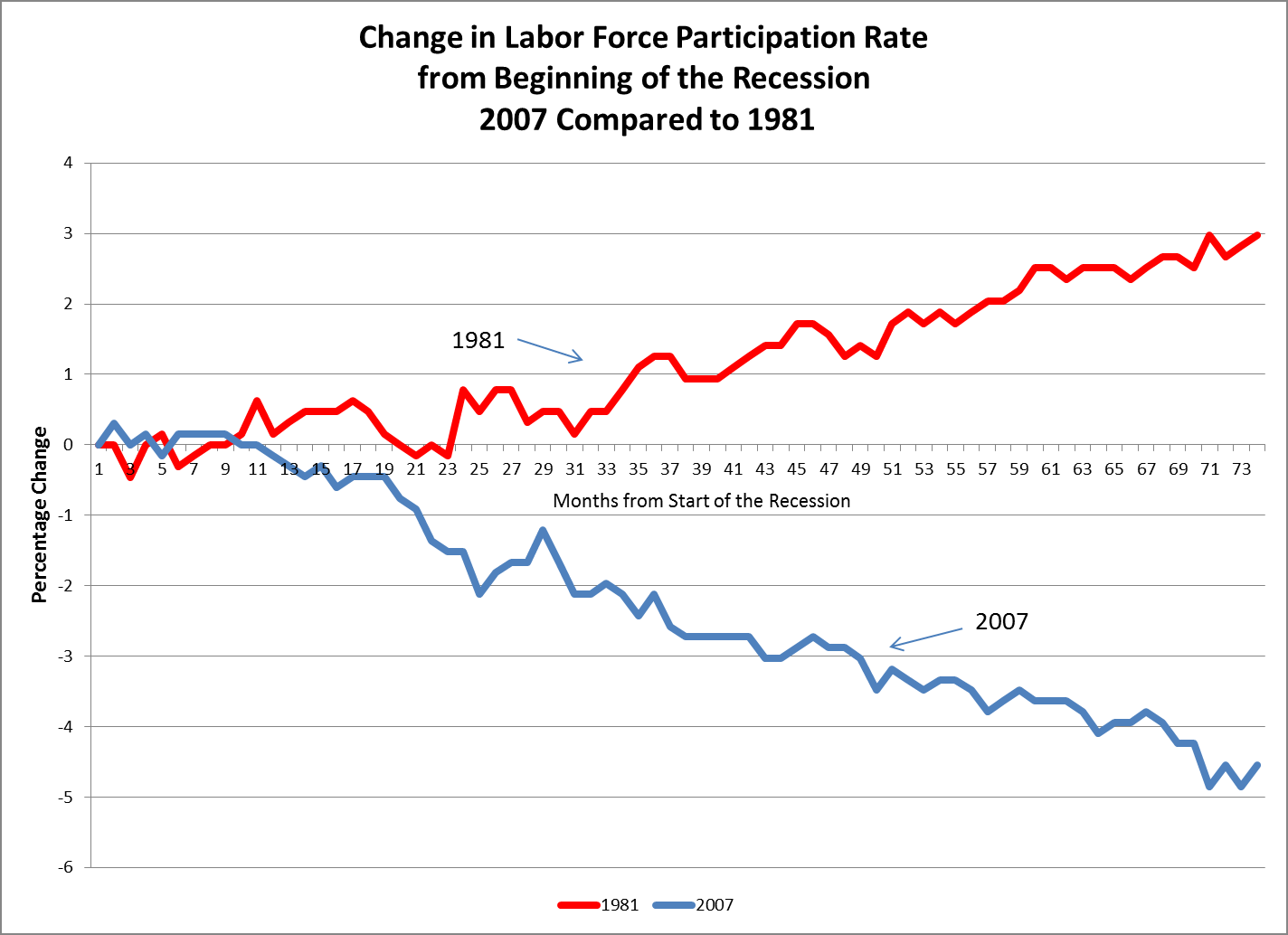
806,000 Americans gave up looking for work in this economy and dropped out of the labor force. The labor force participation rate fell to 62.8% (from 63.2% in March), the lowest rate in nearly 40 years. If this number had only held steady at March’s value, the unemployment rate would be in the 6.7%-6.8% range.

These data also come on the heels of our GDP datum for the first quarter of 2014, which ended in March: GDP grew at the sickly rate of 0.1% over the 4th quarter 2013.

The jobs report turns out to indicate a fine beginning for the second quarter of 2014.

Jobs and Income in the Current “Recovery”

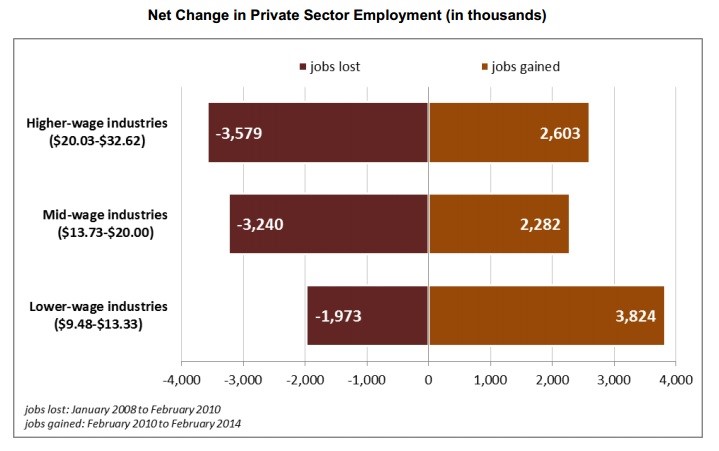
AEIdeas‘ James Pethokoukis has some data in his article, “Obama’s low-wage jobs recovery.” He talked about the type of jobs being…created…in this so-called recovery; the graph below highlights his point.NetChangeEmployment

There’s another aspect to this, though, and that’s the income implication of the type of jobs being created. I constructed the table below from the data in the graph above, using the mid-points of each industry type wage range and assuming a 2080 hour work year—that is, everyone, even the low-wage industry worker, either works all 52 weeks of the year or gets paid in full for vacation time, including holidays, to keep the arithmetic simple.

Wage Mid-Point Jobs Lost (Thousands) Jobs Gained (Thousands) Not Jobs Gained (Thousands) Net Annual Wages Gained/Lost (Thousands $)
High Wage: $26.3250 (3,579) 2,603 (976) ($53,441,856)
Medium Wage: $16.8650 (3,240) 2,282 (958) ($33,605,874)
Low Wage: $11.4050 (1,973) 3,824 1,851 $43,910,162
Total: ($43,137,567)

You’re reading that right. The only net gain in income is in the low end industries; these folks, by being able to go back to work, have gotten a net increase of some $44 billion in their annual income. But that’s swamped by the losses in the other two categories, and the nation as a whole has lost some $43 billion in annual income.

This is a fine recovery, yes, indeed.

Income Inequality and Blinders

The impact of Obamacare, still being denied in some circles:

In January, nearly half of small-business owners with at least five employees, or 45% of those polled, said they had had to curb their hiring plans because of the health law, and almost a third—29%—said they had been forced to make staff cuts, according to a U.S. Bancorp survey of 3,173 owners with less than $10 million….

And

Given how much the President talks about income inequality, it is perhaps ironic that his signature achievement is preventing people from earning incomes.

ObamaCare-induced phenomenon of “29ers”—employees held below 30 hours of work per week to avoid counting as full-time workers eligible for employer-provided health insurance. As a Journal editorial explained last year, “The savings from restricting hours worked can be enormous. If a company with 50 employees hires a new worker for $12 an hour for 29 hours a week, there is no health insurance requirement. But suppose that worker moves to 30 hours a week. This triggers the $2,000 federal penalty. So to get 50 more hours of work a year from that employee, the extra cost to the employer rises to about $52 an hour—the $12 salary and the ObamaCare tax of what works out to be $40 an hour.

Hmm….

Paying the Vig

New York’s Metropolitan Transit Authority has reached an agreement with the Transport Workers Union Local 100, the union representing the city’s 34,000 subway and bus employees. No news there. What’s interesting is a “side letter,” also agreed, about which both the MTA and the TWU carefully kept quiet.

A side letter of this sort is a separate deal that commits to paper the wink and nod that otherwise would represent an unspoken agreement that no one is supposed to know about, but that the winker and winkee reached on the q.t.

This particular side letter has the MTA paying, over the next three years, $6 million into a union slush fund “trust established for permissible purposes.”

The payments are being made “in the interests of sound labor relations.”

Of course.

The UAW and Its Volkswagen Union Vote Appeal

The UAW has, at the last minute, withdrawn its appeal to the NLRB of the vote it lost in Chattanooga concerning its attempt to unionize the Volkswagen plant there.  The UAW lost the vote despite having had the most favorable conditions for their side imaginable, including union representatives proselytizing in the plant during working hours while plant management was not allowed to counter-proselytize.

UAW President Bob King offered this as the rationale for the withdrawal:

The UAW is ready to put February’s tainted election in the rearview mirror and instead focus on advocating for new jobs and economic investment in Chattanooga.

Why does this not feel like an acceptance of reality, but rather that the union has something up its sleeve?  Or is my concern simply borne of the distrust created by the UAW’s routine mendacity in the past, and now my mistrust is misplaced: the union really is interested in cooperation rather than contention as the means of generating jobs?

Gary Casteel, responsible for the UAW’s southern region operations, in fleshing out King’s position,

called on Governor [Bill, R] Haslam to reinstate an offer of $300 million in economic incentives to Volkswagen.  The offer was suspended just before the union vote.

Hmm….