JOBS

Who wants any of these?  Plainly not Progressives and their supporters.

The House of Representatives passed the Jumpstart Our Business Startups Act on 8 March by a vote of 390-23 (yes, that’s 158 Democrats in the House that also voted for this bill.  Apparently not all Progressives are anti-JOB).

But now that it’s in the Democratic Party-controlled Senate, where is it?  Senate Majority Leader Harry Reid refused to allow it to be debated and voted on unless he got his approved judges voted up in his “jobs for judges” debacle.

Others, Progressives and turf-protecting bureaucrats and unions, also have weighed in in opposition.

SEC Chairman Mary Shapiro, whose regulatory empire would be reduced, however slightly, objects to a provision to exempt companies with annual revenues less than $1 billion from a variety of regulations like Dodd-Frank’s executive compensation rules and duplicative Sarbanes-Oxley audits of internal controls.  Senate Majority Whip Dick Durbin joined this particular fray arguing that the agency that watched, while doing nothing, Allen Stanford and Bernie Madoff is somehow needed to oversee the next Bill Gates or Steve Jobs or Mark Zuckerberg.

The accounting firms that stood around and watched Enron and WorldCom are objecting to a reduction in the mandate (i.e., guaranteed business and fees) for their “services”  stemming from an exemption for new companies from critical parts of SOX.

Unions, worried about their own loss of power in a free market environment, object because—well, just because.

Senate Progressives (other than Reid) object because it came from a Republican House.

The Senate vote will be interesting to watch.

An Economy

President Obama is campaigning heavily, these days, on the strength of “his” economic recovery.  Let’s look at this recovery.

Peter Ferrera, cited in The Wall Street Journal, writes

From 1947 to 2007, the U.S. economy averaged real growth of 3.2% a year. At that rate, our GDP would double every 22 years. … Last year, U.S. real economic growth was a paltry 1.7%. The current quarter will probably not be much better.

and

[T]he American economy catching up to its long term economic growth trend line would mean the economy booming over the next 10 years with average annual real growth of 4.4%, and then continuing on after that at 3.2% real annual growth.  Ten years of 4.4% real growth would leave the American standard of living, and GDP, over 50% higher than today.  That is the boom this economy has in it naturally, with the right pro-growth policies just getting the government out of the way, and freeing the economy to grow.

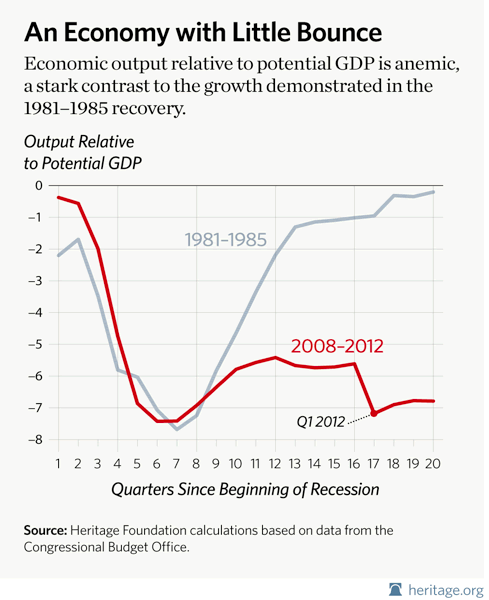
How are Obama’s policies doing?  Typical recession recoveries are faster and higher the deeper the recession from which we’re recovering.  This chart draws a comparison with our nearby history—the recovery from the recession of the ’80s, which was as deep and hard as the present one. The recovery just isn’t there very much.  Unemployment is falling off, and job creation is occurring (more on that below), but it’s anemic.  The zero-line represents full GDP output—our economy is operating on all cylinders—and three years after the ’80s recession’s deepest point, we were at full production.  With the current recession, it’s not even close.  In fact our current growth rate of 2.4% per year since the recession’s formal end in the spring of 2009 is the slowest rate since WWII.

The next three charts look at our labor—our employment—picture in particular.

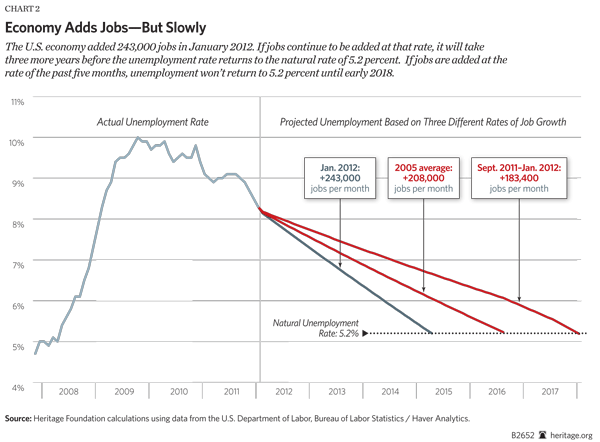
This chart looks at three different growth rates and the time from today to full employment.  If employers continue to add jobs at the same rate they did between September 2011, when unemployment began to improve, and last January—183,400 jobs per month—the unemployment rate won’t reach even 7.8% for another 20 months, December 2013, and will not full employment for five more years: January 2018.  Even if employers add jobs at their 2005 pace, we won’t reach full employment until mid-2016, and if January’s unusual rate is continued, we’re still looking at mid-2015 before reaching full employment.

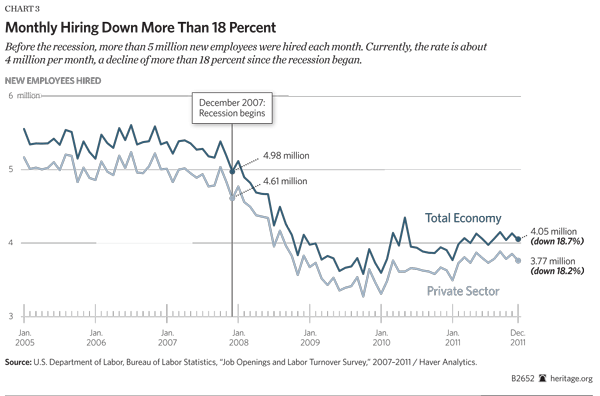
This next chart gives another look at our future.

Fewer existing businesses are hiring, and fewer entrepreneurs are starting new businesses; there are fewer jobs for the unemployed.  Moreover, it takes time for startups to grow and to increase their hiring, just as it does existing businesses to recover, resume growing, and increase their own hiring.  Delays now in growth and job creation mean continued delays tomorrow in getting growth going and hiring to increase.

The next chart shows the falling labor participation rate in our current economy.

The present  63.7% of adult Americans active in the labor force (either employed or looking for work) is the lowest participation rate since 1983—when far fewer women were working.  Keep in mind that this historically low participation rate artificially reduces the measured—headline—unemployment rate because folks not looking for work aren’t counted as unemployed.  The Congressional Budget Office estimates that the unemployment rate would be 1.25 points higher—9.45%—if labor force participation were at normal levels.

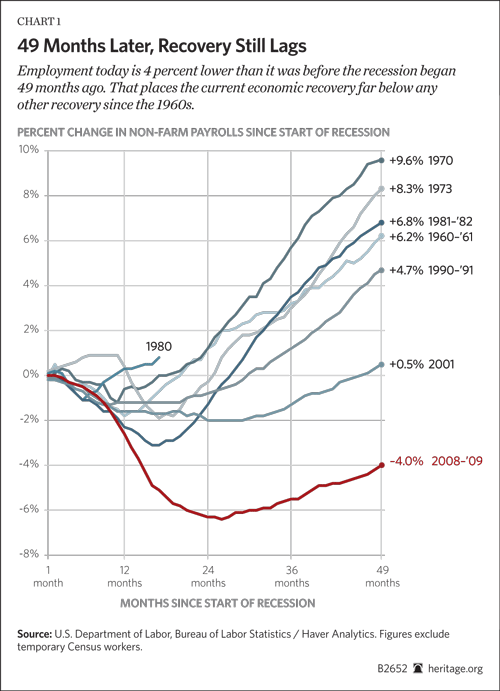
Finally, how does our current recession…recovery…compare with past recoveries?  This last chart is illustrative.

In every prior post-war recession, employment has fully recovered within four years.  As of December 2011—four years after the recession’s onset—payroll employment remains 4.0 percent below the number of workers employed when the recession started in December 2007. Private-sector employment is 4.5 percent below pre-recession levels.  That represents 5.6 million net fewer jobs; 5.2 million of those net job losses occurred in the private sector.

In sum, as The Heritage Foundation points out,

It’s the natural tendency for the economy to grow—and taking credit for its meager improvement is sort of like accepting kudos for the rising and setting of the sun.

We have any sort of recovery at all solely because of that natural tendency to grow.  What are the differences between our current straits and past recession recoveries?  Obama’s policies are of a kind with a prior Progressive President, Franklin Roosevelt.  Both sets of policies centered on expansive, intrusive government, increasingly interfering with the operation of our free market and even going so far as to dictate what individual Americans are permitted—or required—to do in the market place.  All for our own good.  Just as those policies so tragically prolonged the Depression of the ’30s, so are these policies prolonging the current recession’s effects.

On the other hand, when met with shrinking government and reducing personal and business tax rates, as Jack Kennedy (!) and Ronald Reagan, for instance, did, our free market economy responded with rapid, prolonged growth.

I agree with President Obama.  The credit for these three years of historically poor economic performance is entirely his.

The Senate and Jobs

Here’s another aspect of the Democratic Party-controlled Do-Nothing Senate’s attitude toward free markets and private enterprise—that is, non-government—job creation.

Earlier this week, Senate Majority Leader Harry Reid (D, NV) offered to allow a swift vote on the JOBS Act, a Republican-led jobs bill that passed the House [last year!] with overwhelming bipartisan support, in exchange for Republicans dropping their objections to confirming some of President Obama’s judicial nominees.

Senate Minority Leader Mitch McConnell (R, KY) has the right of it.

I think most Senators would rather be working on things that the American people believe would actually help create jobs than to see the Senate embroiled in another controversy which I fear my good friend, the Majority Leader, is seeking to precipitate.

Now the Democrats are ready to talk about jobs for Americans?  But only as a quid pro quo, and not because jobs are something that Americans actually need?

Against what trades is Reid holding the other 25+ House-passed jobs related bills?

This is Stimulating

…on a couple of levels (but, no, it didn’t generate a tingle down my leg).  Paul Chesser, of the National Legal and Policy Center, wrote about a law firm and Fisker Automotive earlier this week.  Of particular interest to me in the article were two things.  One was this:

Debevoise & Plimpton LLC, received $1,842,180 in Recovery Act funds to provide legal advice, conduct due diligence, and review documents for two loans from DOE’s Advanced Technology Vehicles Manufacturing Loan Program.  One $529 million loan award was to Fisker Automotive to develop and produce two lines of electric vehicles….

Debevoise provided the same services to DOE for its $5.9 billion loan to Ford Motor Company, to convert five of its factories…so they can produce more fuel-efficient vehicles.

That’s a potful of taxpayer money for what seems a straightforward legal task (I won’t go into the political donations employees of the firm made; there’s more of that in the article.  Besides, there’s no evidence of anything illegal having been done here).  Perhaps some of the lawyers reading this can weigh in on the actual costs and charges such analyses normally entail.  I also wonder how many jobs were “saved or created” by this particular Stimulus payout.  Oh, wait, Chesser addressed this:

At the height of its legal services activity for DOE, 1.25 jobs were created that were attributable to Debevoise’s work on the two loans.

The other thing is the quality of the due diligence and analysis provided.  Now it’s certainly possible that loans on which proper due diligence has been done will still fail.  But getting information about this particular loan analysis out of the Department of Energy has been like pulling teeth from a chicken.  Judicial Watch has been forced to sue in Federal court under the Freedom of Information Act to get any serious data concerning this loan of taxpayer money.  The cynic in me has to ask what information has the administration so nervous.

A Wise and Practical Man

What he said.

The Honorable Barack Obama
President
The White House
Washington, DC 20500

Dear Mr. President:

I am writing today to urge your Administration to take overdue but necessary action to confront soaring gasoline prices. In the last three years, gas prices have doubled, draining the disposable income of millions of hardworking Americans. In 2011, the typical U.S. household already spent $4,155 on gasoline, almost 10 percent of their income. Yet some analysts now predict prices may rise this year to more than $5.00 per gallon.

In a speech this Thursday, you stated that “there are no quick fixes to this problem. You know we can’t just drill our way to lower gas prices.” While we should explore a variety of energy resources—most especially those which do not put taxpayer dollars at risk—I respectfully disagree that we cannot utilize our remarkably vast untapped energy reserves to provide Americans with much-needed relief. I reject the defeatist view that says the nation that won two world wars, pioneered space travel, and overcame the Soviet Empire is now helpless in the face of high prices at the pump. We are not at the mercy of dictators, cartels, and events beyond our control.

Simply by removing the bureaucratic barriers imposed by your own administration we can begin to make progress. But we can go much further than that. Powerful action to harness America’s untapped oil and gas resources would place downward pressure on prices and speculation in the short-run and, by surging global supply, would serve to keep prices low in the future. Crucially, it would also provide millions of Americans with good-paying private-sector jobs; produce substantial royalties for local, state, and federal governments; reduce our enormous trade imbalance; and put an end to our huge wealth transfer from America to competitors oversees.

I therefore recommend the following proposals for immediate implementation:

1. Restore the bipartisan 2010–2015 offshore lease plan to ensure that the 31 lease sales called for in that plan are completed expeditiously. Your Administration only directed one lease sale in 2011 and has announced just one lease sale for 2012, far short of the number of sales that would have occurred over this period under the original 2010–2015 plan that your Administration discarded.

2. Take all necessary steps to accelerate the leasing and permitting process for domestic shale oil production. The United States has recoverable shale oil reserves estimated at 800 billion to 1.2 trillion barrels, meaning our nation has potentially three to four times more recoverable oil than any other country in the world except Canada.

3. Maximize energy production from federal lands. As I and 21 other Senators noted in a January 25, 2012 letter to you, actual oil production on federal lands is now just 714 million barrels per year, a 16 percent decline from what was projected just five years ago. This decline must be reversed.

4. End the de facto moratorium on permitting for offshore oil and gas production.

5. Direct the EPA, the Department of Energy, and other federal agencies to grant all necessary waivers and approvals to oil and gas refineries to facilitate maximum production at minimum cost. Refinery expenses comprise 11 percent of the price for gasoline that Americans pay at the pump, but your Administration has imposed numerous regulations that have driven refining costs up, not down.

6. Abandon your proposal to increase taxes and fees levied on U.S. energy production by more than $40 billion. These additional costs would be passed along to consumers, taking money out of their pockets and discouraging needed domestic production.

7. Approve the Keystone XL pipeline and grant necessary waivers, licenses, and permits, where possible, to ensure expedited completion of this important North American energy project. The pipeline would carry 700,000 barrels a day to U.S. refineries, which is nearly half what the U.S. currently imports from the entire Middle East.

America has the potential to fundamentally shift the balance of power in global energy production—to produce more energy, more efficiently and more cheaply, than your Administration has recognized. Such bold steps will broadcast an unmistakable signal to the world that not only places downward pressure on prices in the near-term but helps deliver a future of abundant, affordable energy. Moreover, unlike costly short-term stimulus, achieving energy independence would provide long-term relief to both struggling families and our indebted treasury.

I look forward to working with you on this important matter.

Very truly yours,

Jeff Sessions
U.S. Senator

Hmm….