
A New Category

There is a need for a discussion of how to handle terrorism and terrorists.  Before that discussion can be useful, though, we need to understand the relationship among terrorism, crime, and war.  This is a beginning of that discussion.

We currently have two categories of conflict participants which I’ll term—my layman’s terms, understand, not any legal or legalistic ones—criminal and soldier or combatant.  The one is a domestic (usually) question involving the violation of a nation’s domestic criminal laws.  The other is an international question involving a nation’s soldiers or combat arms engaging in more or less declared war and during the conduct of which the nation and its soldiers are subject, together and individually, to national laws and generally agreed international laws of war (for instance, the Geneva Conventions).

As we have seen at least since the turn of the century, though, there is a third category of conflict, and those who perpetrate this third kind—both the polity and its individuals—need a different form of response when encountered on the battlefield or after capture.  It’s important to understand, too, that the battlefield in this third category isn’t limited to classic set-piece force on force encounter on a field or over a beach, nor is it the hit and run battlefield of a guerrilla effort.  This new battlefield includes those, certainly, but it also includes our theaters, concert venues, shopping malls, subways, airports, airplanes—anywhere groups of people are gathered.

This third category already exists in the public’s mind, but it needs a third category of legal handling.  This third category is terrorism and its participants are terrorists.  Examples of these include polities like al Qaeda and the Daesh and gangs like Boko Haram and their individual members.

These are entities and individuals who are intent on killing innocents, not soldiers, and they’re intent on the killing for its own end.  The resulting terror is their goal and their tool for destroying the body politic of their target.

Mere criminal laws are inadequate for handling such mass murderers, whose killing does not rise from insanity, but from a desire for creating the terror that is their tool for larger ends.  Nor can these entities and individuals be handled adequately with laws of war governing how soldiers are to be encountered and killed or treated after capture; their behavior, their targets, place them outside such laws.

For the individual terrorists of a polity or a gang, we need new laws, laws of terror war, both domestic and international, with which to govern our encounters with them in battle and our handling of them should any be captured.  Simply putting them on trial and locking them up on conviction is useless; they’ll just return to their battles upon release (nor are they worth the effort, expense, or resources of maintaining in confinement).  Dealing with them on the battlefield under existing laws of (ordinary) war is unsuitable, too: in far too many cases, to take just one example, their shields are not building walls or bunkers, but innocent, helpless women and children.

Similarly, we need a new Convention with which to deal with a terrorist polity or gang.  Simply crushing these in a series of battles is insufficient.  Their existence as non-nation-state entities, as network entities, makes any battle victory, any war-level victory a chimera.  Their goal of wanton destruction for the terror to be caused make any defeat, or appearance of one, an empty gesture.  Sterner, more permanent measures and the rules governing those measures are needed.
A Grasping EU

French President Emmanuel Macron has repeated the EU’s diktat that Great Britain, after leaving the European Union, cannot have full trade relations with the EU unless the British open their borders to anyone in the EU who wants in and accept the dominance of EU courts over the British government and laws.  In addition to that, the Brits must make a “contribution to the budget.”

This is just a naked power grab by the EU, and national sovereignty be damned.  What the EU is doing here is just a kinder, gentler western Europe version of what Russian President Vladimir Putin is trying against Ukraine and threatening the Baltics, Poland, and Moldova with.

Not even Putin is demanding tribute, though.

Great Britain can’t get out of the EU soon enough.

An Embassy Move

The Trump administration has taken steps to speed up the move of the US embassy to Israel from Tel Aviv to Jerusalem.  Instead of building new, the administration

has decided to modify an existing property to accommodate the new mission that will open next year, US officials said.

Good.  This illustrates that President Donald Trump is not just engaging in Obamatalk about any move, he’s actually suiting action to his words.

The execution of the move also is consistent with past behavior.  The original plan was that brand, spanking new building that would have cost a billion dollars and years of time to get done.  Instead, by retrofitting an existing consular building, a more than adequate (if not ridden with lots of bells and whistles and froo-froo) building can be had for considerably less (the retrofit still won’t be cheap: think security and cyber protections) and be open for business next year.

A Bad Deal

And all for the sake of a personal legacy, apparently.

Republic of Korea President Moon Jae-in has cut an Olympic-sized deal with northern Korea concerning the latter’s participation in next month’s Winter Olympics.  According to the deal,

South Korean athletes and performers [will go] north of the demilitarized zone for training at a North Korean ski resort and a cultural event at a scenic mountain resort.

Further,

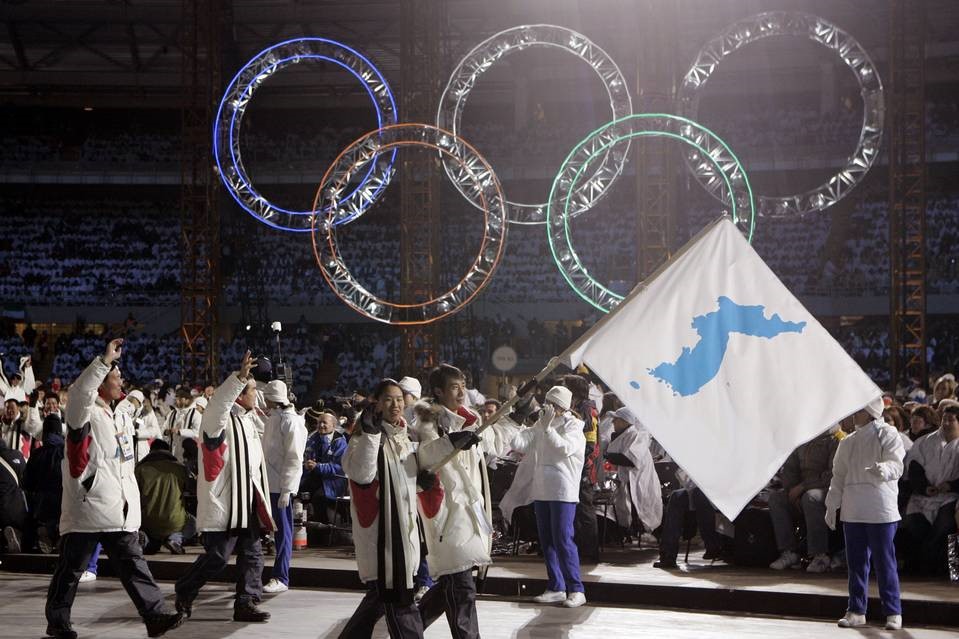
[T]he two Koreas will walk into the opening ceremony of next month’s Winter Games in Pyeongchang, South Korea, under one flag—the unification flag that depicts all of Korea. The two countries’ women’s ice hockey teams will unite to form a joint Korean squad.

It’ll be interesting to see how many ROK athletes and performers will be willing to go north and the quality of those who do.  It’ll also be interesting to see what the single flag looks like; here’s what the “reunification” flag looked like at the 2006 Winter Olympics:

It’ll be even more interesting to see how many of the RoK women’s hockey team actually show up.  There’s considerable disgruntlement among the team, Olympic athletes generally, and athletic sphere leadership over Moon’s agreement here, both over the agreement and over the RoK players who will be cut or denied ice time to make room for the north’s players.

And: the agreement seems not to have been done with athletes’ input or even warning that it was coming.  Moon certainly is setting his legacy.

Nuclear Weapons Proliferation

President Donald Trump has moved to fix or withdraw from ex-President Barack Obama’s (D) Executive Agreement with Iran, cosigned by the leaders of a number of European nations, covering Iran’s nuclear weapons program.

Folks can argue that this step has taken too long (and the terms of Obama’s EA have not been fixed, yet, nor have we canceled it; the deadline for that is next May), and I’m among the impatient.  However, the delay isn’t all bad (so far), since discussions of the Agreement, both public and behind the scenes (I assume), over the course of this delay have made the problems with it plainly evident, and the other parties to the deal no longer have excuses—they’ve have plenty of time to make their positions plain.

And the European parties are doing so.

European leaders have pushed back against major revisions. That, they fear, could give Tehran an excuse to walk away from the deal entirely, accelerating Iran’s path to a nuclear weapon.

This is naïve.  Accelerated or only moderately accelerated, Iran will get nuclear weapons in the current circumstance.  That would be the true disaster, since Iran has sworn to destroy Israel, and Iran will happily sell (or give) nuclear weapons to its client terrorist network entities for the latter’s use in Europe, the US, and elsewhere around the world.