Free Speech

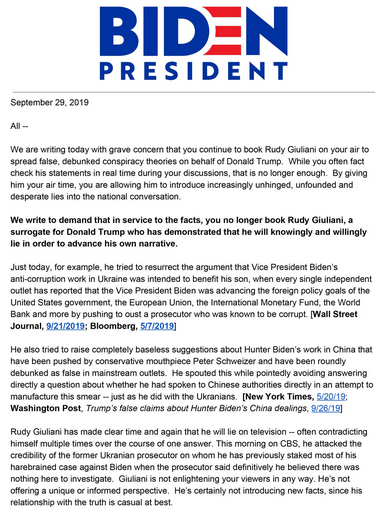
We’re beginning to see more of the value system that the most progressive candidate of them all, Progressive-Democratic Party Presidential candidate and ex-Vice President Joe Biden, wants to impose on all of us.  His campaign team, led by Anita Dunn (one of ex-President Barack Obama’s early White House Communications Directors) and Kate Bedingfield (Biden’s 2015 Communications Director) of Biden for President, have written to

executives and top political anchors at ABC, CBS, CNN, Fox News, and NBC, including star interviewers like Jake Tapper, Chuck Todd, and Chris Wallace

to demand all of them cut Rudy Giuliani out of his ability to speak to us ordinary Americans via those widely disseminated and watched programs.

We are writing today with grave concern that you continue to book Rudy Giuliani on your air to spread false, debunked conspiracy theories on behalf of Donald Trump.
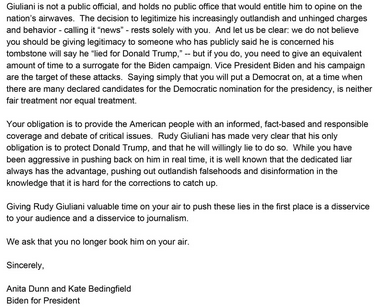
Giving Rudy Giuliani valuable time on your air to push these lies in the first place is a disservice to your audience and a disservice to journalism

This is as clear an expression of the contempt in which members of the Progressive-Democratic Party hold us ordinary Americans.  Plainly, they think us just too grindingly stupid to decide for ourselves what we’ll listen to or how to think about what we hear, including whether Giuliani’s comments really are false, debunked conspiracy theories.  Or whether it might be Biden, et al., who are distorting the facts.  Biden, with this letter that The New York Times go hold of, has made that contempt explicit.  Again.

Much worse, though, is that this is a demonstration of the overall nature of free speech that the Biden the Presidential candidate is pushing.  Think about the breadth and depth of his assault on our freedom of speech that a Biden administration would inflict on our nation.

NYT provided these images of the Biden team’s letter.

In Which Alphabet may be Getting One Thing Right

Alphabet’s Google subsidiary is developing a new Internet protocol, and competitors are worried that the protocol would mak[e] it harder for others to access consumer data. Some thoughts on that below.  Congress is concerned, too, and its “antitrust investigators” are looking into the matter.

The new standard modernizes a fundamental building block of the internet known as the domain name system, or DNS. This software takes a user’s electronic request for a website name such as wsj.com and, much like a telephone book, provides the series of internet protocol address numbers used by computers [to provide user access the website].
Google and another browser maker, Mozilla Corp, want to encrypt DNS. Doing so could help prevent hackers from spoofing or snooping on the websites that users visit, for example. Such a move could complicate government agencies’ efforts to spy on Internet traffic. But it could prevent service providers who don’t support the new standard from observing user behavior in gathering data.

Alphabet, via Google, also runs its own DNS service, Google Public DNS, which lends credence to monopoly abuse concerns.  Alphabet also pointed out, in its proposal, that the new standard would

improve users’ security and privacy and that its browser changes will leave consumers in charge of who shares their Internet surfing data.

My thoughts are these:

  • There’s nothing wrong with Alphabet developing any new Internet nav protocol, including this one. I’d expect them to be required to license it, though, much like chip makers are required to license their tech.
  • There’s nothing wrong with alter[ing] the internet’s competitive landscape as the article put some of the concerns. Product and tech development and innovation always alter the existing competitive landscape. That’s to the good.
  • They [cable and wireless providers] fear being shut out from much of user data.… That’s a bit of too bad. They’re not the providers’ data; they belong to the user. It’s exclusively (or should be) the user’s call whether to share his data with any provider or other vendor.

And this:

Mozilla…will move most consumers—but not corporate users who use providers such as Akamai—to the new standard automatically, even if the change involves switching their DNS service providers.

Users better be able to override that switch. Otherwise, this may resume the browser wars between Mozilla/Netscape and Microsoft.  To Alphabet’s credit, if they can be believed, its Google subordinate has no plans to ape Mozilla and compel a change in DNS providers.

Given licensing, the only real concern is this:

[T]he new system could harm security by bypassing parental controls and filters that have been developed under the current, unencrypted system.

That’s fairly straightforward to restore, though.

A Parallel

The Progressive-Democrats are pretending to hold “‘official’ impeachment inquiries” against President Donald Trump.  It’s a pretense because were they serious, House Speaker Nancy Pelosi (D, CA) would put the matter to a House floor vote and put all Representatives—Republican and Progressive-Democrats alike—on the public record as being for or against an actual impeachment inquiry, as the House, under majorities of both parties, has done for past impeachment moves.  Instead, she has not; the Progressive-Democrats intend only to keep the smear going for the next 14, or so, months in a naked attempt to control the next election.

It’s a dangerous move, though: ordinary Americans, the object of so much contempt from the Left and from Party, aren’t stupid, and they can see clearly what’s happening.  Further, such moves have backfired in those past, legitimately serious (because deeply bipartisan) impeachment efforts: the minority party made equally serious gains in the subsequent elections.

There’s a parallel situation currently unfolding in Austria.

In 2017, Vice Chancellor Heinz-Christian Strache was filmed offering to facilitate the purchase of the Kronen Zeitung, Austria’s largest tabloid newspaper, if the purchaser would commit to editorial support for Strache once she gained control.

The filming turned out to be a setup to entrap Strache (the purchaser turned out to be a woman pretending, for the sake of the sting, to be the wealthy niece of a Russian oligarch), but by whom?

Even today, there are few details about who organized the trap or why they waited two years to release the footage….

Even so, the government fell.  Like Bill Clinton, Stache seemed and seems guilty as hell.

Chancellor Sebastian Kurz called a snap election the day after Strache resigned but by the end of the month, Kurz himself had been ousted by a no-confidence motion and replaced by an interim chancellor.

However, today we’re four months later, the new elections were yesterday, and as of Friday,

The party [Freedom Party, Strache’s party] quickly re-calibrated after Strache’s resignation; portraying themselves as victims in a shadowy sting operation.
“The FPÖ came out as heroes—as martyrs—they rephrased the situation,” says Paul Schmidt, Secretary General of the the Austrian Society for European Politics, an NGO in Vienna.

And

The polls indicate Kurz will be re-elected chancellor and he has not ruled out renewing his old coalition with the Freedom Party.

Indeed, early returns indicate Kurz’ party (not directly involved in the scandal) looks to gain seats.  Like ordinary Americans, ordinary Austrians are not stupid, and they don’t like cheap shots—that setup run by who knows whom—or politicians and seeming self-important activists making serious, purely political moves out of relatively minor business.  Clinton’s misuse of a young intern was certainly serious business for his intern and for him, but the impeachment effort was strictly politically done by a party that simply didn’t like the man.

The Progressive-Democrats’ present effort fits the latter.  Trump is atypical for holders of political office, being routinely bluntly- and occasionally crudely-spoken and prone to acting rather than talking.  He’s very much hated by professional politicians for that atypicality, and especially by Progressive-Democrats, who consider election outcomes their personal property and Trump an unauthorized squatter.  They want their property cleared out, and they’re going to do whatever they think they must to reclaim their property in 2020.

Update: Based on exit polling, it looks like Kurz’ ÖVP will gain 37% of the vote, up sharply from the 31% his party got in the prior election.  Only the FPÖ was damaged by Strache’s misbehavior, falling to 16%, and a renewed governing coalition between ÖVP and FPÖ seems unlikely.  Kurz, though, still needs a coalition in order to form a governing majority.

Aid for Ukraine

One of the topics discussed by President Donald Trump and Ukraine’s President Volodomyr Zelenskiy in “that telecon,” was the degree of aid Germany has provided Ukraine in the latter’s on-going struggle against Russia’s invasion and occupation of Crimea and eastern Ukraine.  Neither considered Germany’s actions anywhere near adequate.

Deutsche Welle demurs from that position.

[A]ccording to the latest OECD figures, Germany is the third largest donor to Ukraine after the European Union as a whole and the US.

Those amounts?

[F]igures provided to DW by the German Foreign Ministry indicate that since 2014, the country has pumped almost €1.2 billion ($1.3 billion) of bilateral financial aid into Ukraine. This total includes some €544 million of official development cooperation, €110 million in humanitarian aid, a financial loan of €500 million, and some €25 million for stabilization measures, such as conflict monitoring and the promotion of the rule of law.
Germany has paid another €200 million to Ukraine via EU aid contributions.

That works out to all of €240 million ($260 million) per year.  And none of it actual material assistance: no money at all for defensive weapons systems or even individual protective equipment, much less systems that would help Ukraine drive the invader back out.  And money for “conflict monitoring?”  Ukraine is already fully capable of watching the Russians in their nation.  The other aid, in other circumstances, would be very useful, but with Ukraine in the military and political straits in which it exists today, the results of that aid are very much in doubt in the face of that Russian occupation and the continued Russian effort to drag the nation back under the Russian yoke.

Third largest amount of aid behind the EU and the US: what a statement of the paltry level of aid that is—especially considering that, during the Obama years, the US also refused to provide any serious aid at all to Ukraine, limiting our “largesse” to blankets and medicines, but not a single bullet or other self-defense capability.

Returning to Germany’s alleged contributions: far from helping Ukraine, Germany has utterly betrayed the nation, functionally repudiating the Budapest Memorandum as it has.  Instead, Germany has pushed for the quickly-failed Minsk Protocol, and continues pushing for Minsk II.  Both of these codify the dismantling of Ukraine that the Memorandum was supposed to prevent—hence the betrayal.

A Chinese Firewall

…erected by the European Court of Justice.  The ruling is a partial victory for Alphabet’s Google subsidiary in a “right to be forgotten” case brought by Google as it appealed a fine imposed by the French watchdog, the National Commission for Computing and Liberties, which wanted Google to delete all references worldwide to personal data an EU citizen wanted “forgotten.”

The ECJ ruled that the EU’s “right” applied only within the EU—the partial victory.  However, it added that

search engine operators such as Google must put in place measures to discourage internet users from going beyond European borders to obtain information.
Dereferencing must “if necessary, be accompanied by measures that effectively prevent or, at the very least, seriously discourage Internet users” from accessing “via a version of this engine and outside the EU, the links that are the subject of the request,” the court added.

And so it begins in Europe, too.