
A Modest Proposal for Financial Law

Standard Chartered PLC agreed to pay a $340 million “fine” for improper financial transactions amounting to $250 billion, a fine of just a tad over 1% of that total.  Judge Jed Rakoff, of the United States Federal District, refused to sanction a proposed settlement between the SEC and Citigroup Global Markets of a $160 million “fine” for an improperly handled billion dollar CDO fund, arguing in part that there was no basis for a punitive settlement when there was no allegation or admission of a wrongdoing.

It is, in fact, routine for supposedly misbehaving financial entities and their Federal regulators to negotiate such chump change fines, whether or not actual wrongdoing is conceded or alleged.  This disconnect between the sanction and the (phantom) misbehavior generally is not the result of cronyism; all the players are, say I, fundamentally honest.  No, such settlements are driven by the complexity of our financial laws, of which Dodd-Frank is only the latest addition.  The defendant financial institution usually finds it cheaper to pay the government’s vig than to defend itself, even when innocent, and the government usually finds it cheaper to charge only a taste and make no demand for admission of wrongdoing than to prosecute a case.

As a result of this unnecessary complexity, the government simply continues to hector the financial institutions and the financials simply continue to misbehave (my remark about honesty not withstanding) with the settlements just part of the cost of doing business.

Accordingly, a modest proposal.  Get rid of the financial laws and the regulations.  Replace them with a few simple laws (which, in their simplicity will need no implementing regulations) to the effect of honoring freely signed contracts, the products sold having to be openly and clearly described, all parties to the contracts, and their roles, having to be clearly and openly described.  There might be one or two others, but you get the idea.

Then get serious about cases.  If these laws are violated, hale the miscreants into court and go for serious penalties.  No more “negotiating” pocket money payments.  That’s like negotiating with Willie Sutton over his “community service.”  $250 billion in illegal trades ought to get that much as the floor of a fine.  If that puts the misbehaving company out of business, I suggest that a criminal organization won’t be missed.
Government Keynesian Waste

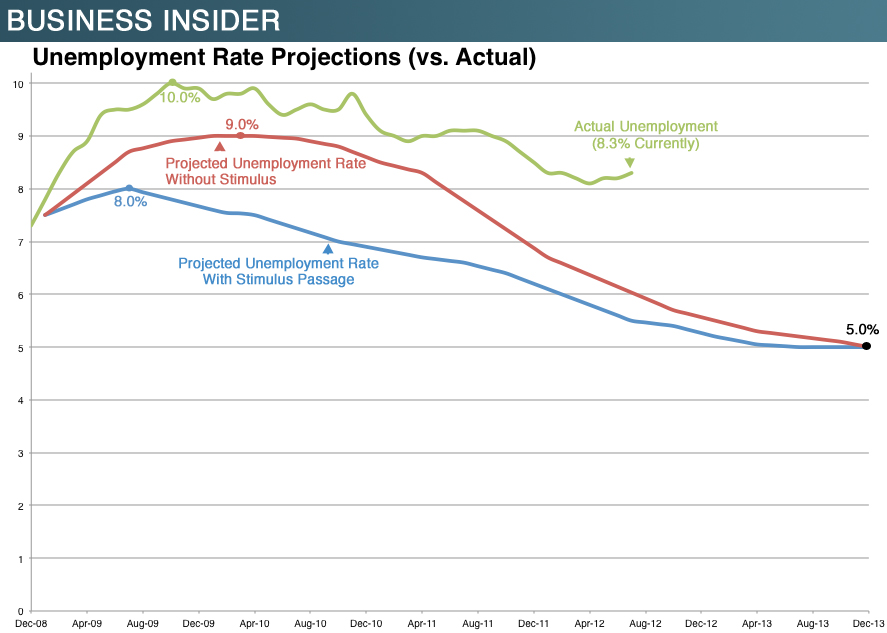
As if there’s any more need to demonstrate the fallacy of Keynesian stimulus pseudo-theory after its failure in the ’30s, some empirical evidence from today’s economic dislocation and failed “recovery” is neatly summarized in the following graph from Business Insider:

Most are already familiar with those projection curves, from the 2009 hype associated with ramming the American Recovery and Reinvestment Act of 2009 (the Stimulus Act) through the Democratic and then-economically timorous Congress.  Government standing aside and letting the economy recover on its own was going to let unemployment peak at around 9% and not move below 7% until Dec 2011 or reach “full” employment until Dec 2013.  On the other hand, the Obama Stimulus would cause an almost immediate peak (in August 2009 after a February enactment) at 8% and lead to recovery below 7% unemployment by fall 2010, a year sooner than under non-interference.

Instead, the Obama Stimulus has actively suppressed employment—and so economic recovery.  Unemployment, at roughly 8.5% at the time of stimulus enactment, continued rising unabated to above 10%, and it has remained above the worse-case no-government projection ever since.  Notice further, that actual unemployment has generally followed the shape of the no-government projection curve: the only effect of Obamanomics in this milieu has been to make government involvement worse than no involvement—it hasn’t altered anything else.

Do we have empirical data for the contrary position, that government noninvolvement is actively beneficial?  You betcha.  The Depression of 1920-1921 ran from the start of 1920 through the middle of 1921, and President Warren G Harding’s administration sat it out, with no significant government intervention attempted.  The graph below is constructed from data taken from Table 9 in a paper by none other than Christina Romer.

There are a couple of takeaways here.  One is the sharp, high peak to unemployment and the rapidity with which both the peak and the recovery occurred.  Another is the rapidity with which our economy actually worked its way through this Depression compared to the projected recovery rates in the first graph above.  The projections for our current failing recovery are, compared to hard data, cynically pessimistic.  This pessimism, though, cannot be laid at Democratic Presidential Candidate Obama’s feet; a broad range of economists assumed that slow pace.

In general, to repeat earlier posts and statements made by others: money spent by government is money not available to the private sector or to individuals to spend on their own goals and needs.  Money spent by the government is money that first must be taken from those private enterprises and citizens in the form of taxes today to pay for that spending or greater taxes tomorrow to pay both for that spending and for the interest on the debt incurred by that spending.  And here we’ve seen empirical evidence that government spending, above a minimal level for funding government itself and national defense, isn’t just useless, it’s actively counterproductive—destructive.

Winston Churchill’s Advice to Americans

OK, actually he was talking to his party about how to talk with the British public at the end of WWII, but the advice is valid here, too.  Republican Presidential Candidate Mitt Romney’s choice for his Vice Presidential running mate indicates that he’s following the first part of Churchill’s advice.  Now the team needs to follow the rest—that seems to be their intent—and we need to support them in that.

This is no time for windy platitudes and glittering advertisements.  The Conservative Party had far better go down telling the truth and acting in accordance with the verities of our position than gain a span of shabbily-bought office by easy and fickle froth and chatter.

All my experience of the British people, which is a long one, convinces me that never at any moment more than this have they wished and meant to face realities, and woe betide those public men who seek to slide into power down the slippery slope of vain and profligate undertakings.

This is no time for humbug and blandishments, but for grim, stark facts and figures, and for action to meet to immediate needs.

What he said.  Americans aren’t as dumb as the Progressives insist on making us out to be.


h/t Power Line

Subsidy and Food

Here are some minor facts concerning a particular subsidy, courtesy of an The Wall Street Journal op-ed.

USDA lowered its 2012 corn forecast by 13% from last year’s, to 10.8 billion bushels, the shortest harvest since 2006, even though the planted acreage is the highest since 1937 and 4% more than last year.

only 24% of the corn crop is in good or excellent condition in the 18 major corn belt states, down from 72% just since June.

USDA’s world agricultural outlook board estimated that global corn consumption will be reduced by 38.9 million tons, with US problems responsible for ¾ of the shortage.

As a result,

Corn futures are up nearly 50% over the last six weeks.  The US accounts for 60% of global exports, and corn feeds cows, pigs, chickens, and humans through its role as a key ingredient in a broad range of foods.

Those corn futures will be realized as actual, sharp price increases that consumers will pay.  The price increase wouldn’t be so bad, but for a certain Federal subsidy.

The food-to-fuel mandate, Renewable Fuels Standard, requires 13.2 billion gallons of ethanol to be blended into the gasoline supply this year, rising to 36 billion gallons by 2022.  Fully 40% of 2011’s corn production went to ethanol, and courtesy of our EPA (though the subsidy originated in an earlier administration), and now more corn is devoted to fuel than to livestock or other foods.

But not to worry.  Despite the drought, the resulting corn crop failures, and the succeeding price increases driven by the crop failure, despite all of these hardships and negative impacts on the food supply, the ethanol makers got theirs.  The Renewable Fuels Association put out a statement, without a trace of irony, that there’s no danger of an ethanol shortage:

obligated parties under the RFS will have every opportunity to demonstrate compliance this year.

Helps to have your priorities straight.

“Ryan Budget” in a Nutshell

Here’s a summary of the budget that the Progressives have begun demagoguing the moment Congressman Paul Ryan (R, WI) was asked to run for Vice President.

  • The latest full-scale version of the plan, unveiled in March, vows to cut spending by $5 trillion over the next decade, compared against President Obama’s plan.
  • The plan would, a decade from now, give seniors the option of taking a government payment to purchase health insurance. That payment could be used to buy a private insurance plan, or go toward the traditional Medicare plan. The plan calls for extra assistance to help low-income beneficiaries and those with “greater health risks.”
  • The plan would overhaul Medicaid by turning it into a block grant system for states.
  • The plan would cut the corporate tax rate from 35 percent to 25 percent. It would implement two individual income tax brackets — 10 percent and 25 percent.
  • The plan would head off the scheduled automatic defense cuts, first by diverting the planned $55 million defense cut in 2013 by implementing those cuts elsewhere.
  • The plan vows to bring the size of government to 20 percent of GDP by 2015.

Of what are the Progressives so terrified in this budget?  Ryan put his finger on it two years ago in the summary paragraph of his Wall Street Journal op-ed, reprinted by the WSJ over the weekend:

The contrast with our budget couldn’t be clearer: We put our trust in citizens, not government.  Our budget returns power to individuals, families and communities.  It draws inspiration from the Founders’ belief that all people are born with an unalienable right to the pursuit of happiness. Protecting this right means trusting citizens, not nameless government officials, to decide what is in their best interests and make the right choice about our nation’s future.

With the people in charge, Progressives won’t have anything to do.