The State of the Obama Recovery

…now that we’re in the fifth year of it.

Real gross domestic product—the output of goods and services produced by labor and property located in the United States—decreased at an annual rate of 1.0% in the first quarter according to the “second” estimate released by the Bureau of Economic Analysis. In the fourth quarter, real GDP increased 2.6%.

It might not get better soon:

Personal consumption—which captures spending on goods and services—fell a seasonally adjusted 0.1% from March[.]

Nanny State and School Lunches

The fight over school lunches intensified Tuesday as first lady Michelle Obama defended her signature school-nutrition program during a meeting with school officials and decried efforts in Congress to allow schools to delay the program.

“Now is not the time to roll back everything we have worked for,” Ms Obama said[.]

Part of the fight, presently, is over a House proposal to waive the school “nutrition” program’s requirements for those schools that can’t afford to comply. Part of the fight is over puny servings that leave the student hungry—and so just as distracted from learning as if he had eaten a sugar-laden lunch. Part of the fight is over who should pay for the mandated lunching system, even by those schools able to “afford” those costs.

But none of the fight is over whether States should determine for themselves what their schools should be doing in their cafeterias. Worse, none of the fight is over what the parents should be doing about their children’s nutrition.

Whose responsibility are the kids, after all? Certainly not the schools’. Certainly not the State governments’. Most especially not the Federal government’s.

The parents are responsible for their own children. If their kids aren’t getting adequate lunches at school, and that argument is a reasonable one, then the parents should be sending their kids to those schools with sack lunches that are balanced and nutritious and with appropriate (the parents’ definition, not government’s) serving sizes. And an enjoyable treat—which may be a sugar bomb, it may be an extra piece of fruit, it may be…. That treat should be determined by what the responsible parents have been teaching their kids, from the cradle, about healthy as well as fun eating. That treat should not at all be influenced by a government intruding into a family’s lunch table.

Greater parental involvement won’t help much in improving the nutrition of children from poverty-stricken (true poverty, not the Federal Poverty Guideline defined poverty) homes, whose only real meal too often comes from the school they attend. But those children aren’t helped, either, by a Federally-mandated one-size-fits-all law that requires schools in well-to-do districts to supply what those children’s well-to-do parents should be supplying. Nor are those children helped who are in school districts that can’t afford yet another costly Federal mandate and so must sacrifice education on the Church of Nanny State’s altar of “appropriate” school lunches.

However, limiting an overreaching, private resource-grasping (can you say taxes?) Federal government will leave more resources in the private economy where they belong. From that better private economy, family, friends, church, charity, et al., will be much better equipped to help the children in those truly poverty stricken families, and by being local being able to apply resources directly and more efficiently to those most needing the help.

College, and What Degree Are You Looking For, Again?

From Millennial Branding and their report The Multi-Generational Job Search (done in conjunction with Beyond.com), centered on a survey of “job seekers and HR professionals,” come these tidbits.

On the matter of whether going to college is, of necessity, for everyone:

[T]he majority of hiring managers (64% [2,978 respondents]) would still consider a candidate who hadn’t even attended college.

And

73% feel that college is only somewhat preparing students for the working world.

Then, this:

Liberal Arts majors (who are historically more focused on communications [and communications skills sought by 83% of respondents]) were shown to be the least likely to land a job, with only 2% of companies actively recruiting those graduates.

This against 27% looking for some sort of STEM degree and 18% looking for business majors (aside: these low numbers are an outcome of this administration’s poor economic policies, say I).

Hmm….

Not the Best Move

According to Spiegel Online International, the European Central Bank intends to introduce a negative rate on cash deposits member banks make into their ECB accounts—a rate of -0.1%. This means that banks would be paying the ECB to deposit their money with the central bank: if a member deposited €100 million with the ECB, the latter would take a €100,000 fee.

The central bank’s motive is to stimulate more lending by those private and commercial banks, to get more money flowing in the EU’s economy. But with loan rates already at historic lows (the ECB itself is only charging 0.25% and intends to reduce that to 0.15%), it hardly seems likely that loan demand is the only impediment to lending—loan quality, borrower quality also are major factors.

Further, with loan rates so low—there’s no room, for instance, for a premium for poor credit risk—the cost to the lender of defaults goes up a lot: only those enormously low rates are there to absorb default losses.

This is a move that can only end badly for the ECB, and at best end indifferently for the banks and the EU’s overall economy. Banks look to make money, not just to let cash sit around twiddling its thumbs. If the ECB is going to charge a fee for making a deposit, look for the member banks to deposit their cash, instead, with each other.

Signs of this will include an increase in the markets for seven-day repurchase agreements, and variations on these. Repurchase agreements are mechanisms whereby banks will lend each other short-term (typically, seven days…) to cover momentary—and expected, even planned—cash flow shortfalls. Repos will make suitable substitutes for deposit accounts in the ECB.

Look, also, for increases in the markets for interest rate swaps—mechanisms whereby banks will trade future interest income streams with each other, typically with one exchanging a variable rate stream for the other’s fixed rate stream. These swaps generally are used to get (slightly) lower interest rates, or because the bank trading for the one stream finds that more useful to it than the stream it’s trading away. But these will make adequate “deposit” arrangements, also.

Look, among other places, for an increase in riskier “deposit” arrangements, too, with the member banks looking again to such instruments as credit default swaps and mortgage-backed securities. These devices aren’t much riskier, if they’re properly constructed and monitored, their negative press during the Panic of 2008 notwithstanding.

All of these, though, will make borrowing at least slightly more expensive, when (if?) borrowing picks up—hence the “at best indifferent” aspect of the ECB’s move from the private market’s perspective. On the other hand, deposits with the ECB are a major source of the funds the ECB loans out. To the extent CDS and MBS (and/or other financial instruments) do go bad, and to the extent the ECB (or its governmental masters) feels constrained to bailout, again, financial instrument market participants, it’ll be hard-pressed to do so. It won’t have the deposited funds to lend on.

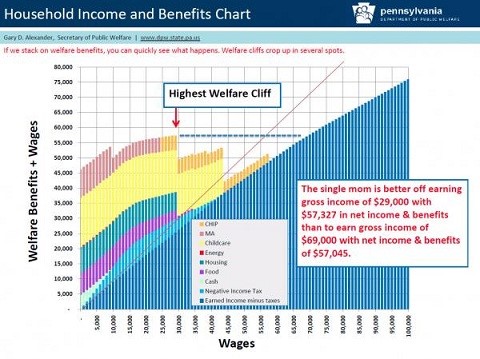
The Welfare Cliff from another Perspective

I, among a number of other folks, wrote about this a short while back.

Following is the money graph from that post, from the perspective of the present post:WelfareCliff

Here’s another perspective on the matter, the point of “present post,” from AEIdeas‘ James Pethokoukis, who cited John Merline’s article for the Richmond Fed.

Writing about the “decline in labor force participation as a result of reported illness or disability,” Merline had this [emphasis added]:

Another driving force, Autor and Duggan found, is the fact that the value of disability benefits relative to wages has risen “substantially” since the late 1970s, because of the way initial benefits are calculated. That’s particularly true at the lower end of the income spectrum. When the value of SSDI benefits and the value of the Medicare benefits that SSDI enrollees qualify for are combined, the share of income replaced by the disability program climbed from 68% in 1984 to 86% in 2002 among lower-income men aged 50-61.

That’s an enormous marginal tax rate that must be paid in order to get a better job.