
National Defense Cuts vs National Defense Purpose

Yochi J. Dreazen  of the National Journal describes the announced US military reduction as follows.  He characterizes the reduction as “a decisive shift away from manpower-heavy counterinsurgencies like Afghanistan,”  and this isn’t inaccurate.  Our military leadership, in fact, insists

that ground wars like Afghanistan are a thing of the past while air and naval conflicts with nations like Iran or China represent the most important threats of the future. The document explicitly said the Pentagon will shift military and financial resources away from Europe and toward the Middle East and Asia-Pacific regions.

and consequently,

potentially significant cuts to the size of the Army and Marine Corps[.]

However,

Both men [Panetta and Obama] have previously indicated that the purchases of costly armaments like the F-35 Joint Strike Fighter, the most expensive warplane ever built, and several next-generation types of warships may be slowed or reduced to save money, though they offered no new details on Thursday.

There are some problems with this thinking, though.  In the first place, if the primary upcoming threats are Iran and the PRC, then what do they call the terrorist organizations like the ones actively at war with us now?  These are just competitors, then?

Secondly, if we’re to rely on our Navy in the Asia-Pacific region, and PRC is building up its navy, its long-range counter-ship capability, and its air force, how will we deter and defeat that threat without modernized—and more—ships?

Thirdly, do we no longer care about the safety of our only reliable ally in the Middle East, Israel?  Are there no important threats there to our interests or to our ally?  Or, for how long do the Pentagon and the White House expect that Israel can hold out while we’re “spoiling” an attack there, perhaps one by a nuclear Iran, while we are fully engaged elsewhere?

Additionally, air and naval forces can’t seize and hold territory—which is what terrorist organizations and their supporting nations, as well as directly threatening nations occupy.  To defeat these enemies, we need to take their territory away from them and hold it ourselves until a more peaceable government can be installed.  That requires ground forces not merely equipped and trained to the task, but numerous enough for it, as well.

Secretary of Defense Leon Panetta says

The U.S. joint force will be smaller and it will be leaner.   The Army and Marine Corps will no longer need to be sized to support the kind of large-scale, long-term stability operations that dominated military priorities…over the past decade.

He’s partly correct.  The Marines are an expeditionary force, best used for power projection and for breaking down the barriers to entry into enemy territory, and it’s the Army’s job to complete that entry and then to effect the subsequent destruction of the enemy’s ability to prosecute his war against us.  Reversion of the Marines to its primary role—if that’s what’s actually intended, and not simply a “cost-saving” across the board slashing of manpower for its own sake—is a useful move.  However, also stripping the Army of the numbers it needs to do its job—and there is a threshold number required, regardless of skill and equipage—simply strips us of our ability to protect ourselves.

Dreazen adds

Canceling or curtailing planned weapons buys is always difficult politically because lawmakers typically work to shield armaments built in their states as a way of saving jobs. It is likely to be even harder now because of election-year partisanship and legitimate concerns about the Pentagon taking steps that would almost certainly mean job losses at a time of deep economic weakness throughout the U.S.

To a large extent, though, as with the “smaller and leaner” bit above, this is only partially true.  Where weapons systems cuts are legitimate—the F-22 is a prime example of a boon-doggle, and the F-35, within the new defense concept, is of questionable value, unless it can deliver the goods in the secondary “spoiling” engagements elsewhere in the world that is a part of this new “fight one and hope for the best everywhere elsedenying and deterring aggression elsewhere” strategy—the systems should be eliminated and the funds put to better use in the DoD.

On the other hand, systems that are necessary for this new strategy (vis., modernized and enlarged naval forces, longer-ranged air forces with larger payloads and better protection systems, and additional forward basing systems in places like, oh say, the Republic of China, the Republic of the Philippines, the Socialist Republic of Vietnam, the Republic of India) will need to be increased, not cut.  Congressmen of all parties and independencies will have to decide whether they’re going to be partisan hacks for favored private companies or Representatives of their constituents come together with their fellows at the Federal level, and look to doing what’s best for the nation as a whole: making the requisite cuts here and increases there, regardless of personal political profit.

Finally, I have to ask:  Is Panetta now suggesting we have no more need of dealing with terrorists?  The GWOT is over?  As I mentioned above, neither insurgency and its associated terrorism, nor terrorism directed against us or our friends and allies, are destroyed unless someone is prepared, in the aftermath of the fighting, to occupy the territory and engage in “stability operations.”  In the end, assuming we’ve won the proximate fight, who else will conduct the stability operations?  The just defeated nation?  With what resources, and to what motivated end?  Europe?  With what resources?  They ran out of bombs five minutes into the Libyan No Fly campaign and had to drop American ordnance for the duration.  Given that failure, from where will Europe get the manpower and equipment—including civil engineering manpower and equipment—to conduct stability operations?  Or is Panetta’s plan to simply to shoot up the area, crush the enemy forces in the field, for today, and then just walk away?  This seems somehow…incomplete.

In the end, the Pentagon and the White House seem to have lost sight of a fundamental tenet: quantity has a quality of its own.  What’s the value of the best trained, best equipped, most courageous and dedicated force in the world if it can be overwhelmed by sheer numbers from an attacker that cares not a whit about his own casualty rate, so long as he kills and wins the battle?  The terrorists in the World Trade Center attacks achieved ~110:1 kill ratio, and at Mumbai the terrorists achieved a kill ratio of nearly 20:1.  Across both attacks, one attacker survived.  The enemy simply didn’t care; he achieved his goals.

In the Korean War, the PRC forces kept coming against the American and Republic of Korean forces, absorbing enormous casualties to achieve their victories.  Over the course of the Chosin Reservoir battle, for instance, the Chinese absorbed nearly 50% casualties in their attempt to pen up and destroy an Allied force half their size at the start of the battle.  Even though the allied force escaped, the Chinese carried the battlefield, and so they counted the outcome as worth its cost.

Our enemies don’t think like us; it’s foolish—and fatal—to base our planning, strategy, and tactics on the assumption that they do.

It appears the present “draw-down” is based more on political rationale than on the evolving threat environment.  Our new national defense concept seems based on a muddled, ill-thought out view of the purpose of our national defense, and of who the threats against us really are.

There are nation-states that remain our enemies and would like nothing more than to see our destruction.  War is not out of the question with these.  There are non-national organizations that already are at war with us, intending to destroy us.  The force structures and capability sets necessary to engage and destroy these threats are as different from each other as are the threats themselves.

Does any rational person really think the proposed rump military that will result from the present reduction will be capable of being fully engaged simultaneously against both types of threats and defeat them—rather than itself being destroyed in those battles leaving us disarmed and helpless?  Or that it’ll be able to function at all without control of the high ground—space—which went completely unmentioned?
Misunderstanding the Threat

Former CIA Director Michael Hayden (USAF Gen, ret) is reported by FoxNews as saying,

But externally it [closing the Straits of Hormuz] just doesn’t make any sense.

Number one, they [Iran] need the straits as much, perhaps more, than anyone else, the free flow of oil, otherwise their economy is more in the tank than it is today.  Number two, does closing the straits make Iran more or less isolated? … Does closing the straits make it more or less likely that someone will think it’s a legitimate step to attack the nuclear facility at Natanz?  I think it makes it more likely.  So why would the Iranians do that?

Our government’s blinders here (yes, Hayden isn’t any longer in the government, but those who are think similarly) is the utter misunderstanding of Iran and its goals.  As Hayden also says, “This government and its decision-making processes are incredibly opaque.”

I offer some clarification, from my lofty perch on my navel.

“Number one, they need the straits as much, perhaps more, than anyone else, the free flow of oil, otherwise their economy is more in the tank than it is today.”  Number one, the sanctions going into place have the potential to seriously threaten their ability to export oil due to a lack of buyers.  In that scenario, no, they won’t “need the straits…”.

“Number two, does closing the straits make Iran more or less isolated?”  Does Iran care about its isolation?  Certainly the lack of international intercourse can hurt, but is the Iranian government’s pain tolerance the same as ours?  Plainly not.  Nor does the Iranian government care about its isolation as isolation.  Finally, do the Iranian people have any capacity to act, should they disagree with their government?  Those people watched while a previous American administration seemed to incite Iraqis to rebellion against Saddam after our first Iraq war and then stood by while Saddam butchered the Shiites and Kurds.  Lately, they did try to act against their government and experienced the present administration standing by and watching the present Iranian government butcher them.

“Does closing the straits make it more or less likely that someone will think it’s a legitimate step to attack the nuclear facility at Natanz?”  The Iranian government, after years of loud and vociferous chit-chat and firm finger-shaking by the rest of the world, and after years of active support by Russia and the PRC for the Iranian nuclear program, has no reason seriously to think anyone will do anything at all along these lines.  Oh, and not being complete fools, they have been dispersing and bunkering their nuclear weapons facilities.  They think the Israelis might have the stones to act, even though an Israeli mission is fraught with difficulties and has an uncertain outcome.  The Iranian government isn’t too worried about strikes; a greater or lesser likelihood of one is irrelevant to them.

Understanding the threat from a nation begins with understanding that government’s goals.  Let’s broaden Hayden’s question of “why would the Iranians do that?”  One overriding goal of Iran’s is the utter destruction of Israel.  To that end, a successful nuclear weapons program gives them the tools with which to achieve that.  They don’t care the cost to themselves of achieving that destruction; indeed, Iran (at least those who populate the government; the only ones whose goals matter) will simply view their own fate as honored martyrdom.

Another overriding goal of theirs is the destruction of the United States.  To that end, a successful nuclear weapons program also is useful for arming terrorist groups who then will attack the United States (and Europe, and the hands that feed their armorer, Russia and the PRC).  Again, both the terrorists and the Iranian government will simply view their own destruction as a  martyrdom to be sought after.

This threat doesn’t think like we do.  Basing our assessments on the premise that they do is fatally flawed.

National Defense or National Security

When did they become mutually exclusive concepts?  In the Progressive meme, the downsizing of the US’ status in the world is in full force.  Because of cuts to our national security—our defense—budget driven by Progressive intransigence in cutting spending anywhere at all and their parallel intransigence in demanding increased taxes, our military capability is shrinking dramatically.  Rather than being able to fight two wars simultaneously, which we have been able to do for decades, the defense cuts will reduce us to being able only to

…fight and win one major conflict, while also being able to “spoil” a second adversary’s ambitions in another part of the world while conducting a number of other smaller operations, like providing disaster relief or enforcing a no-flight zone.

Notice that: we’ll be able to win once (maybe—war always is an iffy thing) and only hold elsewhere, hoping for a miracle there.

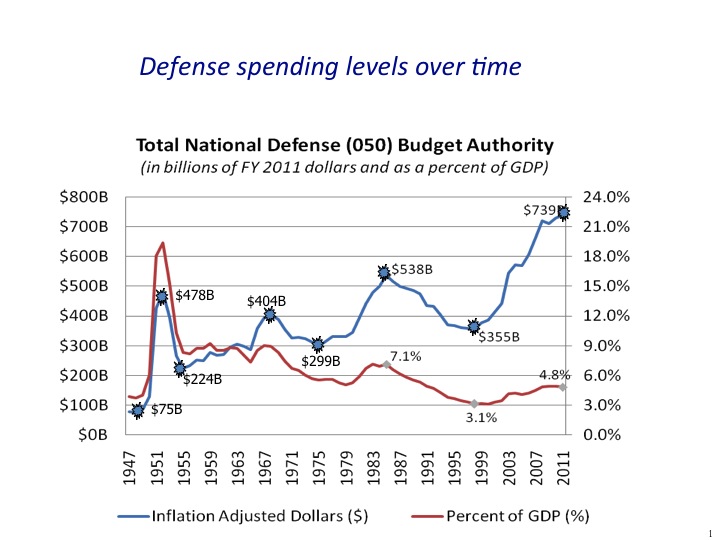
This is based on the idea of a superfluous military—we won the Cold War 20 years ago, for crying out loud, and if we hadn’t had this large military-industrial complex, we would never have been able to start those evil wars in Iraq or Afghanistan.  Besides, defense spending has been going up and up and up, and we need to stop it.

But here’s a graph that sheds some light on that last (I’ll not dignify the others with a response.  (a hostile Russia and China, 9/11, a nuclear Iran, Saddam’s inhuman butchery are sufficient answer.)

Notice that.  As a percent of GDP, defense spending has been remarkably stable.

Nevertheless, for the sake of national security, defense spending must be cut—the deficits and debts are too great and they threaten the weal and the safety of the nation.  The debt and the deficit picture certainly are as threatening as they’re made out to be, but consider: with no defense capability, where is the security?

What do we gain, though, by cutting defense?  Consider these items, courtesy of Neptunus Lex:

…shutting the doors on DoD entirely would still result in an $800 billion increase to next year’s aggregate deficit….

…radically reduce the ground forces, a couple of fighter wing equivalents and at least one or two aircraft carriers—the same forces which have allowed the US since the Cold War days to provide forward presence and deterrence.

Which is actually OK, because the Islamic Republic of Iran has just told us that the USS John C. Stennis is no longer welcome in their neck of the woods….

Well, at least one of those carriers won’t be needed, since it’s worn out its welcome in Iran as well as in DC.

One Progressive argument is that we can get away with such draconian cuts.  Even with cuts as deep as 90%, we can still wipe our attackders off the face of the earth.  But there are a couple of flaws with this argument.  The first is a moral one—and so a practical one.  With such deep cuts, we could wipe our enemies off—by going nuclear.  But with no intermediate capabilities, we’re stuck with the moral, and practical, choice of nuclear war or surrender.  There aren’t any intermediate options with such deep cuts.

The other flaw, though, goes to that ability to go nuclear.  Our nuclear weapons are aging.  They need testing and upgrade.   That takes money that’s being cut from the defense budget.  In the end, we have to ask ourselves, “what is the value of our nuclear weapons when we can’t count on them working?”  while our enemies are asking us, “Do you feel lucky, punk?  Well, do you?”

But the whole “we can cut defense” attitude suffers from another fundamental misconception.  It assumes that our enemies think like us, that their pain level is similar to ours, that their goals are similar to ours.

What do we gain by cutting defense rather than cutting somewhere else?   We keep three entitlement programs that are bankrupting us, and that will continue to do so, even after gutting national defense: Social Security, and Medicare, Medicaid.  But those are the programs that politicians use to buy votes with which to stay in power.

In the end, national defense and national security aren’t mutually exclusive.  Without both, we have neither.

America’s Future—Defense Policy Principles, Part I

I wrote about nature of war from foreign policy perspective here.

In this first post about national defense policy principles and force structures, I want to talk about the meaning of “war” and “state of war”  from a defense policy perspective.  There is far more to war than shooting and exchanging missile fire, although overtly military actions are certainly central aspects of any war, especially in the end game.  A clear understanding is necessary if Defense and State are to work together as the unified whole they must in order for the United States effectively to defend itself in wars of any type.

The damage doesn’t have to be done with bombs or bullets.  Anything that is designed deliberately to impede or to prevent our freedom of action is damaging: it is an act of war.

What, then, is “war?”  Certainly it includes the formally declared state of war, wherein Congress acts under its Article I, Section 8 responsibilities; I won’t go into that further here.  War also includes, though, the aggregation of those acts of war described in the link above (and in links within that post); it need not be declared in order to be in progress, or to be damaging to us and to our security and even survival.  Indeed, in the modern world, where the distribution of formal military power among the nations of the world is so vastly asymmetric, the weaker almost invariably will make war—shooting or otherwise—outside a formal, openly declared state.  Rather, the (weak) attacker will fight in as stealthy a manner as can be managed, at least until the damage done has accumulated to the point of eliminating military advantage and transferring practical advantage to the attacker.  Obviously, such conflicts from deep within the shadows, includes seemingly nonviolent fighting [sic] as well as the asymmetry of terrorist attack.

Moreover, America’s enemies, especially those actively fighting us, are not even necessarily classically formed nation-states; they’re much more amorphous.  These entities, which I’ve been calling non-national entities in earlier posts, have components that are spread across national boundaries; they’re organized as coordinating, but largely separate and more or less independent components.  Further, these non-national entities operate outside Geneva Conventions governing the “proper” way of conducting warfare.  This diffusion across national boundaries and this lack of Convention guidance complicates our response to attacks, but they need not constrain us to the point we cannot defend ourselves.

Complications arise when an overt attack, or a limited series of “acts of war,” originate from within the jurisdiction of a nation-state with which we are not (formally) at war.  (When the attack originates from within a nation that is a friend or ally, the situation actually is much simpler: we can expect that when the attackers are identified, the “host” nation will act decisively on its own initiative.)  It is difficult to enter the host nation’s borders in order to strike the entity and destroy its ability to continue its war against us.  Alternatively, the diffusion of the non-national entity can make it difficult to identify useful targets.  It is the role of diplomacy to create the conditions, permissive or not, that facilitate our entry.  Afghanistan is one example of diplomacy’s success in enabling such an entry for such a purpose.

The Geneva Conventions contain within them mechanisms for prosecuting a defense against attackers who themselves do not follow the Conventions; however, even at that, the Conventions themselves are obsolete: they cannot apply in any practical way to modern wars that don’t necessarily involve actual shooting, nor are they an efficient framework for addressing the kind of war prosecuted by terrorist non-national entities.

In the end, while our diplomacy is creating the conditions that legitimize bypassing the Conventions in wars involving non-national entities and/or undeclared wars inflicted on us by nation-states, our defense policy that must create the conditions for actually fighting such wars to their only possible end: the destruction of the attacker’s ability to continue, wherever it exists, whether that attacker is a nation-state or not, and whether a legal, formal state of war exists or not.

Some examples of patterns of actions deliberately inimical to us and of non-declared war include these (note that this is not an exhaustive list; it is for illustration only).

Russia:

  • in 2007, threatened nuclear war against a US ally, Poland, if we went ahead with a planned missile defense shield radar installation.
  • in 2008, invaded and partitioned a US ally, Georgia, in a naked Sudetenland-like Anschluss.  Nominally, the partitioned provinces, with Russian tanks backing them, simply declared their independence from Georgia; however, they are functionally principalities of Russia.
  • in 2009, participated with the People’s Republic of China in a hack into our national electric power grid control facilities.
  • presently, in response our renewed efforts to defend ourselves against missile attacks, has said they will move nuclear missiles into western Russia so as to target our defensive installations, and our European allies generally.
  • actively supports Iran’s efforts to obtain nuclear weapons, knowing Iranian purposes for the devices.  Russia routinely blocks any serious options, beginning with truly effective sanctions, that would influence Iran to stop its development and acquisition efforts.

Russia’s behaviors are not overt acts of war, but they are inimical to American interests, and Russia clearly knows this.

PRC:

  • actively engaged in hacking into our defense and national infrastructure computer systems, not just for “ordinary” espionage, but also to plant malware having the purpose of disabling those systems at a time of Chinese selection.  These hacks include a years-long penetration of the US Chamber of Commerce, hacks into our national electric power grid control facilities, and attacks against Lockheed Martin, maker of our newest fighter, the F-35, as well as an attack against the F-35 program itself.
  • routinely ships poisoned trade goods, including laptops assembled in Chinese factories under US trade names having Trojans installed before they leave the factory, baby formula with poisons in the mix, gypsum sheets for American housing permeated with sulfur (including hydrogen sulfide), strontium, and organic compounds associated with acrylic paints.
  • actively supports Iran’s efforts to obtain nuclear weapons, knowing Iranian purposes for the devices.  The PRC routinely blocks any serious options, beginning with truly effective sanctions, that would influence Iran to stop its development and acquisition efforts.

While the poisoned trade goods may not be overt acts of war, but rather reflective of incompetence, it’s hard to accept the thesis that a modern nation like the PRC really is that sloppy.  The hacking and delivery of malware with a view to damaging our national ability to function plainly are acts of war, as DoD has lately recognized.

Iran has had a long-standing shadowy war in progress against the US.

  • in November 1979, Iran attacked the US embassy in Tehran and seized our diplomats and staff, imprisoning them for a year and a quarter.  Under international law, this is a casus belli.
  • in 1998, Iran, together with Sudan, participated in the terrorist bombings of the American embassies in Nairobi, Kenya and Dar es Salaam, Tanzania, another casus belli.
  • presently threatens an ally of the US, Israel, with extermination.
  • presently developing nuclear weapons, which it will use for that extermination, and which it will pass to other terrorists so they can attack US allies in Europe and attack us directly in our homeland.

Northern Korea:

  • frequently attacks with artillery, and at sea, an ally of the US, the Republic of Korea.
  • transfers nuclear weapons technology to nations inimical to the US, including Saddam’s Iraq, Syria, and Iran.

Even Pakistan, a alleged US ally, actively transfers nuclear weapons technology to nations inimical to us, including the same Syria and Iran.

I’ll address the policy principles and force structure that must guide these capabilities in subsequent posts.  Our responses won’t necessarily be to shoot back, or to respond in kind (though these options will plainly be present); they do need to be directed to the purpose, and be capable, of promptly defeating the inimical acts.

Deterrence

Deterrence is one means of influencing another nation’s behavior.  It is, by its nature a passive activity, relying as it does on persuading another nation not to do something by threatening a response so powerful that any gain from the undesired behavior is overwhelmed by the loss from the threatened response.  One nation might deter another from initiating a nuclear attack, for instance, by threatening a nuclear response of devastating effect.

But deterrence, to be successful, relies on a number of factors, only some of which are under the control of the deterring nation.  One of those factors is actually having the ability to deliver the threatened response and the ability to defeat the other nation’s initiating action.  This is generally within the control of the deterring nation.  Either the United States, for instance, has the ability to deliver a devastating response and to defeat sufficiently the initial action, or we do not, and within limits, only we make the determination acquire/maintain those abilities.  Another factor in deterrence is the will to use that strength, should the nation we’re trying to deter act anyway.  This is a shared factor, though, depending not just on our actual will, but on the other nation’s perception of our will.  We can manage that perception only by acting meaningfully and decisively with lesser consequences in response to lesser actions.  If we do not deliver those lesser consequences, the nation we wish to deter will have no reason to believe we’ll respond with our described deterrence actions.  A third factor on which deterrence depends is the clarity of our position.  The consequences of the other nation’s action must be well understood by that nation.  This also is a shared factor: communication is a two-way street, and we must ensure that the other nation does get the message.  A fourth factor in deterrence is the other nation’s tolerance for the damage we’ll inflict should they strike and we respond as our deterrence position says we will.  The moment the other nation decides the cost is worth the gain, our deterrence ceases to exist, and we must adjust our deterrence—and defensive—posture.  And we must recognize the other nation’s tolerance for pain in order to make the adjustments.  This factor, other than our understanding, is entirely under the control of that other nation.

With these thoughts in mind, let’s look at our ability to deter today.

We say we do not want Iran to obtain nuclear weapons, going so far as insisting that such a thing is unacceptable.  How have we gone about pursuing that goal?  This administration began by extending an open hand to Iran, if only they would unclench their fist: we would negotiate with them, offer them incentives, including help with enriching uranium to the level that an Iranian nuclear power plant needs in order to function effectively.  In truth, the negotiation attempts did not originate with the Obama administration; prior administrations had been pursuing this path all along.  When it became clear that the open hand, the negotiations, were failing, then this administration began a parallel course of threatening ever stronger sanctions, and repeated attempts to apply them.

Indeed, President Obama insists that “this administration has systemically imposed the toughest sanctions on…Iran ever.  When we came into office, the world was divided.  Iran was unified and moving aggressively on its own agenda. Today, Iran is isolated and the world is unified in applying the toughest sanctions that Iran has ever experienced and it’s having an impact inside Iran.”

The Iranian response, though, has been continued effort, and progress, toward nuclear weapons acquisition.  The “toughest sanctions” were ineffective, and part of their ineffectiveness was the active interference with global sanctions by Russia and the People’s Republic of China.  Indeed, Iran has taken to openly attacking diplomatic missions in Teheran, and they’re dispersing their medium range missile systems, making them harder to target should Iran take overt military action.

Our deterrence effort vis-à-vis Iran has failed on a number of fronts.  We did not demonstrate any particular will to apply serious consequences at any stage of our interactions with Iran.  We have not demonstrated even the capability to apply serious consequences.  Even our message is muddled: we’ve never really spelled out the consequences of their continued efforts or of their actually getting nuclear weapons: we’ve only made fatuous remarks about sanctions and vague threats of “no option is off the table.”  Finally, Iran has determined that it’s willing to bear the costs we might inflict.

With Russia, it’s a slightly different story.  The question here is who is actually deterring whom.  The Russians object to our having a missile shield to protect against Iranian missiles (against northern Korea’s missiles, too, but Russia’s public objections have centered on a defensive deployment in Europe).  Shortly after President Obama took office, Russian objections became quite vociferous as we concluded agreements with Poland and the Czech Republic to install components of the shield in each nation.  The Russians said that if we persisted, they would move nuclear weapons into western Russia from where they could strike Europe.  They also made direct threats to destroy Poland with nuclear strikes.  We canceled those agreements and agreed not to deploy a missile shield there.  (As an aside, keep in mind that this missile shield would have been part of that larger deterrence against Iranian use of their nuclear weapons—an ability to defeat a strike by them.

Now The Weekly Standard reports that

The Obama administration is…undertak[ing] what amounts to an off-schedule Nuclear Posture Review—one that ices out Defense and State Department experts usually consulted on nuclear issues.  It is also beginning a new round of talks with Moscow here in Washington next week that many observers believe will result in the United States offering to trade U.S. strategic weapons in exchange for reductions in Russian tactical weapons.

Further,

[T]he Obama administration is looking to make unilateral cuts….  Defense Secretary Leon Panetta has suggested that to save money the administration might have to eliminate America’s land-based 450 single-warhead Minuteman III ICBMs (though ICBM sustainment is but a rounding error in the DoD budget)….”

It may be that Panetta’s threats are mere polemics in an attempt to protect the Defense budget from the cuts mandated by the Super Committee’s failure.  However, against the backdrop of Russia’s just concluded success at deterring us from deploying a defensive system—the flip side of which is our appeasement of them (which itself comes against the backdrop of our acquiescence in the Russian partition of an American ally, Georgia), it’s reasonable to ask whether we’re being further deterred, this time from having sufficient offensive weapons with which to respond to an attack against which we no longer can defend ourselves.  Understand: whether we’re conning the Russians (or conning ourselves) into accepting the decommissioning of supposedly obsolete ICBMs in return for their decommissioning of (obsolete) tactical missile systems or we’re being deterred from maintaining an offensive leg of our triad makes no difference.  We’ll lose a major fraction of our offensive capability.  Further, the tactical systems will be faster and cheaper to replace in the event of a breakout and arms race than will be the strategic systems.  And they will be more immediately decisive in a fight, especially one in which we have no defenses.

With no missile defense capability and with such reductions in our offensive capability, where is our ability to satisfy either the first factor in deterrence: the capability to respond?  And with the reduced capability to respond at all, the pain threshold is much harder to cross, also, giving Russia much less pause as they consider an offensive move.  Russia seems to be moving our behavior in directions satisfactory to it, however.

It’s different yet with the PRC, but not optimistically so.  We have a legal obligation to keep the Republic of China well enough armed with modern weapons that they can defeat an attack by the PRC.  Yet when we began the latest round of talks with Taiwan, the PRC objected so vociferously that we walked away from an initial sale of 66 modern F-16s, and agreed only to sell our ally a couple dozen of outmoded F-16s.

Further, the PRC is increasingly aggressive in the South China Sea, threatening American allies (vis., the Philippines) and potential allies (vis., Vietnam) and seizing key islands—including those that belong to the Philippines and Vietnam—and claiming them for itself.  The American response to this has been…silence.

Finally, DoD is on record as saying that the PRC is developing their own road-mobile ICBM (a capability which the Soviet Union had developed in the early days of mobile ICBMs), and they’ve dug a 3,000 mile tunnel system in which to hide their ICBM force.  They’ve also dismissed out of hand an offer of a joint weapons verification facility proposed by then-Defense Secretary Robert Gates.

Here, it’s clear that the PRC does not consider that we have the will to act, and so any ability to act does not concern them.  Nor have we said anything at all about consequences for their continued aggressiveness.  Finally, as they demonstrated with their human wave attacks in the Korean War, they’re perfectly willing, literally, simply to throw bodies into a fight until we run out of ammunition.  The degree of damage they’re willing to absorb is quite high.

So here we are with our deterrent capability.  Iran is about to acquire nuclear bombs, and it already has the missile systems with which to deliver them.

Russia has convinced us not to deploy a missile defense shield in Poland and the Czech Republic.  Russia threatens our allies and any new, potential defensive systems we might deploy with nuclear attack, and it does so with impunity.  Indeed, the imbalance has reached the point where we can’t even determine for ourselves whether we will acquire/maintain the strength necessary for us to deter Russia.  We’re negotiating our arms levels with them.

The PRC threatens our allies and potential allies over sea resources and key islands in South China Sea and over our erstwhile willingness to provide the Republic of China the resources with which to resist a PRC invasion.

Given all of this, what happens when Iran gets its nuclear weapons?  Which of us will be deterred then?  From what else will we be deterred by Russia and the PRC?  What will we deter these three from doing?

Finally, a closely related aside on the question of appeasement: President Obama insists “Ask Osama bin Laden and the 22 out of 30 top al-Qaida leaders who have been taken off the field whether I engage in appeasement.  Or whoever is left out there, ask them about that.”

Let’s also ask Mahmoud Ahmadinejad, Vladimir Putin, Hu Jintao, and Kim Jong-il, how American strength and steadfastness is working out.  Oh, and congratulations to President Obama on his success in carrying out President Bush the Younger’s drone and bin Laden policies.