Spending Our Tax Dollars

The table below is constructed from the table and data provided by Laura Saunders in her piece in Friday’s Wall Street Journal.  It shows how $100 in our tax monies paid to the Federal government were spent on a range of government purposes.

Item 2016
Social Security $23.61
Medicare $15.26
National defense $15.24
Medicaid $9.55
Interest $6.25
Other spending $4.94
Veterans $4.58
Civilian federal retirement $2.57
Transportation $2.39
Refundable credits* $2.21
Education $2.08
Food stamps $1.89
Supplemental Security Income $1.53
Justice $1.48
Housing assistance $1.27
Foreign aid and international affairs $1.14
Affordable Care Act subsidies $1.09
Natural resource protection $1.01
Unemployment insurance $0.86
Child nutrition $0.60
Other health† $0.36
National Park Service $0.08
National Endowment for the Arts and National Endowment for the Humanities $0.01
Congressional salaries $0.00
                                                            Total: $100.00

Notice some things (I’m going to ignore some things, too, but this is my post on my blog; I get to do that). The bulk of the Federal social safety net—Social Security, Medicare, and Medicaid—comprises in its aggregate nearly half of those hundred dollars.  Yet these are the most easily and directly privatisable, and as a matter of personal responsibility and individual freedom, they should be.  Each State should take care of its own poor: New Yorkers shouldn’t be paying any part of Illinois’ Medicaid costs in this arena, for instance.  Each individual should be paying toward his own future retirement and retired medical costs (and/or the retirement and medical costs of his own parents, if he—not the Feds—wishes) and not for the current retirement and medical costs of complete strangers.

There are far better uses to which the Federal government should be putting those $48+.  One such is plussing up another major component of the Federal social safety net: National defense (OK, I’m not using the standard definition of social safety net here, but I suggest that absent an effective national defense establishment, in very short order there won’t be any social to be kept safe).  National defense currently takes up only a bit over 15% of that C-note, and it certainly could use some increases in order to fund more troops, more and better equipment, and much more rapid and broad R&D.

Then there’s that Interest cut.  Those $6+ dollars are the interest on the national debt, a debt that continues to grow, courtesy of another datum Saunders provided.  It takes an additional $15.24 beyond that Benjamin to cover the Federal budget deficit that’s growing our debt.  A significant fraction of those $48+ could be sent toward the debt’s principle as well as those interest payments—which are only going to get larger as the underlying interest rates go up now that the Federal Reserve Bank (finally) is easing up on its artificially depressed interest rates.

One minor side note: congressional salaries aren’t actually zero; they’re just a good approximation of zero on this scale.  But you already knew that.

Social Security Trust Fund Investing in the Stock Market

The Wall Street Journal held one of its aperiodic debates last Sunday, this time on whether the Social Security Trust Fund should be allowed to invest in stocks.  One debater argued that such investing would reduce the need for dependence on benefit cuts or tax increases; the other claimed that government should stay out of the market.

It’s certainly true that investing in the stock market could produce better returns than the Trust Fund’s current requirement to invest wholly in (unmarketable) Federal debt instruments.

Stocks are riskier than bonds, so shifting some Social Security assets from low-risk, low-return Treasury bonds to high-risk, high-expected-return stocks would expose the program to greater financial risk. This risk, however, has to be balanced against the likelihood of a larger trust fund and thereby less need for benefit cuts or tax increases to shore it up down the road. Economists also make a theoretical argument that the plan would especially benefit the young—who haven’t yet accumulated much financial wealth—by enabling them to invest in high-yielding financial assets without direct exposure to market risk.

The problem with this, though, is that a realized loss risk in those stock investments would negatively impact everyone so invested: every person with a present or future claim on the Trust Fund were Social Security to take such a chance, rather than only those individuals who make the choice for themselves.  I’m one of those confident in the long-term profitability of stock investing, but that’s my choice.  No one else should be dragooned into the outcomes of my choice were I to turn out wrong and wind up eating cat food inside my cardboard box under a bridge abutment.

[N]o one wants the Social Security trust fund to control the stock market. Even if the entire trust fund was plowed into stocks, it would account for only a fraction of the market.

This is disingenuous.  It’s the government doing the investing; of course, it will move to protect its investment with laws attempting to bar losses, laws attempting to dictate the kinds of risks companies in the market should be permitted to take, laws demanding taxpayers make the Trust Fund whole from market downturns, laws….  Politics cannot be divorced from the Trust Fund’s investments or the outcomes of those investments.  Especially since, as is currently the case, so much of the Trust Fund’s contents finds its way into the general treasury through “borrowing.”  All for the welfare of our seniors, of course.

Better to duck the question altogether, and make an even more radical change to our retirement safety net: privatize Social Security, as I’ve suggested before.  Let individuals invest their monies (including those, if any, by law earmarked) for their own future retirement in the stock market—if they wish—and be responsible for their own outcomes only and not, as taxpayers, for the government’s, and so everyone else’s, outcomes also.

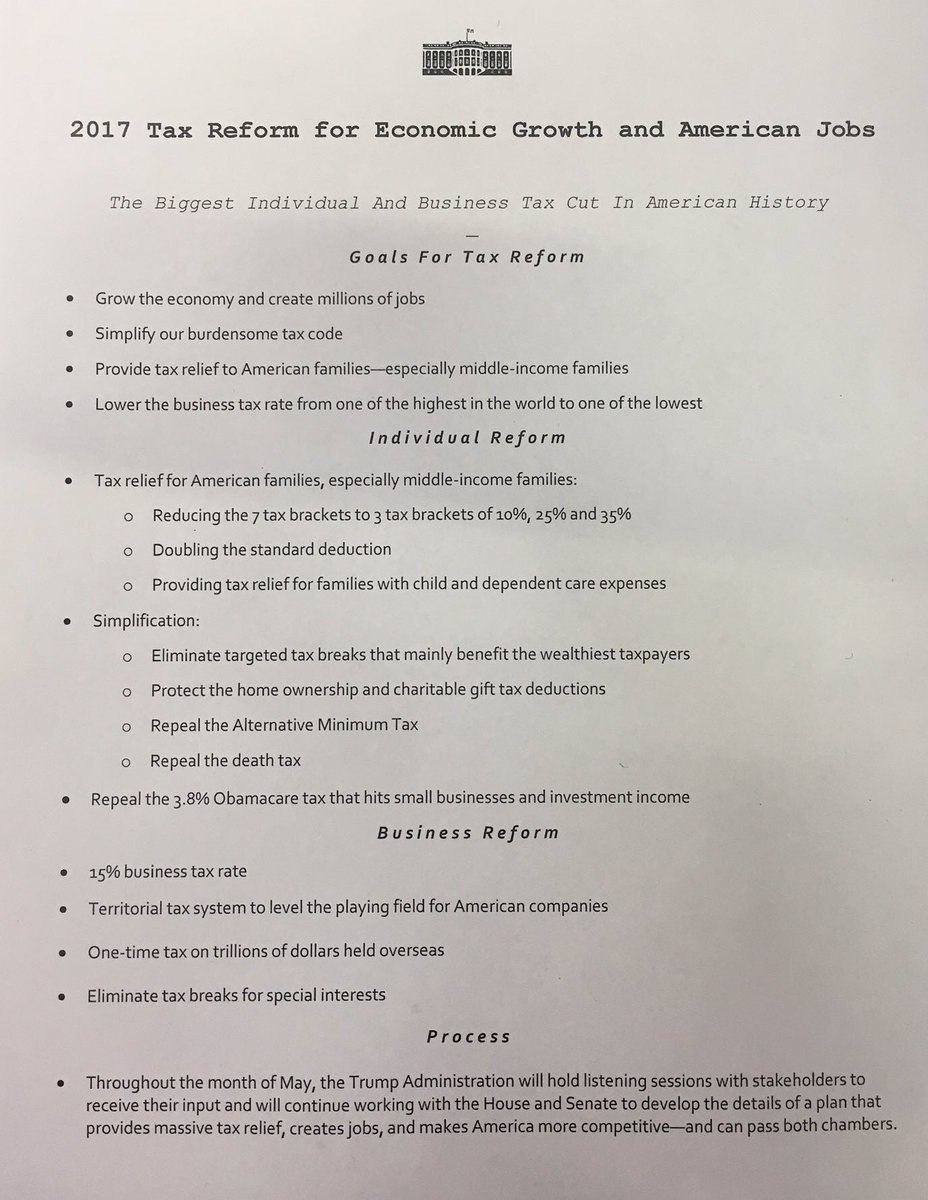
Democrats and Tax Reform

They’re plainly not interested in real tax reform, and so they’ll move to block all attempts to achieve reform that would benefit all Americans and so our economy.  This is illustrated by Senator Ben Cardin’s (D, MD) position on the matter.

Tax reform’s got to be responsible and it’s got to be progressive[.]

Pick one; these are mutually exclusive goals.  Punishing particular Democrat-disfavored groups of Americans for their success is the height of irresponsibility in a taxing venue.

On the other hand, a responsible tax reform package would lower corporate tax rates sharply enroute to an eventual elimination of corporate taxes, lower income taxes to the neighborhood of 10%-15% on all income, regardless of type or source, and eliminate most or all subsidies, credits, transfers, and other loopholes—which would have little value to the beneficiary of such distortions anyway at the lower rates.

Here’s the IRS’ (Internal Revenue Bureau then) Form 1040 from 1913, the first year of an income tax exaction after ratification of the 16th Amendment.  Not quite a post card, but it’s still pretty simple, and it’s the level of complexity we could expect for the form necessary to collect income taxes after a responsible tax reform today.

Until Democrats agree to stop using our tax code for their social engineering goals, though, don’t expect any serious effort toward bipartisanship to originate from them.

“Our Federal Dollars”

It doesn’t get any clearer than this.  Seattle Mayor Ed Murray has illustrated the addictive nature of Federal funds transfers to the States and lower government jurisdictions with that phrase.

In defending his city’s lawsuit against the Federal government over DoJ’s decision to withhold Federal monies from cities that violate Federal law by protecting illegal aliens from enforcement of immigration law, Murray said this:

The federal government cannot compel our police department to enforce federal immigration law and cannot use our federal dollars to coerce Seattle into turning our backs on our immigrant and refugee communities.

Our federal dollars.  The dollars aren’t theirs.  Those dollars are Texas citizens’ money.  Those dollars are New York citizens’ money.  Those dollars are Illinois citizens’ money.  Those dollars are Oregon citizens’ money.  Those dollars are the money of the citizens of every State and territory in the nation, including Washington.  Those dollars are money transferred from all those other citizens around the nation.

This is what such transfers lead to: the powerful addiction of a sense of entitlement to other people’s money and the loss of any sense of responsibility for a jurisdiction’s own money.

Tax Rates and Tax Credits

One illustration of the value of the relationship between the two is provided in Laura Kusisto’s piece, Tax Overhaul Threatens Affordable-Housing Deals, in a piece in Tuesday’s Wall Street Journal.

The possibility of a tax-code overhaul is casting a shadow over the $10 billion affordable-housing industry, which receives tax credits so valuable they often determine whether or not projects get off the ground.

Members of Congress and President Donald Trump have proposed reducing the corporate tax rate to 15% to 20% from the current 35%, dimming the allure of a credit investors such as big banks and insurance companies receive to offset income taxes.

Well, of course it would.  With low taxes, there’s little value to tax credits or deductions.  There’s no mystery here.

Of course, there’s much wailing, teeth-gnashing, and bodice ripping that subsidies for builders are losing value.  The horror.

On the other hand, the availability of truly affordable housing would seem to be at risk, at least superficially.

On the third hand, though, it remains a truism that our Federal tax code has no business being used for government-directed (or any other -directed) social engineering.  These projects will work because they’re economically viable; otherwise they shouldn’t be tried at the rates they are.

In a low tax régime, too, there will be more money in the private economy, more employed labor, and commensurately less need for “affordable housing.”  And housing generally will be lower-cost, reducing the number of folks truly needing help finding housing.  That’s a number individual States can easily afford.  At least those that aren’t wasting their citizens’ resources on frivolous toys like bullet trains or engaging in virtue signaling with their sanctuary city/state foolishness.