
Quotas

German businesses better add women to their governances.  Or else Germany’s Großer Bruder will do it for them.  Regardless of qualification.

Big German companies need to put more women on their executive boards, said Germany’s Women’s Affairs Minister Katarina Barley. The official threatened legal measures if the firms fail to fix the problem within the year.

Bad idea.

Quotas just stigmatize those who got in via quota, whether they were truly qualified for the position or not.  And those who are not, and so fail, only strengthen the stigma.  Quotas are especially damaging to black women.  My GP was contemptuously treated as a twofer in med school because she allegedly filled two squares: she’s a woman, and she’s black.  It stinks.

The way to get more favored group into organization is to train those folks up for those positions in the first place so they can compete effectively.  That means the educational system needs to do a better job of training women to lead businesses (to take the present example) and to convince them they want to compete for those positions—which the German educational system already does, it seems, for boys and men.

That, though, would take time—years, a generation or two or three—and politicians (Germany’s are not unique here) don’t care about tomorrow, only about today.  And today’s virtue signaling.
Bogus Beef

Congressmen don’t pay their interns.  Who knew?

At least 174 of the 184 lawmakers who support legislation raising the federal minimum wage to $15 per hour do not pay their interns, according to a recent Employment Policies Institute analysis.

It’s a bogus beef, though.  Folks employed in minimum wage jobs are low-skill workers doing low-value work, and they’re doing it to build general work experience and ethic, to earn summer spending money, to earn money for college, to build a resume, to supplement an existing family income.

Interns do very little of that.  They’re in the position in order to gain specific experience in the particular job, to build a resume, for college/graduate school course credit, and in many cases with an expectation of being hired by the company for which they interned after graduation.  The “compensation” of expectation for an intern isn’t a dollar income; it’s that particularized experience.

Stuart Varney, a Fox News contributor and host of Fox Business News‘ Varney & Co, added this:

If you don’t pay them anything, then you’re simply giving jobs to the sons and daughters of the rich.  You’re giving opportunity to the rich so that they can get in on the ground floor.

That may be true, but it’s not inherent to the concept of internships; it’s specific to the employers—in this case, the politicians.

Labor Law

Recall the 2015 ruling by the National Labor Relations Board that said, via Browning-Ferris Industries v NLRB, that a joint employer was not an employer that shared direct control over a temp agency’s employees with that temp agency, as the long-established 1984 standard held, but that such a joint employer is one that exercises merely tenuous control.

The case is before the DC Circuit on appeal from the ruling.  The Wall Street Journal is properly skeptical of the permanence of a favorable court outcome, as it is with the possibility of a reversing ruling by an NLRB populated with President Donald Trump appointees.

The WSJ is hopeful regarding another path, the Protecting Local Business Opportunity Act, which would codify that earlier standard.

That certainly would be a step in the right direction, but there’s no reason to believe a later NLRB wouldn’t simply ignore that or find a way to work around the standard—by creatively reinterpreting it to match it to then supposed social imperatives, as judges do too often with their own rulings.

No, the longer term and more effective solution is for Congress simply to abolish the NLRB altogether and not replace it.

Labor Under the Radar

Rather, a labor reform bill making its way (too slowly, IMHO) in the House.  The bill has some interesting items in it:

  • require unions to obtain permission from workers to spend their dues on purposes other than collective bargaining
  • mandate a recertification election upon the expiration of a collective-bargaining agreement if a workforce has turned over by more than 50%
  • take card-check off the menu of options for holding a union election
  • allow employees to withhold their personal contact information from unions

What’s not to like?

What’s holding up the bill?

Minimum Wage and Automation

Is technology—automation—really going to kill jobs?  No.  As many, including me, have written before, automation is only going to shift the nature of jobs.  Minimum wage laws are killing jobs, and will continue to and at increasing rates, by making robots cost effective despite their high up-front costs.

Wal-Mart, for instance, used to employ humans to track individual stores’ cash and manage their books.  Now at roughly 4,700 Wal-Marts, roughly 4,700 of those employees have been replaced by a machine that can track the books and while counting bills and coins at rates of 480 and 3,000 per minute, respectively.  Because it’s Wal-Mart, those folks, where they’ve wanted to, have taken jobs elsewhere in their store at the same pay, but those jobs are at risk, too.  Cashiers are being replaced by automated check-out stands, for instance.

Machines are made cheaper by current and rising minimum wage mandates from Government.

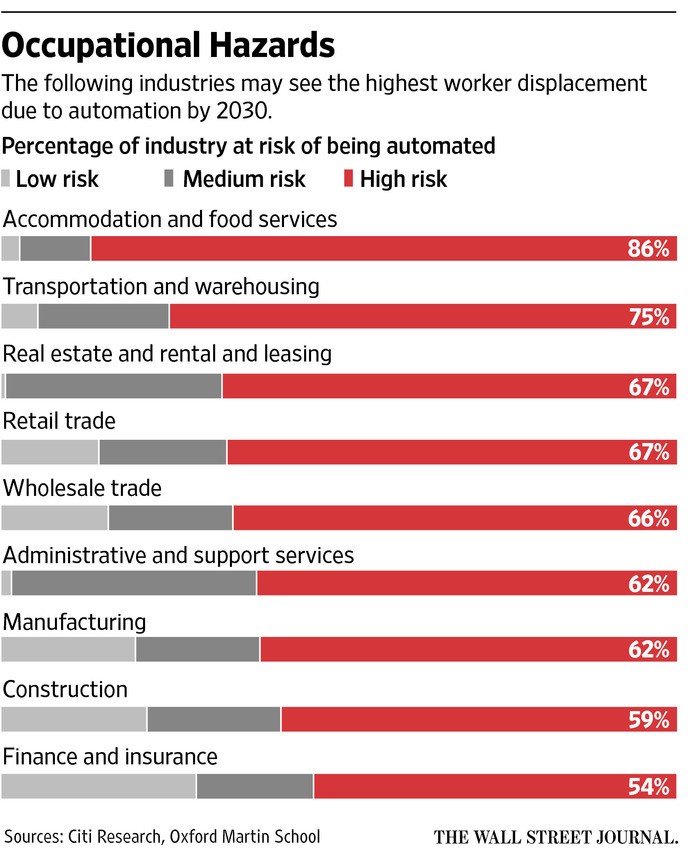
It’s not just Wal-Mart, either; it’s retail in general.  This graph, also from The Wall Street Journal, shows how widespread the risk is.

That’s good for us consumers, as those machines enable us to avoid much of the damage to our pocketbooks minimum-wage laws would do through labor-driven price increases.  Notice that the industries in the graph are especially labor-driven.  So far.

There’s another, this time insidious, impact of this increasing minimum wage driven increasing automation.  Lots of those jobs being lost are moderate-skill ones—counting the money and tracking the books, for instance—and those folks, as the Wal-Mart example illustrates, can find other work.  But what about the low skill work, where the employee truly is being paid minimum wage, because that’s all the work itself is worth (Wal-Mart’s money counter got $13/hr, above the current minimum wage, albeit threatened by $15/hr mandates)?

Those folks—the teenagers looking for summer work for the experience and to build money for college and a resume for later employment, the low/no skill worker trying to work at anything, the single mom or married spouse trying to work a second job to add income to the family—are going to be SOL.  Because Government won’t let them work for less than what Government deigns permit them to work.

The mandated minimum wage does a wannabe worker no good at all, if the job paying that mandated wage no longer exists.

That doesn’t make automation bad; as I wrote above, it’s good for us consumers.  What’s bad is minimum wage mandates—they drive automation, but the bad thing about them is they deprive the unskilled of jobs, with the knock-on failure of preventing them from becoming consumers, too.