Big Government vs Free Market

An economist says Apple isn’t paying its fair share of taxes. There is many things about which to criticize Apple, but this isn’t one of them.

Davos lights insist that companies are responsible to and for their employees, their suppliers, and their communities. Indeed. And the way to execute that responsibility is to be responsible first to companies’ owners. That’s what helps companies thrive so they can have, and have more, employees and suppliers—which money rotation funds those local communities.

What is Apple’s “fair share?” This economist declined to say—just that it ought to pay more.

The economist insists, instead,

the first step to being a good corporate citizen is to pay tax….

But how much? There’s that carefully undefined “fair share” bit, again. And: why should a business pay any tax at all? After all, the business might sign the tax payment check, but it’s the business’ customers who pay the tax, in the form of higher prices to cover the tax cost. Again, this is carefully unaddressed.

Instead, the economist and the lights of Davos insist that it’s somehow wrong for businesses to minimizes its costs and that it’s somehow wrong for nations to compete on tax rates in order to draw business investment so their citizens can have jobs and prosper.

This is Big Government ideology.

In a free market environment, though, nations do compete on tax rates for the benefit of their citizens. Businesses do work hard to minimize all costs so as to compete effectively on pricing, which directly benefits their customers and which indirectly benefits their communities from localities up through their nations.

In a free market environment, a good corporate citizen works to compete and so to thrive and so to take care of its employees, its suppliers, and its community.

Wage Growth

It’s been almost entirely missed by Progressive-Democrats and almost entirely ignored by the Left and its NLMSM.

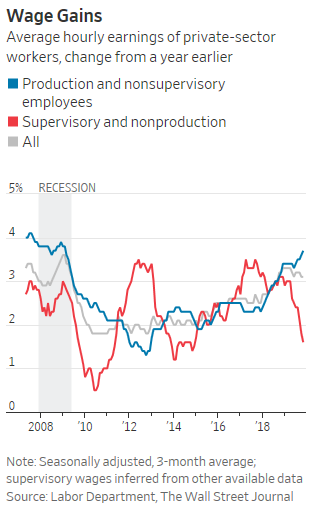
Rank-and-file workers are getting bigger raises this year—at least in percentage terms—than bosses.
Wages for the typical worker—nonsupervisory employees who account for 82% of the workforce—are rising at the fastest rate in more than a decade, a sign that the labor market has tightened sufficiently to convey bigger pay increases to lower-paid employees.

Of course, it’s understandable that Progressive-Democrats have missed this. They’ve trained their fire on the Evil Rich and demands that those folks should give up their wealth for redistribution to the…middle class.  All along, Progressive-Democrats have ignored the bottom of the employed and want-to-be-employed spectrum.  Other than, of course, those worthies’ virtue-signaling and anti-employment minimum wage increase demands.

It’s also understandable that the Left and its NLMSM have done their best to ignore this wage increase development.  After all, it comes on the heels of the slowest post-recession (let alone post-Panic) reemployment development since WWII, and it comes so quickly after wages for the typical worker stagnated, and real wages actually declined, during the Obama administration’s post-Panic pseudo-recovery.

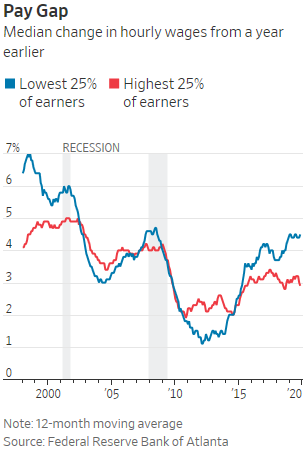
Progressive-Democrats also want to talk about the evils of income inequality, while carefully ignoring the opportunity inequalities that would result—have resulted—from their policies.  See, for instance, the results of their mandated minimum wages: net lower income for those still employed low-skill workers and the lower employment rates in thin-margin businesses, second-job family seekers, teenagers looking for their first jobs.  Here are a couple of graphs depicting income inequality.How terrible are these inequalities?

Another Welfare Cliff Example

A small business owner having direct experience with employees, hiring, and welfare schema, wrote in his Letter in a recent Wall Street Journal:

We are seeing a segment of the workforce, usually single mothers, who want to work but can’t work too many hours because they would lose their federal, state and local subsidies.

This is by the design of the Progressive-Democrats: their goal is to keep these unfortunates trapped in their welfare cage, dependent on Progressive-Democrat politicians’ handouts because…votes.

The letter-writer went on:

Government assistance programs should be designed to allow people to make progress, earning more and building up savings so they can eventually be financially independent. Instead, many of these capable people are locked into a cycle of dependence.

Of course assistance programs should be structured that way rather than locking capable people…into a cycle of dependence. However, letting those people out of the cage would be a reduction of Progressive-Democrat political power.

Minimum Wage Mandate Outcomes

A National Bureau of Economic Research-sponsored Georgia Institute of Technology study by Sudheer Chava, Alexander Oettl, and Manpreet Singh tells a tale.

For each $1 increase in the minimum wage, the authors estimate that loan amounts dropped 9% more in the affected states. The risk of default was 12% higher. The average credit score for small companies in those states showed “a sharp decline.” Business entries fell 4% in the year the minimum wage went up. A year later, business exits rose 5%.
These results, the authors say, hold throughout various statistical analyses, such as while controlling for local economic conditions. The effects are stronger in businesses like restaurants and retail, which rely on low-skilled labor. Smaller and younger companies are more severely affected as well. In short, the authors conclude: “We find that increases in the federal minimum wage worsen the financial health of small businesses in the affected states.”

It’s not only the loss of jobs and harder-to-get loans, though; a minimum wage increase has more broadly reaching outcomes.

It’s also the loss of job opportunity, the loss of entry-level experience as a necessary item for moving up, the loss of spending money and/or a taste of college money for teenagers.

It’s the loss of a second income for a family that needs—or just wants the flexibility of—a second income.

It’s an increase of welfare cost to Federal and State governments as those additional unemployables—now due to Government mandate—are driven out of the labor force and into the welfare force.

But, hey—future votes to be harvested from that last bit’s crop planting.


The study can be seen here (paywall for the whole article; the abstract is freely available).

Head in the Sand?

Volkswagen is building cars in Xinjiang, People’s Republic of China.  You know Xinjiang, the “semi-autonomous” region of the PRC that’s home to tens millions of Muslims and to President Xi Jinping’s “reeducation” camps, Mao-ist internment camps for millions of those Muslims, a people of whom Xi disapproves.

VW thinks all of that is jake.

Speaking with DW on Tuesday, the company said its 2012 decision to open the Urumqi facility was “based purely on economics.” VW says it expects “further economic growth in the region over the coming years.”

Sure. Because economics isn’t just important (such considerations are), it’s all that matters (because principles, apparently, are for academics and parlor small talk).  And: economic growth in the region for whom?  The camp inmates?  Volkswagen?

Never mind the likelihood that Volkswagen’s facility uses forced labor.

We do not assume any of our employees are forced laborers.

Well, alrighty, then. A forced labor force is assumed away, so it doesn’t exist.  It’s all good.