Censoring the Media

The censors have expanded their operation from the Facebooks, Alphabets, Twitters of our nation to our newsroom simulacra. Daniel Henninger noted the latest examples of the invasion:

In the past week, the editorial page editor of the New York Times, the editor of the Philadelphia Inquirer, and the editors of Bon Appétit magazine and the young women’s website Refinery 29 have been forced out by the staff and owners of their publications for offenses regarded as at odds with the beliefs of the current protests.

It’s more than mere censorship, though. It’s George Orwell and Franz Kafka in the press room collaborating on the press’ editorials.

The…news…outlets and the society gossip magazines cited by Henninger are canonical examples.

Henninger, though, is mistaken in one respect. These editors may have been forced out by the institutions’ owners, but staff played virtually no role—it was those editors’ abject cowardice in the face of opprobrium from their subordinates that assumed that character’s place in the tragedy.

Another Study in Contrasts

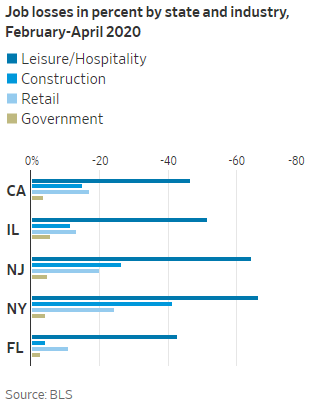
I last week about the difference in performance between Republican-run Florida and Progressive-Democrat-run New York.

Here are some more contrasts.

Notice that California, Illinois, New Jersey, and New York all are Progressive-Democrat governed. And there’s that Republican-governed Florida.

This is the degree of economic dysfunction we can expect from a Progressive-Democrat-run nation.

Notice another thing. Employment by government, of either party, has been remarkably stable. This is the sinecure of jobs in government, the remarkably deep entrenchment of the bureaucrats in the Bureaucrat State.

A “Careful” Economy

In a Wall Street Journal op-ed about the dangers we’re facing because we’re reopening our economy much too soon to suit him, John Cochrane had this remark:

…the most important thing government can give us is accurate and timely information on how widespread the virus is in each community—how dangerous it really is to go out—something we don’t have now.

The truly Critical Item on how dangerous it might be to go out is the mortality rate, and that’s down around 1% for Americans younger than 60-ish, which includes children and working age Americans, and it’s not much higher for those older.

That mortality rate is going down further as we learn more about the components of the denominator.

Of course, getting sick can be more than an inconvenience, but even hospitalization rates are falling, both in absolute terms and as we learn more about those denominator components.

Mortality rate information, contra Cochrane, in fact is well known to those of us who seek it out—which we have to work too hard to do because the press and Progressive-Democrat State governments studiously ignore it.

In the end, the medical dangers of restarting are overblown and the economic dangers of not restarting are underestimated if not ignored outright.

There’s nothing uncareful about reopening now or of pushing the pace of reopening.

Do This In Parallel

There’s a movement afoot in Congress to subsidize employees, lost employees, and prospective employees through employers and prospective employers.

The House plan would give employers enough money to cover up to 80% of their wages and benefits, up to $45,000 per worker, plus a credit for fixed expenses like rent. Eligible companies would simply keep taxes withheld from employees’ paychecks. If that isn’t enough to equal the credit, they could get additional money from the Internal Revenue Service.
Smaller businesses would get the subsidy for all workers, while larger ones would get it only for furloughed workers still receiving wages or benefits. The break would be scaled to each employer’s revenue loss during the coronavirus pandemic.

There are a couple of tweaks needed, stipulating purely arguendo that this is a useful idea:

Don’t make the thing a one-size-fits-all arrangement. Weight the $45k by the regional- or MSA-based cost of living.

Put a milestone-based (not calendar-based) automatic expiration on the subsidy and credit, something along the lines of the unemployment rate in the region/MSA falling below a specified threshold that’s consistent with the region’s/MSA’s [5-yr pre-Wuhan Virus average] unemployment rate multiplied by a greater-than-one factor or a return of the region’s/MSA’s GDP to [80%] of its pre-Wuhan Virus level.

Such a move, reducing revenue flowing into government as it would, should come with a parallel: a reduction of government spending commensurately. After all, the only Constitutional purposes for Federal spending are three: to pay the Debts and provide for the common Defence and general Welfare of the United States.

The long pole in that is defense spending—an especially important pole in an environment of aggressively acquisitive Russia and the People’s Republic of China and of a nuclear and nuclear wannabe northern Korea and Iran.

General Welfare spending, limited as it is (for all that the limit has been winked at for too long) to the 16 purposes enumerated in Art I, Sect 8, doesn’t take many dollars.

Our Debts will become much more manageable and repayable with spending held within revenues.

Encourage employers to hire—with, of course, that caveat of an automatic expiry to the incentive—but spending cuts must be done in parallel with the revenue reduction.

Backwards

The transportation departments of a number of States are backing away from transportation projects, infrastructure projects that they have been claiming are desperately needed. Their excuse? They “need” more Federal aid. The already allocated $15 billion isn’t enough, they’re bleating.

The States have this backward. They don’t need Federal aid—the dollars of taxpayers in other States—they need to let their own citizens get back to work, including, perhaps beginning with, infrastructure projects like these road projects.

The States will then get all the “aid” they need: directly, in the form of income and business tax revenues from those businesses and employees working on those projects, and indirectly from the general, vast pickup in overall economic activity that would result from releasing American citizens from homebound gaol.