Federal Arrogance

Jennifer Valentino-Devries reported on a case involving the recently expanded US Patriot Act in a recent Wall Street Journal.  In this case, an unnamed telecom company, a recipient of an FBI National Security Letter, is objecting to the letter and the demands in it, which are, in essence, to turn over to the FBI whatever the latter demanded, based on…well, because FBI inquiring minds want to know.

The Patriot Act has a lot of good things in it, but it grants a dangerous level of power to the government, also.  NSLs, for instance, don’t require a judge’s prior approval, as a search warrant does.  In fact, the company’s representative who physically receives the NSL is “legally” barred from even acknowledging the letter’s existence except to company lawyers.  The FBI’s secret demand is good enough; we’re to take their word for it.  Here, just to confirm the danger of such star chamber power, the FBI’s response to the telecom’s protest was to instruct its victim to sit down, shut up, and deliver the goods.  Or else.

The US Department of Justice fired back with a serious accusation. It filed a civil complaint claiming that the company, by not handing over its files, was interfering “with the United States’ sovereign interests” in national security.

As far as I’m concerned, this is grounds for dismissing the Government’s claim and its letter with prejudice.  It is never out of order to defend one’s rights.

Leaving that aside, though—the FBI’s case, nor its NSL, have not been dismissed out of hand—the opposing positions are starkly apposite:

[T]he company is arguing, among other things, that the gag orders associated with most of these letters improperly restrain speech without a judge’s authorization.

On the other hand,

The FBI says it must maintain the secrecy of national security letters to avoid tipping off potential terrorists.

This gives the game away.  DoJ has said in its filings

The object of the nondisclosure provision is not to censor private speech[.]

This is just a cynical red herring: the 1st Amendment isn’t there to protect private speech.  It’s there to protect public, political speech.

Finally, Stephen Vladeck, a professor at American University Washington College of Law and an expert on terrorism law says about this case

It raises a question Congress has been trying to answer: How do you protect the First Amendment rights of an NSL recipient at the same time as you protect the government’s interest in secrecy?

The 1st Amendment rights to free speech and to petition the Government for a redress of grievances are specifically intended to allow the sovereign people, individually or collectively, to rein in an overreaching government.  The government’s interest in secrecy plainly is subordinate to those sovereign rights—which it is the government’s duty to defend, not its duty to attack those who insist on them.

Social Engineering Taxes

The efficacy of these taxes are amply demonstrated by their extremely regressive nature.  For instance, the payroll taxes for Social Security and Medicare/Medicaid hit the lowest income folks the hardest.  They’re taxed at the same nominal rate as everyone else (except the well-off in the case of Social Security: there’s an upper limit on the income taxable for this purpose).

However.

Someone making the Federal Poverty Guideline income ($22,350 for a man in a four-person family in 2011) was taxed at 4.2% of that income (6.2% when the cut expires next January, but we’ll stick to the lower rate here)—$938.70.  A man making $100,000 paid a tax of $4,200, including that same $938.70 on his first $22,350 of income.  Who do you suppose was hit harder by that $939 tax?

The poor man already is living at the edge of his income; the dollar taxed to him—the very same dollar that is taxed to our better off man—is far more important to the poor man.

So it is with income taxes, whether those taxes are for Article 8 purposes, or some of them are for other government-determined—social engineering—purposes.

Legitimate taxes must be evaluated for their impact on what Wretchard of Belmont Club has described as the design margin: how much safety is left for handling the unforeseen when a tax dollar is taken away from a man?

The correction, of course, is not to raise taxes on everyone else—the well-off already are paying far more than their share, while the half [sic] at the “bottom” of the distribution are paying next to nothing.  Moreover, this would do nothing to reduce the importance of those tax dollars that are in the poor man’s margin of safety between what he has and what he needs for an emergency.  No, the answer is to lower tax rates—to increase the width of the design margin—and to move to a flat tax with no deductions.  Taxation for government-mandated social engineering purposes just hammers at that design margin, shrinking it, no matter the good intentions behind the assessment.

A tax dollar always will be more important to the poor man than to the better off man; no amount of attempted progressivity in a tax code will reduce this.  A flat tax will reduce the difference in relative importance, though.

The American Welfare State

James Pethokoukis, of AEIdeas, an affiliate of the American Enterprise Institute, has an article that shows the economic devastation extant in the policies of the Federal government.  It’s important to note that, much as I dislike the present administration, these results also flow from the “efforts” of a long string of administrations.

I don’t have much to add, so here is the complete article, reprinted with the kind permission of AEI.

6 charts that show the Welfare State run amok

The original purpose of Medicaid was to provide improved healthcare access for poor people, while not turning the safety net into a trap. Under President Obama’s Affordable Care Act, Medicaid will be greatly exapnded beyond what Congress originally intended.

In fact, as these charts show, it has already expanded beyond what Congress surely originally envisioned and, in the process, has created a terrible fiscal problem for the United States. (These charts and graphics come from a briefing today here at AEI, conducted by Gary Alexander, secretary of public welfare for Pennsylvania.)

A few scary factoids:

– In the 1960s, there were 18 workers per Medicaid recipient. Today that number is 2.5.

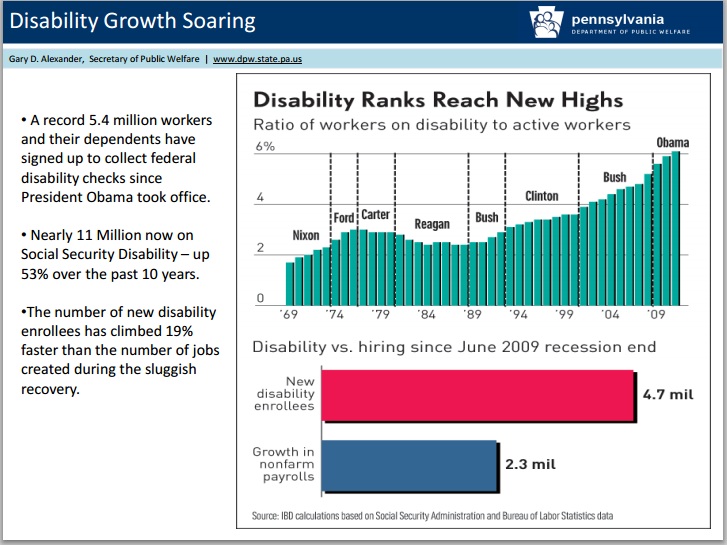
– The number of Americans on disability has risen 19% faster than jobs created during this recovery.

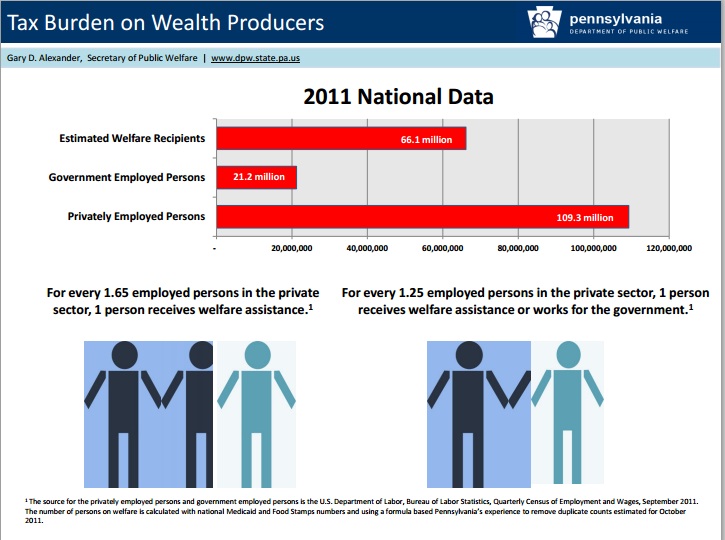
– There are just 1.2 private sector workers per 1 person on welfare or working for government.

– There are now just 1.65 employed persons in private sector per 1 person on welfare assistance.

Check out the charts and graphics for yourself:

1. Fewer workers and their tax payments have to support more and more Medicaid recipients.

2. The number of takers is now approaching the number of makers.

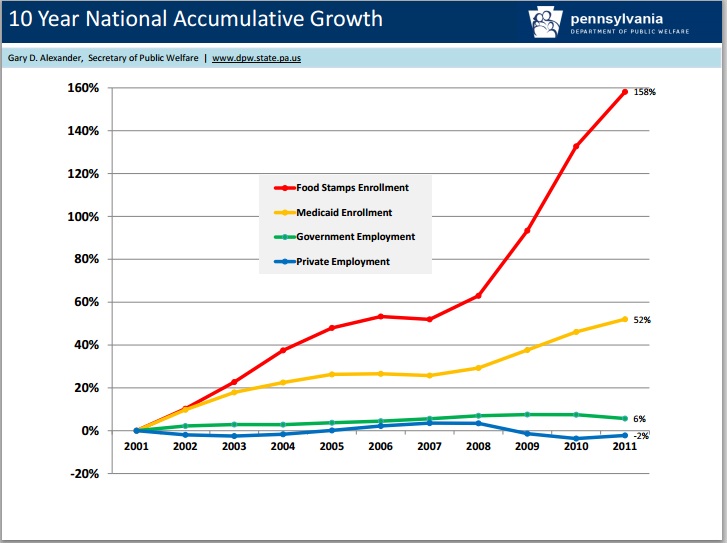
3. Medicaid and other welfare enrollment has exploded.

4. Medicaid enrollment is growing faster than economy.

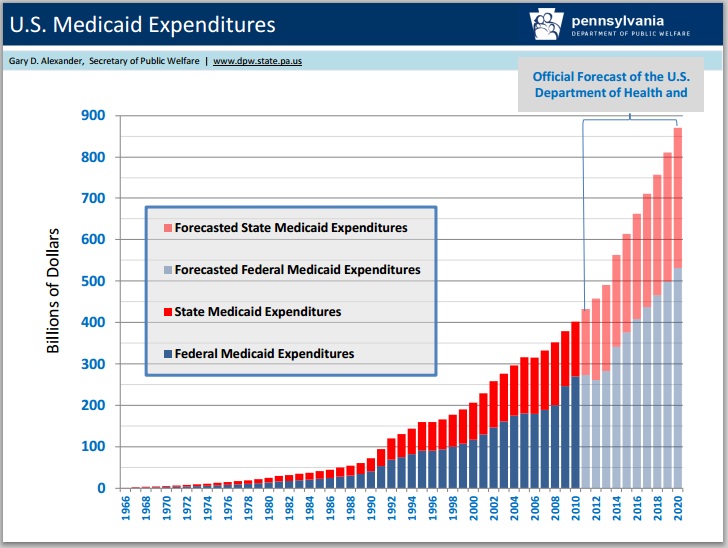
5. Medicaid spending? You ain’t seen nothing yet.

6. Disability enrollees have exploded and are rising faster than job creation.

These charts show an out-of-control welfare state that is about to get even bigger, increasing both budget costs and dependency.

Yet More Thoughts on Immigration

I want to comment a bit about one leg of our immigration policy, that of what to do about the illegal aliens currently present in the US.

Roberto Suro has a recent piece in The Washington Post that bears on this; although he talks primarily about a second leg of our immigration policy, one that also must be solved: how we let aliens into our country (an immigrant is someone who intends to settle permanently, so I’ll stick to aliens in this post).  All three legs (entry, border security, the existing population of illegal aliens and immigrants), though, must be handled together, or the totality of our immigration policy will continue to be the failure that it is today.

Suro noted,

Along with the many [immigrants] looking to make a permanent home in the United States came those who had no intention to stay, and who would make some money and then go home.   Between 1908 and 1915, about 7 million people arrived while about 2 million departed.  About a quarter of all Italian immigrants, for example, eventually returned to Italy for good.

Today, we are much more rigid about immigrants. We divide newcomers into two categories: legal or illegal, good or bad. We hail them as Americans in the making, or brand them as aliens fit for deportation.

And

To start, we can recognize the new birds of passage, those living and thriving in the gray areas. We might then begin to solve our immigration challenges.

…

If we accept that there are spaces between legal and illegal, then options multiply.

The second part, though, is simply wrong.  There can be no gray area between legal and illegal; that would only perpetuate the limbo in which the illegal aliens currently exist.  Instead, we need to broaden what constitutes legal, and make it easier for these folks to comply.

Who are these folks living this shadow existence?  They are crop pickers, violinists, construction workers, entrepreneurs, engineers, home health-care aides and particle physicists.  These folks are active participants in a global economy driven by the flow of work, money, and ideas; they wish to come and go as opportunity calls them. They manage to have—they often are forced to have—a job in one country and a family in another.  Thus, they are forced to straddle—or avoid—the laws of multiple jurisdiction, with particular emphasis in this context US law on the part of the worker.

Nevertheless, we need them in the US being productive while they’re here, and it’s unnecessary to force them to choose to be here permanently, or to lie about their intent to be here permanently as a precondition for being here legally at all in order to achieve that.

Thus, I propose the following for the current population of illegal aliens.  I’ve proposed a general idea elsewhere, and Congressman Luis Gutierrez (D, IL) and Senator Marco Rubio (R, FL) have ideas that bear on this.

We should issue a “green card lite” for those who come and go at a relatively high rate—migrant workers, for instance, but not exclusively.  Such a card would be good for an extended number of years, allowing the holders to cross the border multiple times as their (seasonal, perhaps) work requires, without having to go through the entry bureaucracy—or risk coyote depravations—each time they want to reenter.  The folks who are here already and want such a card, though, must provide documentation to support their claimed work history.

Additionally, in support of that documentation requirement, I suggest a one year amnesty for employers of (potentially, from their perspective; I assume the good intentions of the vast majority of employers) immigrants, illegal or legal, so those employers can provide their documentation supporting the (illegal) immigrant’s application without fear of government reprisal.

Moreover, a regular green card, for those who aver a longer duration/steadier residency should be far more easily requestable and far more quickly issued, with a similar requirement for work history documentation from those who are already here and want to come out of the shadows.  The employer amnesty should be extended to employers of this group for the same reason.

Note, though, that I’m not proposing amnesty for the illegal aliens themselves.  As many have suggested, these must pay a penalty, variously including a fine and/or a requirement to leave the country and then to reenter legally.  I believe that both penalties should be applied.  The fine, though, must be sized to the illegal alien’s ability to pay, and it must be large enough to sting but not so large as to be an impenetrable barrier.  The requirement to leave the country and return, though, I hold can be satisfied by traveling to the nearest consulate in the US, paying their fine, and applying for their green card from within that consulate.

On the other hand, those who’ve used falsified or stolen documentation (e.g., a false or stolen social security number) to facilitate their getting hired must pay a sterner penalty.  These must leave the US voluntarily for some period of years before applying for a green card (lite), and they must apply as though they have no work history to claim (they’d a first-time immigrant, now).  Failure to leave voluntarily should result in deportation, never to be allowed back in.

Finally, notice that there is nothing in this that presupposes the now legal immigrants wanting to become citizens.  Nor need there be.  As demonstrated by those immigration statistics at the beginning, when folks are in our country openly and freely, our country sells itself.

Let’s not forget, though, the other two legs of our immigration problem.  We also need to look at the difficulties we inflict on those who want to enter our country for legitimate purposes—to settle here, for instance, or to “make some money and then go home.”  And we also need to get serious about securing our borders so that we do a better job of filtering out the ones who come here with nefarious purposes so that only those who want to come here to settle and contribute, perhaps (but not necessarily) to become citizens, or to be here for a time and then go home, can do so.

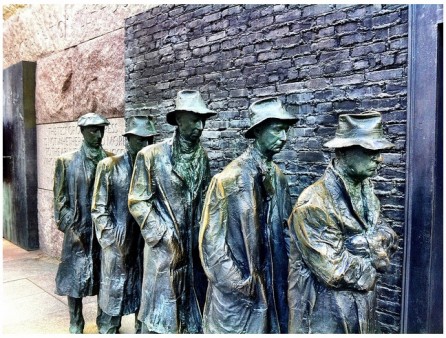
Be Too Bad if Something Was to Happen to It

So, pay the vig.  That’s the extortion Senator Patty Murray (D, WA) is threatening us with.  Roll over, and give us our tax increase on those we don’t like, or we’ll raise taxes on everyone.

[If] we can’t get a good deal, a balanced deal that calls on the wealthy to pay their fair share, then I will absolutely continue this debate into 2013…. We will have a new fiscal and political reality….

Of course, she continues to insist that “fair” is whatever the Progressives say it is, at any moment.  She, like her fellows, have continuously refused to say what amount constitutes a “fair share,” for her hated rich or for her sainted poor.

Here’s her naked extortion threat:

If middle-class families start seeing more money coming out of their paychecks next year—are Republicans really going to stand up and fight for new tax cuts for the rich? Are they going to continue opposing the Democrats’ middle-class tax cut once the slate has been wiped clean?

She’s also taking our national defense hostage and demanding that it be ransomed with more taxes.  The article at the link cites her as adding

[If] Republicans don’t negotiate to her party’s liking on the automatic spending cuts—known in Washington as the “sequestration”—set to take effect at the start of next year, her party would let those cuts happen, too.

Can we afford four more years of this assault on our freedoms?  Can we afford four more years of bipartisanship meaning “do it the Progressive way, or else?”

As to the taxes themselves, to which Senator Murray and her fellows are so tightly bound, Murray and her fellows, as with so much of the legislation they’ve rammed through, are running against the wishes of Americans.   The latest McClatchy-Marist poll has found the following:

  • Registered voters want all of the tax cuts extended, including for those with incomes above $250,000, by 52% to 43% wanting the cuts reserved for those making $250,000 or less
  • Those making less than $50,000 per year supported tax cuts for all incomes by 53% to 41%
  • Voters in the age band 18-29 favor tax cuts for everyone by 69% to 29%