Of Course It Is

Now that the Obama administration’s end is near, and a new guy is being put forward to run Obama’s EPA, that agency is changing its mind about the impact of fracking.

Fracking can affect drinking water supplies in certain circumstances….

The report, written by Environmental Protection Agency scientists, includes findings that are more open-ended than those in a draft version last year, when the agency said fracking, or hydraulic fracturing, isn’t having “widespread, systematic impacts on drinking water.”

When pressed on the “updated” report, which contradicts that earlier draft, EPA Deputy Assistant Administrator Thomas Burke conceded the draft’s prior conclusion that only a small number of cases of contamination had been found—even though that was left out of this later iteration of the report.

While the number of identified cases of drinking water contamination is small, the scientific evidence is insufficient to support estimates of the frequency of contamination[.]

Even the identified instances of contamination—surface spills of fracking fluids or poorly done cement casing of a wells—have little to do with fracking, but are failures to execute.

Of course this drives the conclusion that when you can’t find the needle in the haystack, you don’t have enough evidence to say that there aren’t many needles in the haystack.  That’s some science the EPA has there.

Keep in mind, too, that this is same agency whose pseudo-science concluded that plant food—atmospheric CO2—is a pollutant.

Apparently rigorous thinking was outside of these guys’ school safe spaces.

The Entire Island

Repair crews worked through the night trying to restore electricity to Puerto Rico’s 3.5 million people early Thursday after a fire at a power plant blacked out the entire U.S. territory.

Officials said they hoped to restore service by morning….

It turns out that they didn’t make by the morning, and the outage extended into a second day—lengthened not just by the severity of the problem, not unique in itself to Puerto Rico, but also by Puerto Rico’s lack of money with which to fund repairs or even parts and equipment to replace the damaged/failed parts and equipment.

I have to wonder about similar vulnerabilities, similar single points of failure, extant on our separated States and other separated territories and within CONUS.  I have to wonder about these vulnerabilities not only in our power distribution grids, but in our communications grids, and cascading from those, in our financial networks and our government effectivity networks.

As Governor Alejandro Garcia Padilla said,

The system is not designed to withstand a failure of this magnitude.

Neither are any of our systems.  Nor are they designed to any large degree to minimize, if not eliminate, single points of failure.

Energy Subsidies

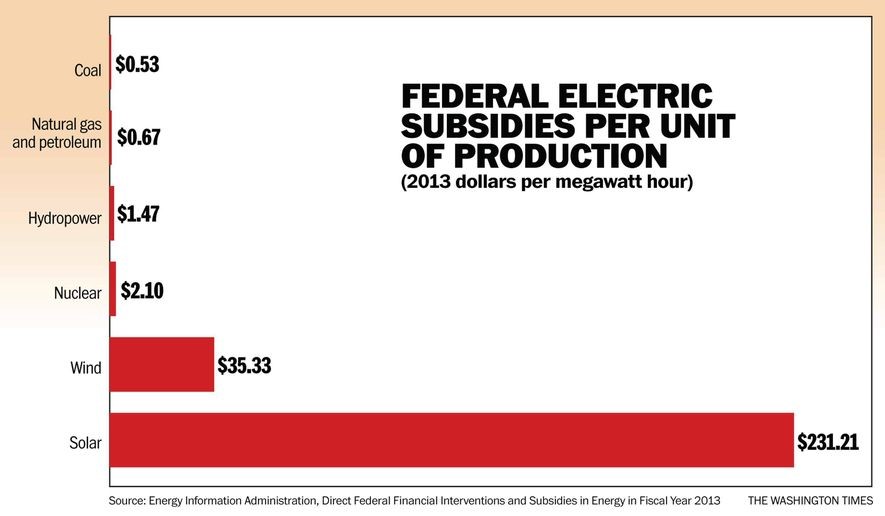
Mr [Congressman Dave, R, WA] Reichert is co-sponsoring legislation to extend the PTC [Production Tax Credit] because the subsidies “reduce electricity costs and create jobs.”

But what jobs? Lower costs for whom? Who do you think pays that subsidy? Three years later, there still aren’t any in significant number. Electricity costs aren’t lower for the producers, and Reichert still hasn’t explained who’s paying for those subsidies (answer: we taxpayers are).

Mr [Congressman Steve, R, IA] King, who likes to advertise himself as a principled conservative, his line is that “Iowa is a wind energy success story” that only needs the federal government to “provide stable, low tax rates.”

Three years later, again left unanswered: if it’s so successful, why does it need federal subsidies? Why does it need subsidies at all? Why does it need continuation of subsidies as old as 1992—now 23 years on?

Oh, wait:

One need not literally seize the assets of businesses and install gov’t bureaucrats into management position to effectively nationalize those businesses. All it takes is to make them dependent on gov’t and/or direct their activities through regulatory constraints.

Or government subsidies.