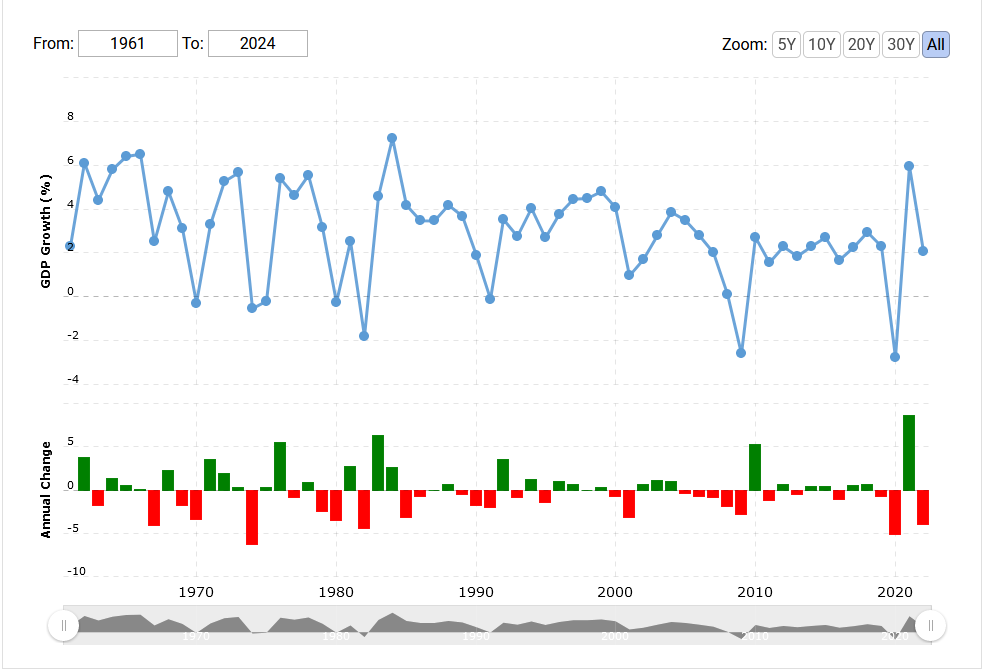
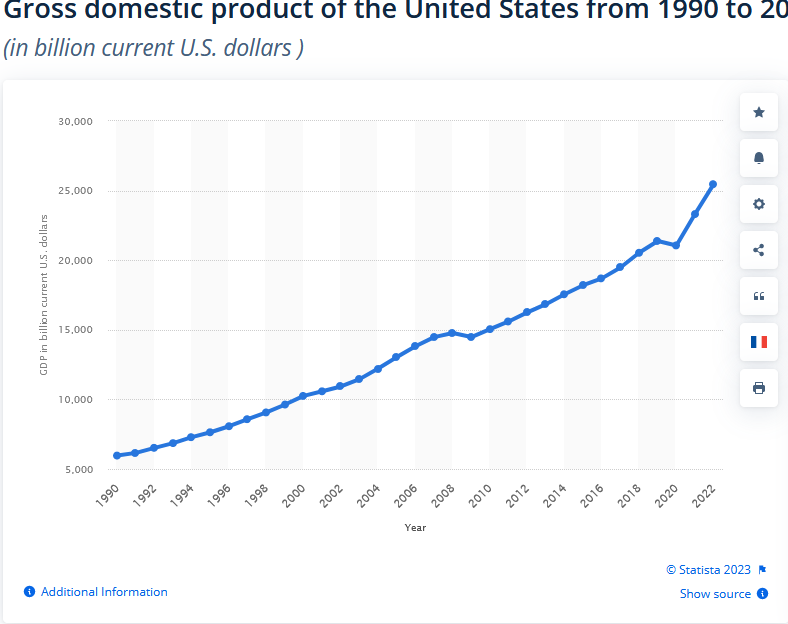
But, But—Bidenomics is Working

That’s the claim of President Joe Biden (D) as he insists our eyes are lying, and we should believe him, instead. These two lede paragraphs say otherwise:

Surging inflation gobbled up household income gains last year, making 2022 the third straight year in which Americans saw their living standards eroded by rising prices and pandemic disruptions.
Americans’ inflation-adjusted median household income fell to $74,580 in 2022, declining 2.3% from the 2021 estimate of $76,330, the Census Bureau said Tuesday. The amount has dropped 4.7% since its peak in 2019.

It’s true enough that the Biden inflation runup has ebbed, but it’s still nearly double what it was in the fall before he took office. It’s also true that, over the last couple of months, wage increases have been greater than current inflation.

We still have, though, that overall shrunken income, and it’ll be a long time before that recovers. Recall the income loss during the Obama-Biden years post-Panic of 2008, a loss which lasted for several years, until roughly 2015. Keep in mind, too, that even with the lower inflation today than the Biden peak, the prices us ordinary Americans pay remain badly elevated. What we pay for critical items like food and energy—items typically excised from inflation measures because they’re so “volatile”—still is 16% higher than when Biden took office.

There’s this tidbit, too:

Total [Federal tax] receipts are down 10%, year over year, owing to slower growth….

But ’twas a famous victory, by Biden and his cronies. Over truth and the facts, but not over reality and the straits our economy truly is in.

The Judge Got It Wrong

Matthew Whitaker, former Acting US Attorney General, disagrees with a Puerto Rico bankruptcy judge’s ruling regarding the Puerto Rico Electric Power Authority’s bankruptcy and the subsequent handling of the utility’s creditors. He wrote in his Fox Business op-ed that

[US District Judge Laura Taylor] Swain…concluded that special revenue bondholders do not hold a secured claim on current and future net revenues. As The Wall Street Journal explained in March, “A federal judge curbed Puerto Rico bondholders’ rights to the electric revenue generated by its public power utility.”
Furthermore, the ruling stated that the original legal obligation of the borrowers is not the face value of the debt, but rather what the borrower (in this case “PREPA”) can feasibly repay.

This is wrong. Whitaker is right. The borrower committed to repay what it borrowed, not what it might feel like repaying be able to repay in some speculative future.

This judicial error, though, has much broader implications than just the damage done PREPA’s creditors. Her ruling sets the ugly precedent that no borrower is liable for what he borrows, only for what he might be able to repay. That drastically altered risk terrain can only mean that lenders will be more reluctant to lend, particularly to lower income (and so with higher debt risk) folks and businesses, and that those lenders that do lend will do so only at markedly higher interest to account for the risk the amount they lend will not be recoverable in any guise, especially in the public—municipal—arena.

Buying Battery-Operated Cars

My then-new gasoline-powered 2022 Ford Escape and my wife’s new 2023 Ford Maverick hybrid, each one level down from Ford’s top tier, each cost in the low- to mid-$30 thousands. Joanna Stern, The Wall Street Journal‘s Senior Personal Technology Columnist, evaluated a number of battery-operated cars under $60,000 to see which one of those she liked best. The ones she looked into were the Ford Mustang Mach-E, Tesla Model Y, Hyundai Ioniq 5, Kia EV6, and Volkswagen ID.4.

The prices of these, as tested, were—oh, wait; she didn’t discuss equipage in any detail, nor did she name the price of those cars as tested. Accordingly, here are the prices I found after an arduous five minute Bing search. All prices, save Tesla, are via Edmunds; Tesla’s prices are per Tesla.

  • Mach-E: $42,500-$60,000, depending on how gussied up you want it
  • Model Y: $52,900-$66,000, depending….
  • Ioniq 5: $47,700-$59,400, depending….
  • EV6: $45,900-$60,200, depending….
  • 4: $40,300-$56,500, depending….

Assume, arguendo, that Stern’s evaluations are reasonable (noting that some of her criteria are matters of taste), and truncate the gussying to Stern’s $60,000 cap. This is the cost of transportation that the Progressive-Democrat Biden administration is trying to force us to pay in the name if its—and the Left’s—climate funding industry and related artificial hysteria.

This is just to get into the car, too; the comparison elides questions of range; the availability of charging stations outside the home garage; the long time to charge to the battery-operated cars’ 300-ish miles range (my Escape reaches 400+ miles on a tank of gas, and the tank fills in three minutes, or so); and of special importance to the Left (except when inconvenient to them); the environmental damage done by mining the raw materials and disposing of the spent batteries.

Electrifying Transportation

A Wall Street Journal editorial centered on California’s idiotic push to fully electrify cars and trucks—yes, including heavy duty freight trucks—within the next dozen years, has this tidbit, which is canonical in exemplifying such foolishness anywhere in the US:

One trucking company wanted to install charging stations for 30 trucks at a terminal in Joliet, Illinois, only to be told by local officials they would draw more power than the entire city.

And this, specific to California and its already existing green ideology:

In January northern California utility PG&E told a charging provider that one of its large fleet customers couldn’t charge its trucks on summer afternoons owing to a power crunch.

A power crunch which PG&E knew six months in advance was going to occur. It’s clear: neither facts nor the fiscal or quality of life costs of ignoring them matter to the mainstream Left. They’re right, and if you have questions about that, they’ll enthusiastically disabuse you of your questions. Never mind that

[a] Southern California Edison executive recently said some fleets are powering chargers using diesel generators so electric trucks don’t go unused.

Pay no attention to the zealot behind the door.

Drug Price…Foolishness

President Joe Biden (D) and his associates over in Medicare have identified the drugs of which he’s willing to pretend to negotiate the price. The particular drugs aren’t important; what matters is the precedent being set regarding the Progressive-Democrat-run administration’s view of what constitutes negotiation in Party’s lexicon. Readers interested in which drugs are targeted for now can find the list at the end of the linked-to article.

What’s important here is this.

The naming of the 10 drugs subject to price negotiations kicks off a lengthy process. Drugmakers have until October 1 to say whether they will join in the negotiations.
If they don’t negotiate or accept the price resulting from it, companies face a tax of up to 95% on a medicine’s US sales, or they can pull all of their drugs from Medicare and Medicaid coverage.

And this:

Drug makers that don’t participate or reject the government’s price will incur a crippling daily excise tax that starts at 186% and eventually climbs to 1,900% of the drug’s daily revenues. This is extortion, not a negotiation.

That’s not negotiation, that’s “Take our price, or pay even more through our usurious, if not confiscatory, taxes.” The outcome will be a stifling of medical (not just for medicinal) innovation in the US. Instead, innovation, such as might remain, will be pushed overseas, in large part to nations that don’t themselves innovate very much, having come to rely on American developments which they then heavily subsidize for their own citizens.

Some of those drugs, too, will be pulled from Medicare/Medicaid coverage, along with all of the other drugs a company makes available through those programs, which will price them out of reach of those most in need—those with the ailments being treated by those medicines and who lack the money to pay the full price.

That is, until Party takes the next obvious step and taxes those medicines’ sales revenues earned outside of Medicare/Medicaid, to be followed by Party’s diktat that those medicines must be offered through Medicare/Medicaid.

Which will result in those medicines no longer being manufactured in the US at all and no longer being sold at all in the US, regardless of their manufacture.