
Progressive-Democrats Punishing Victims

There are growing numbers of young adults and adults who underwent surgical and/or hormonal procedures as children or younger adults who, recognizing their mistakes (or their parents’), want to detransition as far as reversing the hormonal and surgical treatments can take them.

Those persons, those efforts to correct their mistakes, are a growing embarrassment to the Progressive-Democratic Party politicians and their Leftist supporters. Last week, the Progressive-Democratic Party in Colorado struck back at those detransitioners—hard, and dangerously to their health and lives.

The Colorado General Assembly’s House Judiciary Committee late Tuesday [18 February] considered legislation, introduced last week, to allow patients who underwent “youth gender transition procedures”—puberty blockers, cross-sex hormones, and surgeries to remove healthy genitals and breasts—before age 26 to sue their providers for damages up to age 38.

At the end of their “consideration,” however, after Progressive-Democrat after Progressive-Democrat after Progressive-Democrat absented themselves from listening to much/most of the witness testimony, Party, which holds the majority, tabled the bills indefinitely, effectively killing them.

This is what Party thinks of us Americans. This is what Party thinks of our children, young people who regret the medical procedures they undertook to more closely resemble the opposite sex. Do not contradict us, and especially, do not embarrass us is the ideology of Party.
Chlorinated Water and Cancer Risk

The New York Post‘s headline screams

Chemical found in US drinking water is linked to 15% higher risk of colorectal cancer, 33% for bladder cancer

The chemical in question is a collection of trihalomethanes (THM)—chloroform, bromodichloromethane, dibromochloromethane, and bromoform—that can form when chlorine reacts with water. Chlorine is routinely added to our nation’s potable water by water producers in order to eliminate bacteria and viruses from our drinking water. Chlorine is very effective at that.

The second paragraph in the Post‘s article lays out the…fear:

A new analysis out of Sweden reports that disinfecting water with chlorine creates chemical byproducts that can increase the risk of bladder cancer by 33% and colorectal cancer by 15%.

What’s the baseline rate of those cancers in the US, though? How big an increase are those 15% and 33% bumps? Those bits of context, critical to understanding the true nature of these risks, are elided by the news outlet.

Here are some data with which to fill in those gaps. According to the American Cancer Society,

[T]he lifetime risk of developing colorectal cancer is about 1 in 24 for men and 1 in 26 for women.

According to the National Cancer Institute,

Approximately 2.2% of men and women will be diagnosed with bladder cancer at some point during their lifetime

Applying the increased risk values to these really quite low baseline probabilities, we get

• likelihood of men getting colorectal cancer rises from 4.2% to 4.8%
• likelihood of women getting colorectal cancer rises from 3.8% to 4.4%
• likelihood of men or women getting bladder cancer rises from 2.2% to 4.2%

Keep in mind the lifetime nature of those risks, which is nicely matched by the lifetime practice we have of drinking chlorinated tap water. Thus, it’s certainly true that these increases are worth watching, especially the bladder cancer risk increase, but these already very low baseline risks remain quite low even with chlorinated water.

Further balancing those risk increases are the enormously reduced risk of infection by serious and debilitating water-borne disease.

Lazy Congress

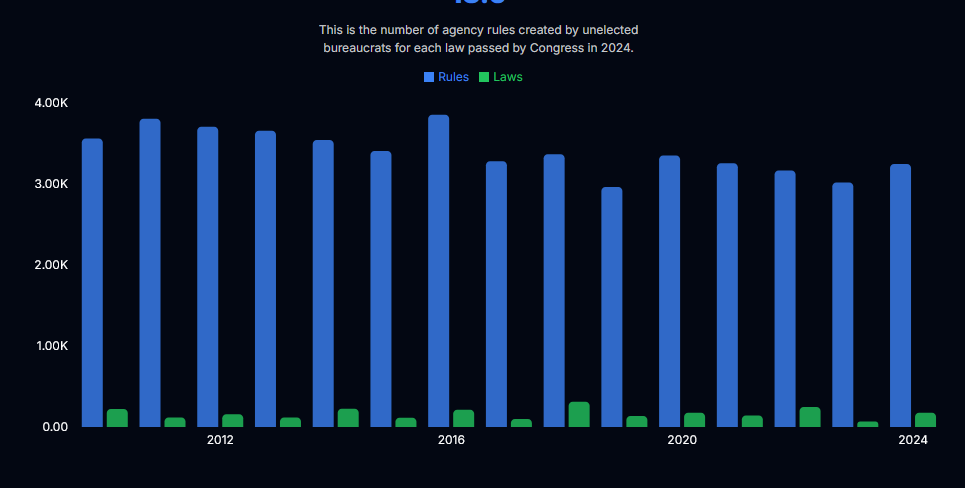
This chart, via DOGE, shows the number of regulations that have been written for each law passed by Congress, just since 2010. (Right click on the image and from the drop-down menu choose “Open Image in New Tab” to get a bigger image.)

Go to the link, and mouse over the bars in the graph to get amplifying data beyond the appalling data visible in the image.

This shows how non-specific Congress’ bills are, and yet the President signs them into law. This laziness by Congress and the too-laissez faire attitude of Presidents are unconscionable. Congress needs to write laws to be complete and specific, rather than outsourcing specifity to Executive Branch entities, and Presidents need to veto these too-vague bills.

How to Handle Federal Lands

Terry Anderson, of Stanford University’s Hoover Institution, has some thoughts on how best to handle Federal lands, a unaggregated expanse of some 640 million acres, 28% of US land. In their essence, his ideas are to handle those lands in a business-like manner.

…three options: raise the price of goods and services (timber, minerals, visits to national parks), reduce labor costs and liquidate money losers.

He’s right, but those are the second steps that need to be taken, not the first step.

Twenty-eight percent is far too much of American land to be retained by the Federal government. The necessary first step is the transfer of those lands to their respective States.

Anderson’s ideas, fleshed out some in the fulness of his op-ed, does recommend [t]urn[ing] ownership of some federal lands over to the states, but that’s wholly inadequate. The vast majority of those lands should be turned over.

The amount that might be retained by the Federal government, to suggest a percentage for opening discussion, would be less than 5%, and the retention purposes might be limited to protecting some historical and scenic areas for public park use, to finishing cleaning up Superfund sites of their contamination—following which those sites should be returned to the States—to maintaining (and I say expanding) our Strategic Petroleum Reserve, to siting military installations, and to setting up, or finishing, nuclear waste storage sites.

The Federal government has no legitimate interest in withholding from State and private use so huge an expanse of our land. Selling it to the States and to private citizens would raise funds for paying down our national debt, too. The modern equivalent of a dollar an acre comes to mind for a suitable sale price—that original one dollar price wasn’t so much for raising money—though it did for that then small Federal budget—than to transfer the land to owners who, by paying for it, would have some incentive to make economic-based use of it.

The retained land then should be managed IAW business principles.

Europe’s Role in Europe

In a Wall Street Journal article centered on the EU’s dismay over being dismissed from peace talks among Ukraine, Russia, and the US, there was this bit near the end:

Ukraine’s army today is larger and more capable than the German, French, Italian, and British armies combined. Alongside Russia’s, it is also the only military in the world with a wealth of experience in large-scale modern warfare against a near-peer enemy.

That’s how worthless NATO has become, particularly including those western European nation members. Sure, those nations are nattering on about increasing defense spending. French European Affairs Minister Benjamin Haddad:

The message is clear: it’s time to take our responsibilities, to safeguard our own security.

Well, NSS.

However.

Germany, not atypically, has made those commitments before, and then welched on them. And even those western European nations who did consent to send weapons and money to Ukraine held back on them until the US first sent weapons and money to Ukraine, so timid they have been to act on their own initiative.

It’s time for the US to stand up a separate mutual defense arrangement centered on the eastern European Three Seas Initiative nations—nations which directly front Russia and still remember the devastation caused by the barbarian’s jackboots on their necks. Those nations, too, already are at the European forefront in material and financial support, on a per-GDP basis, for Ukraine’s fight for its existence. And then for us to walk away from NATO, which has been shown to be three years, at least, past its Use By date.