A Time for Choosing

Europe’s nations—particularly those not directly bordering on Russia—are finally figuring out that Russia is as much a threat to them as it is to Ukraine.

…the cost of building robust defenses able to withstand a potential US pullback is so great that it threatens Europe’s post-Cold War social model.

And

Achieving the military spending that some politicians and experts say is needed would force European members of NATO to start reversing big post-Cold War increases in social spending.
“You have to rearrange the social contract,” said Lithuanian Foreign Minister Gabrielius Landsbergis, who has warned that Russia will eventually attack NATO countries if it isn’t defeated in Ukraine.

Any US pullback from NATO or from Europe at large is, or should be, less a factor in their choice between social welfare and their self- and mutual defense than the continuing refusal of fully 40% of those NATO members to honor their financial and equipment commitments vis-à-vis NATO.

That refusal is those nations’ own betrayal of their fellow members since their refusal severely weakens the collective alliance.

Separately, but closely related, chatter about a US pullback from NATO or from Europe at large sounds like a Leftist conspiracy theory to me. After all, Republican presidential nominee Donald Trump’s out loud questioning of America’s future in NATO has in fact been the motive force behind getting many more of Europe’s NATO members even to begin to honor their financial and equipment commitments to NATO, after 50 years of “pretty please” had achieved nothing but too many member nations’ overt decisions simply to freeload off American treasure and blood.

European nations’ need is to understand very clearly and forcefully that those nations that choose social spending over national defense will, in the end, have their social contract dictated to them by their conquerors. That immutable principle applies equally forcefully to our nation.

A Clear Demonstration

Michigan’s Progressive-Democrat Governor Gretchen Whitmer signed, in the name of the State of Michigan, a deal with Gotion Inc, a subsidiary of Gotion High Tech Co Ltd which is headquartered in the People’s Republic of China. Gotion Hi Tech is not only subject to PRC national security law that requires domestic companies to provide information the intelligence community “requests” in whatever nation that information might reside, it has open and direct ties to the Chinese Communist Party. From that, Gotion Inc, the party to that Whitmer deal, has those same ties and PRC-legal obligations.

The problem is this. The Gotion-Whitmer deal is for a Gotion battery factory to be built at least in part in the Michigan township of Green Charter. Green Charter has demurred from being used for that deal, and in response, Gotion has filed suit…against Green Charter. Chuck Thelen, Gotion’s Vice President Gotion Global, North America Manufacturing Center:

It’s unfortunate that Gotion has had to resort to litigation to get the township to comply with their obligations under the agreement[.]

This, despite that Gotion’s beef is with Michigan and the Governor’s Office as the signatories of the overall agreement, which presumed to commit the Township to it. Green Charter isn’t the jurisdiction with any contractual obligations here.

It’s true enough that a prior Township board of supervisors had negotiated an agreement with Gotion, but that was done against the will of the Township residents. They ran a recall that tossed every one of those board members and installed a board amenable to the requirements of its collective bosses, those residents. That move rendered the prior agreement nonexistent.

This is a clear, dispositive demonstration, then, of the People’s Republic of China’s cultural mindset and that of Gotion’s managers. Government is in charge and subjects must obey. 一切都在國家之內,沒有什麼是國家之外的,也沒有什麼是反對國家的. Everything in the State, nothing outside the State, nothing against the State (hat tip to Benito Mussolini, who originated the maxim).

Biden isn’t the Only One

On the matter of the Republic of China’s ability to defeat a People’s Republic of China invasion, Progressive-Democrat President Joe Biden isn’t the only US President who’s been terrified of offending the PRC too badly. The RoC has long sought to buy offensive, and long-range weapons from the US, even concluding some deals that a variety of US administrations have failed to deliver on. Instead, in the main,

[f]or more than a decade, US officials have encouraged Taiwan to invest in small, relatively cheap weapons such as shoulder-fired missiles, drones, and sea mines. The goal would be to bring a Chinese amphibious invasion force to a halt at close range with thousands of small strikes.
Such asymmetrical warfare is a favorite tactic of guerrillas and weaker nations facing big rivals.

I-Chung Lai, an ex-government foreign-affairs official, has the right of it:

The asymmetrical approach advocated by some people would put the whole of Taiwan into a meat grinder[.]

Defensive weaponry optimized for asymmetrical warfare are, indeed, critical items for a small nation’s ability to defend against a large nation’s invasion.

But. But, but, but. Defense only permanently surrenders the tactical and strategic initiative and is ultimate defeat. A much better defense is a strong offense. The RoC needs those far reaching and offensive weapons in order to have a serious chance of defeating—not merely resisting—a PRC invasion, and to do so without turning the fight into a bloody morass that bleeds the Republic dry while only injuring the invader.

The RoC desperately needs those offensive weapons as well as the defensive ones, and the Biden administration has an excellent opportunity to learn the lessons of Ukraine and kowtowing to Putin’s threats by slow-walking and outright withholding the long-range and offensive weapons Ukraine has needed for the last 2+ years. The Biden administration needs to put an end to the pattern of multiple administrations kowtowing to the PRC’s threats and send to the RoC the long-range and offensive weapons, along with the defensive weapons. it needs actually to defeat a PRC invasion attempt.

There is legitimate concern that the RoC can’t afford both the offensive and defensive weapons, or the offensive weapons in useful numbers. That’s what lend-lease programs and outright loans are for.

A Thought on Interest Rates

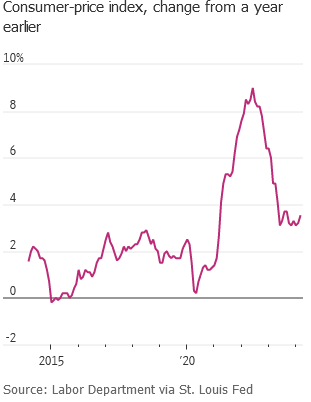
The Wall Street Journal is speculating on when the Fed might start lowering its benchmark interest rates, speculating further that the Fed might be worrying about whether it’s time and whether leaving its rates where they are might spark a recession. (I was one of those worrying about a recession starting up over the last year or year-and-a-half, and still, but maybe the Fed’s worry is as overblown as mine.)

Early in the article, the WSJ has this:

The central bank will keep its benchmark interest-rate target at a range of 5.25% to 5.5%, a 23-year high….

I’m not sure that’s a useful baseline. The first 20, or so, years of that period are when the Fed was artificially suppressing interest rates.

5.25%-5.5% benchmark rates actually are, long-term, reasonably consistent with a 2% inflation rate.

Maybe it’s time for the Fed to cry “Enough” and go back to the sidelines. Nothing more is needed; let the market fluctuate as it will. Rates already are within the historical fluctuation range that didn’t need Fed interference intervention.

Imagine That

Don’t take government money to do something good, thereby avoiding the government’s strings necessarily attached (as well as government’s strings that are attached unnecessarily), and be able to do the good thing at much less cost, including for the taxpayers providing the government’s fettered money.

By forgoing government assistance and the many regulations and requirements that come with it, SDS Capital Group said the [affordable housing] 49-unit apartment building it is financing in South Los Angeles will cost about $291,000 a unit to build.
The roughly 4,500 apartments for low-income people that have been built with funding from a $1.2 billion bond measure LA voters approved in 2016 have cost an average of $600,000 each.

It’s even worse in San Jose:

A recent report commissioned by the city of San Jose found affordable-housing projects that received tax credits cost an average of around $939,000 a unit to build there last year.

There are some naysayers:

Some affordable-housing veterans worry whether privately funded construction can scale quickly enough to match the scope of the homelessness problem and whether its backers will maintain their commitments to serve the needy.

That’s a problem for government to solve, not the private funders of affordable housing. It’s government regulations, both well-intended and done solely for political gain, and government strings dictating how government-provided funds must be spent that impact the scope of the “homeless problem.” Government regulations and strings create, in large part, the homeless numbers, including especially the duration of individual and individual family homelessness.

Another case of the advantage of letting a free market operate freely. Imagine that.