An Appeal

Bayer is appealing a District court judgment against it and its Roundup product which has glyphosate as an important ingredient. The judgment is for $25 million, and Bayer thinks it’s a wrong judgment.

The German company’s main argument is that US federal agencies have determined its product is safe and not a carcinogen.

Bayer noted that the

verdict defies both expert regulatory judgment and sound science.

And

Because the EPA has consistently approved the sale of glyphosate without a cancer warning and has stated that including such a warning on the label would render the product misbranded, any state-imposed cancer warning is expressly preempted

Wow. Truth as defense.  What a concept.

Another Welfare Cliff Example

A small business owner having direct experience with employees, hiring, and welfare schema, wrote in his Letter in a recent Wall Street Journal:

We are seeing a segment of the workforce, usually single mothers, who want to work but can’t work too many hours because they would lose their federal, state and local subsidies.

This is by the design of the Progressive-Democrats: their goal is to keep these unfortunates trapped in their welfare cage, dependent on Progressive-Democrat politicians’ handouts because…votes.

The letter-writer went on:

Government assistance programs should be designed to allow people to make progress, earning more and building up savings so they can eventually be financially independent. Instead, many of these capable people are locked into a cycle of dependence.

Of course assistance programs should be structured that way rather than locking capable people…into a cycle of dependence. However, letting those people out of the cage would be a reduction of Progressive-Democrat political power.

Minimum Wage Mandate Outcomes

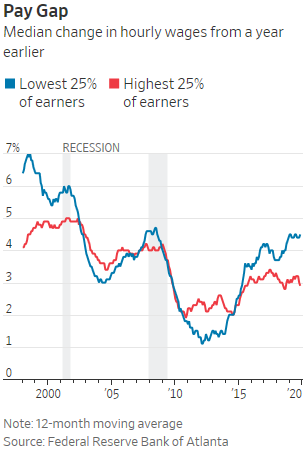
A National Bureau of Economic Research-sponsored Georgia Institute of Technology study by Sudheer Chava, Alexander Oettl, and Manpreet Singh tells a tale.

For each $1 increase in the minimum wage, the authors estimate that loan amounts dropped 9% more in the affected states. The risk of default was 12% higher. The average credit score for small companies in those states showed “a sharp decline.” Business entries fell 4% in the year the minimum wage went up. A year later, business exits rose 5%.
These results, the authors say, hold throughout various statistical analyses, such as while controlling for local economic conditions. The effects are stronger in businesses like restaurants and retail, which rely on low-skilled labor. Smaller and younger companies are more severely affected as well. In short, the authors conclude: “We find that increases in the federal minimum wage worsen the financial health of small businesses in the affected states.”

It’s not only the loss of jobs and harder-to-get loans, though; a minimum wage increase has more broadly reaching outcomes.

It’s also the loss of job opportunity, the loss of entry-level experience as a necessary item for moving up, the loss of spending money and/or a taste of college money for teenagers.

It’s the loss of a second income for a family that needs—or just wants the flexibility of—a second income.

It’s an increase of welfare cost to Federal and State governments as those additional unemployables—now due to Government mandate—are driven out of the labor force and into the welfare force.

But, hey—future votes to be harvested from that last bit’s crop planting.


The study can be seen here (paywall for the whole article; the abstract is freely available).

That Was The Point

The subheadline on a Sunday Wall Street Journal article says it all.

European voters have viewed the process so negatively that even EU-skeptic parties have mostly dropped talk of leaving the bloc or the euro

That was the entire motive for Brussels’ extended bad faith pseudo-negotiations with Great Britain after those uppity citizens voted to go out from the European Union. To be sure, Brit politicians, who insisted they Knew Better than their subordinate citizens, contributed to the mess with their own combination of arrogance and incompetent negotiating, but they just played into Brussels’ hands, they did not create the chaos.

Brussels, with its antics, has successfully cowed other nations that were restive and contemplating leaving into sitting down and shutting up.

That could change if the UK secures a trade deal with the EU that gives it greater national sovereignty without hurting its economy and Brexit comes to be seen as a success for Britain.

What the new government in the UK needs to internalize and then keep uppermost in its collective mind, though, is that the nation doesn’t need much of a trade deal with the EU, especially if that deal does not acknowledge the national sovereignty of a newly freed Great Britain.

Great Britain is in a position to cut a good trade deal with the US and to cut another one with the member nations of its global Commonwealth—either bilaterally or with the group as a whole.  The success of those deals could well revive sentiment of those currently cowed EU-skeptic nations.

Negotiated Penalties

I’m not going to pick on Boeing, but I am going to describe that company’s alleged wrong-doing in a particular case as a canonical example of a principle.

Boeing stands accused by the FAA of

install[ing] defective parts inside the wings of around 130 737NG aircraft and then knowingly vouch[ing that] they met all federal safety requirements.

In consequence, the FAA has proposed a $3.9 million penalty.  As if Boeing should have a say in the penalty it chooses to pay.  This is nonsense.

There should be no proposals, no entertainments of counterproposals from the accused, no time wasted on discussions.  If the FAA thinks it has a case it can make in court, it should make its case in court and apply the court’s penalty.  If the FAA doesn’t think it has a case it can make in court, it has no legitimate case at all, and it should walk away.

So it should be with SEC-“negotiated” penalties for alleged wrong-doings, for EPA “cases,” for any government agency with a beef to bring.

Some might argue that this is little different from a prosecutor offering a plea deal to an accused criminal. Those folks would be right—and it’s wrong there, too.

Others might argue that such affairs are efficient ways to correct bad corporate behavior, that matters can be settled faster this way than through court trials.  Not in the long run, though, and not broadly.  Such “settlements” are binding only on the agency and the company it has “penalized,” and the allegedly misbehaving company too often later repeats the assessed behavior or something similar.

Court outcomes, on the other hand, bind everyone in the court’s jurisdiction (nationally, in those cases that wind up at the Supreme Court).

Furthermore, too often in these business accusations and settlements, the settlement results in the company making no admission of wrong-doing.  In accepting such an outcome, the agency demonstrates that it had no case to bring in the first place; it merely browbeat some vig for the agency by using its vastly superior Government power and breadth of resources.

These “settlements” are conveniences to the government, to be sure, but Government’s convenience is no basis for obtaining justice.  All that’s obtained from such outcomes is…Government convenience.