Germany’s Energy “Crisis”

The Russian “slowdown” of natural gas deliveries to Germany is beginning to convince the German government that they’re overly dependent on Putin’s whims for the nation’s energy.

Minister of the Economy Robert Habeck:

The reduction in gas supplies is an economic attack on us by [Russian President Vladimir Putin]. We will defend ourselves against this. But our country is going to have to go down a stony path now.

That stony path includes what, exactly? Habeck again:

The prices are already high, and we need to be prepared for further increases. This will affect industrial production and become a big burden for many producers.

What else?

Habeck, who is a Green Party politician in the center-left ruling coalition, announced a return to “coal-fired power plants for a transitional period” in order to reduce gas consumption for electricity production.
“We are setting up a gas substitute reserve on call. “That’s bitter, but it’s almost necessary in this situation to reduce gas consumption,” Habeck said.

What not else?

Nuclear power. After then-Chancellor Angela Merkel’s panicky shutdown of Germany’s nuclear power production facilities—all of them—in the aftermath of Japan’s Fukushima nuclear power facility accident (in which there were all of 16 injuries, from hydrogen explosions, and 2 more from radiation exposure related to the accident itself, and a single subsequent fatality due to radiation-induced cancer), the German government remains steadfastly opposed to a source of energy that is utterly free of pollution, doesn’t release evil CO2 into the atmosphere, and that is intrinsically safe: modern nuclear reactors.

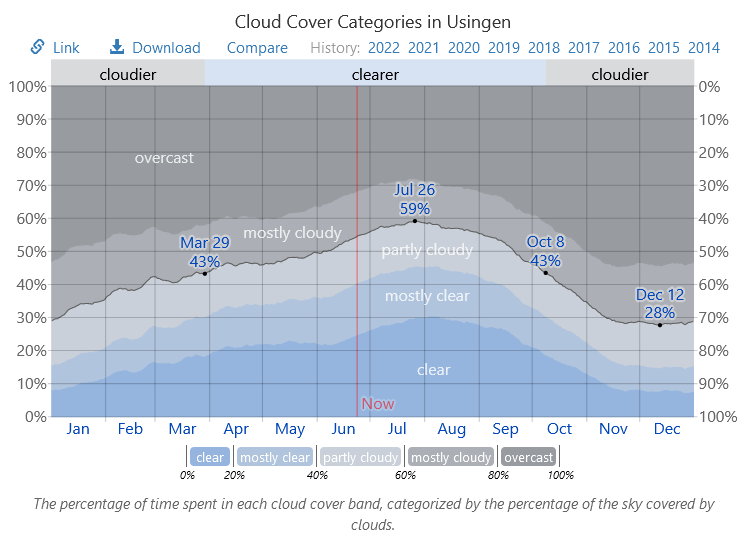
To the extent Germany has an energy crisis, it’s one of Germany’s own making as that nation volksmarched determinedly down two paths: its conscious decision to subordinate itself to Russian energy delivery and so to Russian energy extortion, and its equally conscious decision to eschew an utterly reliable energy source that doesn’t depend on the vagaries of wind or of sun, the latter especially in cloudy Germany.

Unsingen, in west central Germany, illustrates that latter.

An Incoherent Biden Diktat

It’s in the offing. This time, President Joe Biden is threatening to inflict his “emergency powers” on American oil producing companies if they don’t produce more oil.

President Biden may resort to using emergency powers if American oil companies don’t increase output at their refineries, the president told oil CEOs in a series of letters Wednesday.
Biden’s statement blames oil companies for running “historically high profit margins” even as Americans experience surging gas prices.

Never mind that they cannot just turn on the faucet and more oil comes out of the tap. It takes lots of money and quite a bit of time to reopen capped wells, and it takes even more money and lots of time to drill a new, producing well.

But Biden’s administration stands in the way of all of that, even as he threatens his diktat. His administration has already canceled large leases in Alaska. His administration has closed most Federal lands to further exploration, much less drilling. His administration is slow-walking new lease applications. His administration is slow-walking the permits needed actually to explore, and then the permits needed actually to drill, once a lease is approved.

His administration has closed major pipelines and is slow-walking construction of other pipelines so that even were a new well drilled or an existing one uncapped, the producers would have no way to deliver output to a refiner.

Given all of that, and with existing refiners already operating at near capacity, there’s no reason to open/build new refineries—they’d have no additional oil to refine.

Beyond that, there’s the matter of trust. Beyond the time and money it takes to (re)open a well, it takes more time—years—for those costs to be recouped and profit begun to be received from the proceeds of that well. Biden’s administration, though, cannot be trusted not to pull the rug out from under those oil companies and demand wells’ or pipelines’ closure once the current—Biden-created—gas price abates.

And this: oil companies’ “historically high profit margins” exist in part (not entirely) because they’re limited in where they can commit their revenues. They can’t spend them on exploration, drilling, producing, transporting, after all because of those Biden administration policies above.

Biden isn’t alone in this incoherence, though—this is typical of his Progressive-Democrat Cabinet and of the Progressive-Democratic Party politicians who dominate both houses of Congress. Nor is the incoherence limited to oil: there’s the environment and Party’s separate global warming mantra. See, too, our southern border, Party’s immigration “policy,” Biden’s foreign policy, defense attitude, and on and on.

Cajoling Producers

In a Friday Wall Street Journal op-ed centered on the high and rising cost of fuel and the deleterious effect that’s having on our businesses and our economy, Collin Eaton, David Harrison, and Doug Cameron had this remark:

The administration has also tried cajoling US oil companies into increasing production, but few have chosen to do so, instead sticking to leaner budgets urged by investors.

That’s laid off to the maxed out refineries in the US, so there’d be no place to ship increased production, anyway. That’s a player, certainly, but it’s a relatively minor one.

The far more important factor, and it plays to refiners, also is this. Drilling new wells and reopening closed wells each costs lots of money, and it takes years to recoup those costs. It’s the same for the pipelines and other transports used to get the oil and natural gas to refiners, and it’s the same for the refiners.

The Biden administration, though, cannot be trusted not to pull the rug out from under anyone in the oil and gas industry before those costs have been recouped.

There’s no reason, then, for refiners to (re)expand their capacity, even were there product ready for refinement. Biden and his Progressive-Democratic Party syndicate cronies are actively blocking the construction of additional pipelines with which to transport increased production. Biden and his Progressive-Democratic Party syndicate cronies are constantly promising to put the remaining hydrocarbon energy producers—oil and natural gas producers—out of business. This is a plain extension of what Biden’s favorite bud and predecessor ex-President Barack Obama promised to do to the coal producers and largely succeeded in doing.

A Critical Item

President Joe Biden (D) wants half the new cars sold in the US to be electric, and he wants and 500,000 new charging stations for them, both by 2030. He considers reliable EV charging stations to be critical to getting us switched over to battery cars.

Charging stations are necessary (assuming the switchover itself is necessary; it’s not, but that’s a separate story), but they’re far from sufficient. The important thing here is reliable electricity running to each charging station—electricity from the grid. But that requires hydrocarbon-powered electricity generating plants, and it requires the electric grid, itself barely able to handle current loads—see the rolling blackouts that are routine in California and that have become a risk in Texas—to be upgraded to handle the vastly increased loads imposed by all those battery-powered vehicles, whether charged at the charging stations or in the home garage.

Also necessary, but not sufficient even in concert with the above, is an adequate definition of “fast charging.” If a battery-powered vehicle cannot be charged to the 400-mile range of a full gasoline tank in substantially the same 5 minutes it takes to “charge” that gasoline tank to an internal combustion engine-powered car to a 400-mile range, the battery-powered vehicle will remain impractical.

The true Critical Items, then, are at the origin and near-origin: deregulating domestic oil and natural gas production and deregulated electricity generation so there will be energy to put onto that upgraded grid.

One Way to Make the Question Moot

The US 5th Circuit Court of Appeals is hearing a case concerning whether the President personally has the authority to suspend new oil- and gas-lease sales. The particular case centers on climate change concerns as the rationale, but the authority is much broader than that, or it’s non-existent.

The State plaintiffs argue that

a 1987 law dictating the ways in which oil and gas leases will be sold stipulates that a sale must be held at least four times annually in states with eligible land. … “…President Biden put his campaign promises above federal law: By executive fiat, he halted oil and gas leasing on federal lands.”

President Joe Biden’s (D) government employee lawyers argue that

the US president is not an “agency” and therefore not subject to the Administrative Procedure Act.

Biden’s argument strikes me as a frivolous quibble, and the States should win, with the Appellate court upholding the district court’s ruling that, in essence, in this sort of context, a President is, too, an “agency,” and so he has no such authority.

The question can be made non-existent in future, though, with a straightforward fix (however politically difficult it might be to enact): at least on Federal property, make oil- and gas-leasing and -permitting a will-issue matter with licensing requirements, including environmental questions and leasing costs, explicitly barred from being used as barriers to leasing and permitting.