More Big Government

Now we have a big government feedback loop between the EU and the EU wanna-bes.  The Wall Street Journal reported over the weekend that our Treasury Secretary is urging the EU and its European Central Bank to “take stronger action” to get control over Europe’s potentially deteriorating debt crisis.

The success of the next phase of the crisis response will hinge on Europe’s willingness and ability, together with the European Central Bank, to apply its tools and processes creatively, flexibly and aggressively to support countries as they implement reforms and stay ahead of markets[.]

Not, apply themselves to get out of the way of the markets and give them room to right themselves.  No, the big government policies that created the economic disasters of the PIIGS and of the EU generally need to be applied even more so to stem the tide.

Hmm….

Indeed, as the WSJ went on,

Washington has long pressed Europe to bolster its emergency bailout funds and use them to backstop government debt. It has also urged the ECB to use all the weapons in its arsenal to calm financial markets.

How’s that working out for us, exactly?

The IMF is in on this tragicomedy, also.  Its steering committee Issued a Communiqué with this sage advice for the euro zone:

[C]ontinued progress on ensuring debt sustainability, securing financial stability, and undertaking bold structural reforms will be crucial to boosting confidence and productivity, facilitating rebalancing within the monetary union, and promoting strong and balanced growth.

Most of this is pap, intended solely to give the impression of advisement.  However, with apologies to Inigo Montoya, you keep using that phrase “undertaking bold structural reforms.”  I do not think it means what you think it means.

Another Object Lesson

…if we’re only willing to listen to it.  The Wall Street Journal‘s sub-headline says it all:

Borrowing Fueled Chongqing’s Infrastructure Projects, Highlighting National Problem of Reliance on Government Spending

“…10 major investment vehicles the city used to fuel its growth accumulated more than 346 billion yuan ($54 billion) in liabilities,” the WSJ reports.  Moreover, this is just the publicly acknowledged debts of the city.  The various national government-owned enterprises in Chongqing likely have their own debts, and these are not obligated to discuss them.  Northwestern University Associate Professor of Political Science and an expert on local government debt in the People’s Republic of China, Victor Shih, adds

I don’t think it would be a stretch to say that Chongqing local government, state-owned enterprises and state-owned developers collectively owed 1 trillion yuan [$156 billion] at the end of 2011[.]

What has Chongqing to show for this?  High risk, for one: a significant per centage of that debt is secured by land the city owns or controls.  To pick on Chongqing Yufu Assets Management Co., a city-owned investment vehicle established in 2004 as an example: the city loaded Yufu with land that then was used as collateral.  Now its 63% debt-to-asset ratio makes it one of the most heavily indebted financing vehicles sponsored by the Chongqing government.  Its 2010 profit of 1 billion yuan sounds good, however, asset sales now are likely to be necessary in order to service that debt—but Yufu’s assets are that land that’s bound up as collateral.  Moreover, that 2010 profit is down, sharply, from the prior year’s profit of 1.7 billion yuan, due to just as sharply falling revenue from its land holdings.

What happened the last time vast debt was secured by a land or housing market in a country near you and I?  At least in the US, our government can just print up all the money it needs….

Party and Taxes

The argument over the House of Representatives’ just-passed Small Business Tax Cut Act demonstrates the stark contrasts between the Republican and Democratic Parties’ attitudes toward Americans and our money, even as the bill demonstrates a continued Republican failure—it’s a temporary measure, and so it has no economic value whatsoever.

The SBTC allows businesses with up to 500 employees to take a tax deduction equal to 20% of their profits, up to a maximum deduction equal to 50% of their employee wage bill.  This deduction is good for one year, only.

This bill plainly encourages hiring, with the size of the deduction driven by the company’s payroll cost.  Pay raises or intrinsically high wages are themselves unlikely to yield improvements in production or in productivity as efficiently as hiring new employees: a larger work force brings more working hours to a company than simply paying more for an existing number of working hours.

On the other hand, the deduction also can be put to uses other than hiring that are good for our economy.  Improved capital equipment improves the productivity of the existing work force, leading to lower prices to consumers.  Paying down existing debt strengthens the company against the uncertain future our present economy is inflicting on all of us.  Funding active R&D helps the company to stay ahead of evolving consumer demand.  Simply saving the money adds to the company’s strength by building its cash cushion for deployment in crisis or for use in an unexpected opportunity.

What the Republicans say about the bill:

…the one-year tax cut for businesses with fewer than 500 workers would boost job creation.  Only companies that pay wages would be eligible for the deduction of 20% of their domestic business income….

We need to let small-business owners keep more of their hard-earned money so they can start hiring again[.]

It treats every small business equally.  This bill does not pick winners and losers[.]

What the Democrats say about the bill:

…a giveaway to wealthy business owners since it includes no requirement that companies hire workers.

…the tax cut favor[s] richer small businesses, since the tax savings would be larger for firms with higher income.  Democratic aides cited a Joint Committee on Taxation report showing 125,000 business taxpayers with income of more than $1 million would receive $7.35 billion in tax cuts, or $58,500 a tax filer.

…the legislation would cost $46 billion and add to the deficit…. …Democrats said they backed Mr. Obama’s plan for an alternative minimum tax of 30% for people making more than $1 million.

The differences in attitude are clear.  Republicans view the money as our money, and with lower taxes they attempt to leave more of it in our hands and to leave the use of it up to us.  They plainly prefer the money to be used for hiring, but they do not presume to dictate to us how we must spend it.  Republicans trust the judgment of Americans, as effected both by individuals and through our free market, more than they trust the judgment of government.

On the other hand, Democrats have a real problem with Americans becoming rich.  Rather than helping all Americans to do better, as the SBTC could have a chance of doing, they much prefer holding back the wealthy to the level of the rest of us.  Anything that helps them along with the rest of us is anathema to Democrats.  This, of course, caps our own chances of bettering our lives.

The beef about the SBTC favoring the rich is plainly bogus.  It elides the fact that the businesses with the larger profits have the larger payrolls—the larger work forces—and it is the work force bill that is the limiter on the deduction, not the profit.

Democrats consider the “lost” revenue to be the government’s money, not us taxpayers’, and when forced to leave some to us, they want to dictate to us how we must use it: “You must spend our money on hiring.”  Democrats trust their own judgment more than they do that of individual Americans.

Moreover, Democrats insist on raising taxes even further, particularly on disfavored groups, while refusing the obvious alternative: reducing their spending to make up for the reduction in the amount of our money government gets to collect.

As I said at the outset, though, this bill has a serious problem: it’s temporary.  No business is going to do anything of a long-term nature—like permanent hires—on a temporary measure.  To properly impact our economy and have the advertised effect, it needs to be made permanent.

Taxes and a Do-Nothing President

“At the end of the year, some $500 billion in tax breaks expire all at once, hitting American households with an average tax increase of $3,800—if Congress doesn’t act,” reports Jim Angle of Fox News.

Here are, to channel the late Jack Brickhouse, the unhappy totals:

  • $165 billion increase from the expiration of the Bush tax cuts, pushing tax rates from a bottom rate and top rate of 10% and 35% to 15% and 39.6%, respectively,
  • cut the child tax credit by fully half, from $1,000 a child to $500,
  • the marriage penalty returns,
  • tax on dividends, which many seniors rely on, would soar from 15% to as high as 39.6%,
  • a temporary fix to the alternative minimum tax disappears/expires.  The AMT originally was aimed at millionaires, but now it would hit 34 million taxpayers,
  • separate $124 billion cut in the payroll tax would end.

Moreover, as Curtis Dubay of the Heritage Foundation points out,

Taxmageddon falls 70 percent on middle and low income families.  That’s because 60% of the Bush tax cuts were for middle- and low-income taxpayers.

Thus, the Reid/Obama tax increases are set to hammer all Americans, but especially President Obama’s “non-rich.”

Yet this could have been avoided.  During the debt limit ceiling raise kerfuffle of last summer, President Obama had a golden opportunity to fix these things, but in a Chicago shuffle, he tried to steamroll the Republicans with a last minute (literally) demand for an additional $1 trillion tax increase, and he blew up the negotiations altogether.  Obama and Majority Leader Reid (D, UT) had a chance to fix these things later in the fall, but they demanded tax increases as a quid pro quo for extending an expiring payroll tax reduction.  This winter, Obama and Reid got tax increases in exchange for extending an expiring (again!) payroll tax reduction—the one set to expire at the end of this year along with all those other items.

Obama and Reid have spent all of these last three years demanding tax increases to “pay for” tax reductions elsewhere, and spending cuts anywhere—in the name of “fairness.”

What’s also galling, though, is that payroll tax reduction for which the Republicans held out so zealously.  This is the same gang that insists (rightly) that our Social Security system is bankrupt and desperately needs reform—yet they’re insistent on reducing even further that system’s funding with this payroll tax reduction of theirs.  Ignoring the fact that the Democrats were on record as agreeing that a 2% reduction in (payroll) tax rates was good for Americans, ignoring further that Obama had proposed a 3% reduction for both individual Americans and businesses in those payroll taxes, the Republicans chose not to insist, instead, on a 3% (or even a 2%) income tax reduction for all Americans and our businesses.  They just held out for gutting Social Security.

Now Obama is set to get his tax increases in the name of his concept of fairness.  Happy New Year.

Taxes and Fair Share

At the start of the week, the Senate failed a cloture vote on President Obama’s Buffet Rule by a 51-45 vote, with Senator Susan Collins (R, ME) voting for on the excuse that the measure should be openly debated (never minding that President Obama has been debating it on his latest campaign tours), and Senator Mark Pryor (D, AR) voting against on the theory that such a measure should be part of a debate on general tax reform.

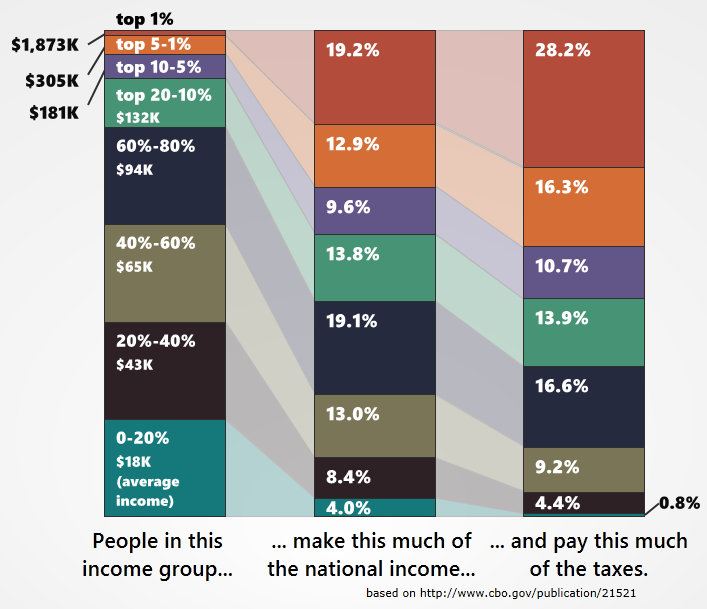
I won’t occupy bandwidth repeating commentary about Obama’s “it’s only fair” mantra.  However, via Villainous Company, comes another view of what’s fair—the following graphic, based on tax rates from 2007 and published in 2010.

Interesting, this.  The only folks paying roughly their “fair share,” if we’re willing to consider what’s fair to be paying a share of the nation’s income taxes roughly akin to the share of national income represented by one’s own income grouping, is those rich folks in the second 10% income group—those whose income puts them in the band of top 10% down to top 20% of income—and the truly destitute—those folks in the very bottom 20%.  The Stinking Rich, those top 10%-ers, are paying far more than their fair share.  And most everyone else below those top 20% are paying increasingly less than their fair share.

But President Obama and his Progressives want to pile on and make his ugly rich pay even further beyond their fair share.  With lots of words about creating yet another entitlement program, a program of transferring tax money from those who pay a lot to those who pay a little.  But with not a word about cutting spending to fit within the revenues already accruing to his administration.  With not a word about reforming existing entitlements like Social Security, Medicaid, and Medicare.

Hmm….