
Obamacare Revisited

I’ve written a bit about Obamacare and its front end, ObamaMart. I thought I’d revisit this with the new enrollment period just getting under way.

My test case was a 62-yr-old husband and his 61-yr-old wife in a Dallas suburb with a combined income of $83,000, not previously enrolled in an ObamaMart plan but now looking for a PPO because they like their doctor and don’t want to risk losing access to her. I just looked at the health plans; I eschewed dental. In looking at plans, ObamaMart offered to estimate my medical costs; I accepted the offer and took the middle road of a Medium (out of Low, Medium, High) level of medical expenses for both the husband and the wife.

There were only Bronze, Silver, and Gold plans available.

There were only two Bronze plans, and they were available only through a single health plan provider—so much for increased competition. These two plans had monthly premiums of $1,500 and $1,570 and deductibles of $10,000 and $13,200—that is, our nearing retirement couple had to pay all those premiums and those deductibles before either of these plans began paying even a fraction of the couple’s medical costs. For all that, ObamaMart estimated annual medical costs above $23,000.

There were only three Silver plans, again only offered by a single provider—the same one as providing those two Bronze plans. Again, so much for increased competition. These plans had premiums ranging from $1,500-$1,800 with the lower premium associated with a $10,000 deductible, the higher two with a $5,000 deductible. Those combinations, though, work out to roughly the same annual premium plus deductible cost. ObamaMart estimated total annual medical costs under these plans ranging between $21,000 and $27,000.

Gold plans, all four of them, also were offered by the same provider, and it was the same provider that offered the Silver and Bronze plans. Competition? Perish the thought. The premiums were $2,000 or more in all cases, with deductibles ranging from $3,000 with the lowest premium to $1,000 with the highest premium. Again, the annual total from premium and deductible payments were essentially identical across the plans. ObamaMart estimated annual total medical costs between $26,000 and $28,000.

There are three takeaways I see here. One is that health plan costs have not at all gone down over the three years we’ve been afflicted with Obamacare (although ObamaMart has gotten considerably better and easier to use, as far as I went. I did not explore the ease of ordering up a plan). Another is that there is none of the promised competition. Not even a Progressive would attempt to masquerade a single provider as competition. This is, though, a step toward the Progressives’ goal of single provider nation-wide. The third takeaway is the biggie: it doesn’t matter much what plan a (two-person) family might buy, their annual total medical costs with all this health plan protection doesn’t vary much. And neither do the totals of premium and deductible.
The Obama Administration and Racism

[Ally Financial Inc] agreed to pay borrowers at least $80 million to settle allegations of racial or ethnic discrimination….

This is the settlement that Obama’s CFPB and DoJ browbeat Ally into accepting. There’s a catch, though:

the lender is prohibited by law from collecting data on the race or ethnicity of its borrowers.

But never mind. Obama and his Executive Branch minions cried racism, and so it must exist, regardless of actual data.

Unfortunately, though, Obama isn’t alone in this sorry charade. Ally management shares shame in this tragedy: they cravenly agreed to a penalty for something they didn’t do, or at least the government persecutors had no hope of demonstrating.

Debt Limits

The reason we need to raise the national debt limit is to be able to borrow to pay existing obligations. Treasury Secretary Jack Lew’s threats that he can’t won’t pay our veterans, soldiers, and retireds is nothing but politically motivated, dishonest foolishness. He can pay these; the tax revenues are plenty for that. What he won’t be able to pay are the payables to Federal contractors and a number of other bills. Those are legitimately owed, though, and they need to be paid.

There’s also plenty of money coming in to pay the interest on our national debt—so there’ll be no default, either. That’s just nonsense.

What’s unacceptable, though, is the Democrats’ refusal to go along with a debt-raise bill that includes spending cuts that will obviate the need to raise the debt ceiling next year and in the out years. President Barack Obama has even said he’ll veto a debt-raise bill that includes such preventive measures. He’s said it’s nonnegotiable.

That’s unconscionable. The Democrats’ addiction to spending—and it is an addiction—has got to be broken. If the only way to cut spending so we don’t need to increase our borrowings next year is to close the Federal government, so be it.

But the Republicans, including the right side, and their “communications” directors had better be able to sell the shutdown to the nation’s public. Democratic Whip Steny Hoyer (D, MD) said it:

[T]hey ought to all be fired[.]

Unfortunately, he wasn’t looking in a mirror when he said it.

Turn the rascals out in a year and a month.

Minimum Wage Laws

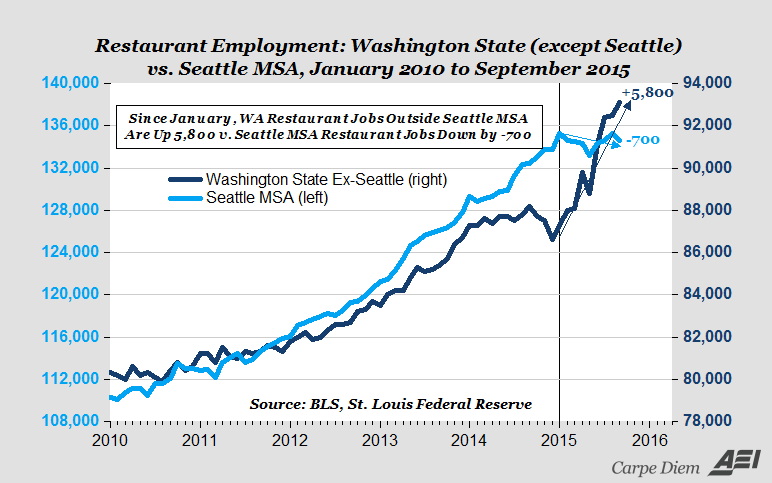
Some empirical data are starting to accumulate. The following graphs are from AEIdeas. The first one shows the apparent impact of Seattle’s minimum wage law, which hiked the minimum to $15/hr, with the first increment to $11/hr taking effect last April. The graph shows restaurant employment in the Seattle Metropolitan Statistical Area and Washington other than the Seattle MSA from 2010 through Sept 2015.RestaurantJobs

There are a couple of things of interest here. One is the headline comparison: Restaurant jobs went up nearly 6% since January (5,800 jobs added to an original value of 87,000 jobs), while the city’s restaurant employment fell those 700 jobs (a drop a skosh under 1%). The other is the trend. Since January, restaurant jobs have risen at a high month-month rate, while Seattle’s restaurant job growth rate has been flat.

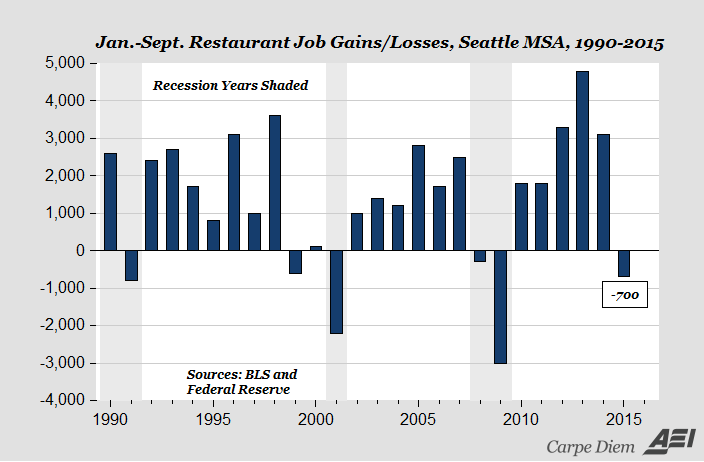
There’s another tale in this graph.RestaurantJobsRecessions

The shaded area are recessions. Only one other time since 1990 has Seattle’s restaurant employment fallen outside of a recession. That was in the year leading into the dot-com bust, with Seattle being nearly as techy as California’s Silicon Valley.

Hmm….

Stimulus

European Central Bank President Mario Draghi has indicated that he intends to expand the EU’s version of quantitative easing as economic stimulus: he’s looking to increase the ECB’s bond-buying program and cut even further the ECB’s already negative deposit rate.

His rationale for this is to boost economic growth in the EU, a growth that has been stunted since the global Panic of 2008.

No, Mr Draghi, adding to a failed program won’t convert it to a success, it’ll compound the failure and make digging out from under it the more expensive.

What you need to do is jawbone the EU governance bodies to do what they need to do: jawbone the sovereign (more or less) EU member nations to do what they need to do. What those governments need to do is to get out of the way of their national economies by cutting government spending and commensurately reducing taxing.

Leaving the people’s money in their hands will let them apply their money to their purposes, not government’s, and they’ll do that with far greater skill than even a well-meaning government can hope to do. Reducing government competition for goods and services by cutting government spending will further expand the reach of that private money left in those private hands.

Now, there’s a stimulus worth applying.