More Federal Dishonesty

This time, it’s an assault on our veterans, using their Mount Soledad Veterans Memorial Cross as the cudgel.  This is a case where the 9th Circuit Court of Appeals has ruled the veterans’ memorial unconstitutional because it uses a cross—a globally recognized symbol of a fallen soldier, as well as a global religious symbol—at the center of its memorial display.  Last month, the Supreme Court refused to hear an appeal of the matter.

Now we learn that after President Obama had his Solicitor General join the appeal, which increased the likelihood the Court would take the case (but did not guarantee it, as we’ve just seen), Obama had his DoJ engage in what would seem to be ex parte discussions with the ACLU—the opposition in this case—without the major plaintiffs, the Mount Soledad Memorial Association, present.  This also had the effect of cutting out the MSMA’s legal representation, the Liberty Institute.

This is an atrocious attack, not only on our veterans’ memorial, but on the concept of our right to petition our government for redress of grievances, and on our right to representation in the cases we have before any court of law.

Whatever you think of the memorial itself, feel free to call Attorney General Eric Holder’s office at 202-514-2001 and let him know, in no uncertain terms, your…dismay…at his underhanded duplicity.  While you’re at it, call your Congressman and both Senators with the same message.

And call President Obama: 202-456-1111 or TTY/TTD: 202-456-6213.
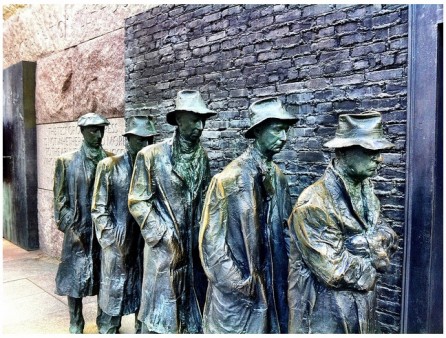
The Progressive View of Free Speech

We ought to be allowed to set limits.  The government should tell you what your limits are.  No less a light than Senator Charles Schumer (D, NY) says so.  Fox News reports that in an effort to pass the Disclose Act, which would have stripped political speakers of their anonymity and exposed them to union intimidation and to Democratic ad hominem attacks (can you say “Koch brothers?”) with a view toward further intimidation,

New York Sen. Charles Schumer claimed Monday that “there ought to be limits” on First Amendment rights, while arguing in favor of Democrat-backed legislation that would require full disclosure of big-money donors behind election campaign advertising.

After all, he says,

You can’t scream “fire” falsely in a crowded theater.  We have libel laws.  We have anti-pornography laws.  All of those are limits on the First Amendment.  Well, what could be more important than the wellspring of our democracy?  And certain limits on First Amendment rights that if left unfettered, destroy the equality—any semblance of equality in our democracy—of course would be allowed by the Constitution.

There’s a pattern here.  The examples he cites are plain acts of dishonesty.  So what else is dishonest in this Progressive’s eyes?  Why, political speech of which he disapproves.  So this must be limited, too.

But, indeed, “what could be more important than the wellspring of our democracy,” the freedom of political speech?

Federal Arrogance

Jennifer Valentino-Devries reported on a case involving the recently expanded US Patriot Act in a recent Wall Street Journal.  In this case, an unnamed telecom company, a recipient of an FBI National Security Letter, is objecting to the letter and the demands in it, which are, in essence, to turn over to the FBI whatever the latter demanded, based on…well, because FBI inquiring minds want to know.

The Patriot Act has a lot of good things in it, but it grants a dangerous level of power to the government, also.  NSLs, for instance, don’t require a judge’s prior approval, as a search warrant does.  In fact, the company’s representative who physically receives the NSL is “legally” barred from even acknowledging the letter’s existence except to company lawyers.  The FBI’s secret demand is good enough; we’re to take their word for it.  Here, just to confirm the danger of such star chamber power, the FBI’s response to the telecom’s protest was to instruct its victim to sit down, shut up, and deliver the goods.  Or else.

The US Department of Justice fired back with a serious accusation. It filed a civil complaint claiming that the company, by not handing over its files, was interfering “with the United States’ sovereign interests” in national security.

As far as I’m concerned, this is grounds for dismissing the Government’s claim and its letter with prejudice.  It is never out of order to defend one’s rights.

Leaving that aside, though—the FBI’s case, nor its NSL, have not been dismissed out of hand—the opposing positions are starkly apposite:

[T]he company is arguing, among other things, that the gag orders associated with most of these letters improperly restrain speech without a judge’s authorization.

On the other hand,

The FBI says it must maintain the secrecy of national security letters to avoid tipping off potential terrorists.

This gives the game away.  DoJ has said in its filings

The object of the nondisclosure provision is not to censor private speech[.]

This is just a cynical red herring: the 1st Amendment isn’t there to protect private speech.  It’s there to protect public, political speech.

Finally, Stephen Vladeck, a professor at American University Washington College of Law and an expert on terrorism law says about this case

It raises a question Congress has been trying to answer: How do you protect the First Amendment rights of an NSL recipient at the same time as you protect the government’s interest in secrecy?

The 1st Amendment rights to free speech and to petition the Government for a redress of grievances are specifically intended to allow the sovereign people, individually or collectively, to rein in an overreaching government.  The government’s interest in secrecy plainly is subordinate to those sovereign rights—which it is the government’s duty to defend, not its duty to attack those who insist on them.

Social Engineering Taxes

The efficacy of these taxes are amply demonstrated by their extremely regressive nature.  For instance, the payroll taxes for Social Security and Medicare/Medicaid hit the lowest income folks the hardest.  They’re taxed at the same nominal rate as everyone else (except the well-off in the case of Social Security: there’s an upper limit on the income taxable for this purpose).

However.

Someone making the Federal Poverty Guideline income ($22,350 for a man in a four-person family in 2011) was taxed at 4.2% of that income (6.2% when the cut expires next January, but we’ll stick to the lower rate here)—$938.70.  A man making $100,000 paid a tax of $4,200, including that same $938.70 on his first $22,350 of income.  Who do you suppose was hit harder by that $939 tax?

The poor man already is living at the edge of his income; the dollar taxed to him—the very same dollar that is taxed to our better off man—is far more important to the poor man.

So it is with income taxes, whether those taxes are for Article 8 purposes, or some of them are for other government-determined—social engineering—purposes.

Legitimate taxes must be evaluated for their impact on what Wretchard of Belmont Club has described as the design margin: how much safety is left for handling the unforeseen when a tax dollar is taken away from a man?

The correction, of course, is not to raise taxes on everyone else—the well-off already are paying far more than their share, while the half [sic] at the “bottom” of the distribution are paying next to nothing.  Moreover, this would do nothing to reduce the importance of those tax dollars that are in the poor man’s margin of safety between what he has and what he needs for an emergency.  No, the answer is to lower tax rates—to increase the width of the design margin—and to move to a flat tax with no deductions.  Taxation for government-mandated social engineering purposes just hammers at that design margin, shrinking it, no matter the good intentions behind the assessment.

A tax dollar always will be more important to the poor man than to the better off man; no amount of attempted progressivity in a tax code will reduce this.  A flat tax will reduce the difference in relative importance, though.

The American Welfare State

James Pethokoukis, of AEIdeas, an affiliate of the American Enterprise Institute, has an article that shows the economic devastation extant in the policies of the Federal government.  It’s important to note that, much as I dislike the present administration, these results also flow from the “efforts” of a long string of administrations.

I don’t have much to add, so here is the complete article, reprinted with the kind permission of AEI.

6 charts that show the Welfare State run amok

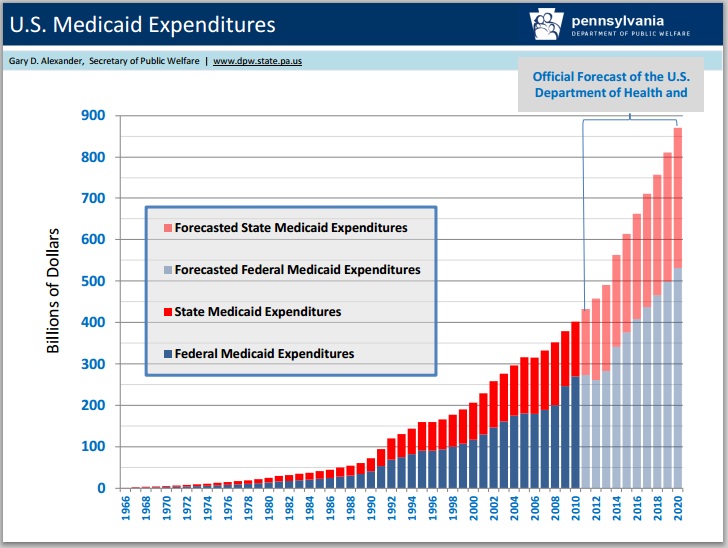
The original purpose of Medicaid was to provide improved healthcare access for poor people, while not turning the safety net into a trap. Under President Obama’s Affordable Care Act, Medicaid will be greatly exapnded beyond what Congress originally intended.

In fact, as these charts show, it has already expanded beyond what Congress surely originally envisioned and, in the process, has created a terrible fiscal problem for the United States. (These charts and graphics come from a briefing today here at AEI, conducted by Gary Alexander, secretary of public welfare for Pennsylvania.)

A few scary factoids:

– In the 1960s, there were 18 workers per Medicaid recipient. Today that number is 2.5.

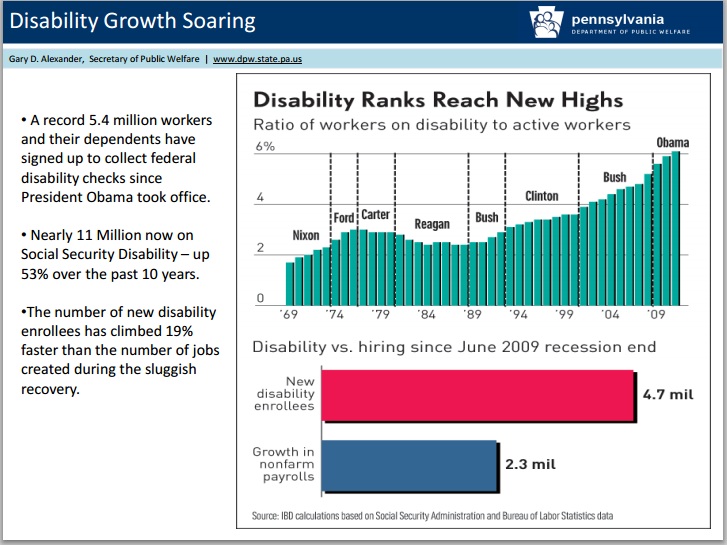
– The number of Americans on disability has risen 19% faster than jobs created during this recovery.

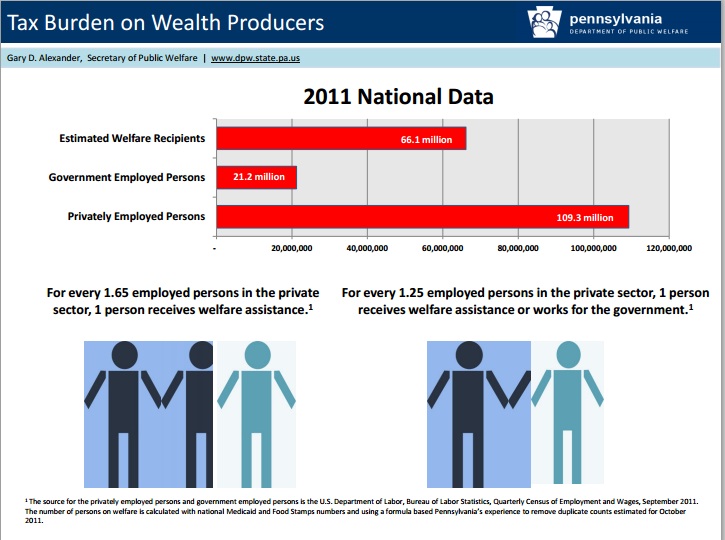
– There are just 1.2 private sector workers per 1 person on welfare or working for government.

– There are now just 1.65 employed persons in private sector per 1 person on welfare assistance.

Check out the charts and graphics for yourself:

1. Fewer workers and their tax payments have to support more and more Medicaid recipients.

2. The number of takers is now approaching the number of makers.

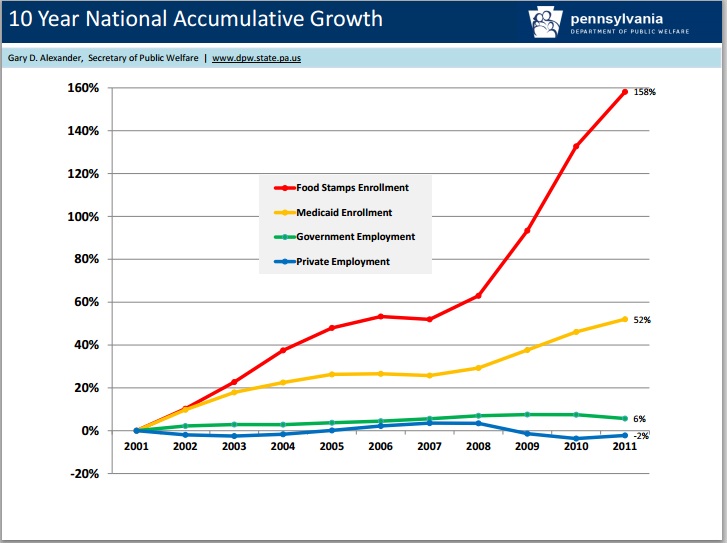
3. Medicaid and other welfare enrollment has exploded.

4. Medicaid enrollment is growing faster than economy.

5. Medicaid spending? You ain’t seen nothing yet.

6. Disability enrollees have exploded and are rising faster than job creation.

These charts show an out-of-control welfare state that is about to get even bigger, increasing both budget costs and dependency.